Showing posts with label Water. Show all posts

12.10.11

Company fined for dumping HCl in Oklahoma. How safe are Pennsylvania's waters?

On our last show, Dave Yoxtheimer from Penn State's Marcellus Center for Outreach and Research talked about some of the hazardous materials used in hydraulic fracturing operations. One of those is hydrochloric acid. According to the Department of Justice's Office of Public Affairs, an employee of Integrated Production Services, LLC has pleaded guilty to improper handling of 500-700 gallons of the acid.

Here's DOJ's release:
WASHINGTON – Integrated Production Services, LLC, (IPS), a Houston-based natural gas and oil drilling contractor, pleaded guilty today to a negligent violation of the Clean Water Act in federal court in Muskogee, Okla., announced Assistant Attorney General Ignacia S. Moreno for the Justice Department’s Environment and Natural Resources Division, and Mark Green, U.S. Attorney for the Eastern District of Oklahoma.

In entering the plea, which is subject to approval by the court, IPS has agreed to pay a $140,000 criminal fine and to make a community service payment of $22,000 to the Oklahoma Department of Wildlife Conservation for ecological studies and remediation of Boggy Creek, located in eastern Oklahoma. IPS will serve a two-year period of probation, during which it will be required to implement and perform an environmental compliance program at a cost of $38,000, to train IPS employees regarding proper hazardous waste handling and spill response procedures.

In May 2007, IPS was performing drilling operations at the Pettigrew natural gas well site in Atoka County, Okla. The company’s operations included hydraulic fracturing, which entails the use of drills and hydrochloric acid to penetrate through bedrock and substrata in order to access natural gas reserves. On May 24, 2007, a tank at the site leaked hydrochloric acid onto the bermed surface of the well, which also was flooded due to recent heavy rainfall. Rather than taking the necessary steps to properly remove the rainwater from the site, Gabriel Henson, an IPS supervisor, drove a company pickup truck through the earthen berm, causing the discharge of the rainwater and an estimated 400-700 gallons of hydrochloric acid into Dry Creek, a tributary of Boggy Creek.

On July 20, 2011, Henson pleaded guilty to a misdemeanor violation of the Clean Water Act. Henson is awaiting sentencing. He faces up to one year in prison and a $100,000 fine. “As hydraulic fracturing occurs with increasing frequency across the country, companies and individuals involved in those operations must adhere to the laws that protect human health and the environment and level the playing field for responsible businesses,” said Assistant Attorney General Moreno. “We recognize the critical importance of developing domestic sources of energy responsibly, and will continue to vigorously prosecute illegal conduct.”

“This was a case of a corporate employee making a careless decision that caused the release of dangerous hydrochloric acid into our waters,” said U.S. Attorney Green. “Whether to expedite oil production or to save corporate expense, these types of actions cannot be justified nor can they be tolerated. This office will pursue all legal remedies necessary to prevent and/or punish such actions.”

“Hydrochloric acid is a highly corrosive substance. Its release into a tributary of Boggy Creek was a serious threat to the environment,” said Ivan Vikin, Special Agent-in-Charge of the U.S. Environmental Protection Agency’s (EPA) criminal enforcement program in Oklahoma.

“Today’s guilty plea demonstrates that companies will be held responsible for environmental crimes.” This case was investigated by the U.S. EPA Criminal Investigation Division and the Oklahoma Attorney General’s Office of Inspector General. The case is a joint prosecution between the U.S. Attorney’s Office for the Eastern District of Oklahoma and the Environmental Crimes Section of the U.S. Department of Justice, Environment and Natural Resources Division.
Just a few weeks ago I was at an EPA public comment hearing on new regulations for natural gas operations (tweeted here on September 27th, 2011). Outraged Pennsylvanians at that hearing wondered who in the government was sticking up for them. It appears as though someone is working in Oklahoma.

But do you ever wonder how many spills like this happen and aren't caught? I am reminded of Jeff Tietz's Rolling Stone article (pdf) on the pork industry a couple of years ago in which he alleged that Smithfield Foods' chairman Joseph Luter III said that the 74 EPA citations under the Clean Water Act were paltry in comparison to the likely 2.5 million violations he estimated they'd actually committed.

The oil and gas industry is not the same as the pork industry. But much of the public suspects that there is woefully little oversight. According to Mary Carol-Frier who compiled DEP numbers with Pennsylvania Land Trust Association report numbers (pdf) , between January of 2008 and June of 2010 in Pennsylvania, the oil and gas industry were cited by DEP for 161 violations for discharge of industrial waste including into streams, 524 discharges of pollutional materials into waters of Commonwealth, 1,149 Oil and Gas Act-specific violations, including improper pits, impoundments, well waste treatment, well casements and cementing and plugging. It is troubling to imagine that the oil and gas industry could be cited for as relatively few violations as the pork industry might have been.

Pennsylvania has the second most surface water in the fifty states after Alaska and a booming gas industry. Many people aren't sure who's protecting them. One woman at the EPA hearing pointed her finger at the board and said, "How do you sleep at night? You're supposed to be protecting us." Three compressor stations roar around her property and fill the air with a smell she can hardly believe. "It's like living in a third world country."

As Dave Yoxtheimer said on our show, there are some good actors and some who aren't. There are the fly-by-night guys and those who are good neighbors who work with families, municipalities and the state. Can we get all of them to be the best neighbors they can be?

3.10.11

Tapping ourselves out

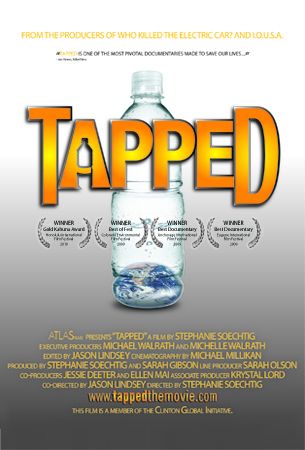
The Bucknell University Environmental Center is hosting a screening of "Tapped," a 2009 documentary film directed by Stephanie Soechtig on Tuesday, Oct. 4 at 7 p.m. The film will show at the Campus Theatre on 413 Market St., Lewisburg
Tickets are $2 and the show is open to the public.

Consider the following:
Giant masses of plastic particles swirling in the ocean.
Human health impairment in towns where PET plastics are manufactured.
Chemicals leaching from plastic packaging into drinking water.

What do these things have in common? They are some of the surprising and far-reaching impacts of the bottled water industry exposed in Stephanie Soechtig's debut feature film, Tapped. Per year, Americans pay a huge premium to consume over 8 billion gallons of bottled water, yet few consider where each bottle comes from and where it ends up. The film also probes topics like the petroleum used to make plastics and transport bottled products long distances, excessive groundwater withdrawals by bottling plants, and the general lack of regulatory oversight over the bottled water industry. Who profits and who loses out when society prioritizes convenience over sustainability? Watch this documentary and find out what's really in your bottle.

You are invited to stay for a post-screening discussion and Q & A session about bottled water and its impacts here in Pennsylvania. The discussion will be moderated by Cathy Curran Myers, Director of the BUEC and former Deputy Secretary for Water Management at the Pennsylvania Department of Environmental Protection. Sustainability Now's Peter Buckland will be a panelist discussing his recent experiences advocating for reduced bottled water use on the Penn State University Park campus.

Please note the BUEC's "Green Screens" sustainability series continues Nov. 8 Manufactured Landscapes and Nov. 29 Consuming Kids.

This event is co-sponsored by the Bucknell Environmental Club, the Bucknell Environmental Studies Program, and the Bucknell Department of Geography. "Tapped" is presented in partnership with the Bucknell Film/Media Studies Film Series (http://www.bucknell.edu/x71259.xml). For more information, visit www.campustheatre.org or email Wendy Chou (wc013@bucknell.edu).

16.9.11

A wellspring for Groundswell Pa

Last week we had Braden Crooks of Groundswell PA on the show. They're arguing for an Environmental Bill of Rights and they are filming the whole movement.

Check it out:


Contribute here to help them document it.

11.9.11

Is there a better way of dealing with shit?

Shit. Crap. Poop. Dung. Feces. Defacation. Pee. Piss. Urine. Call them by their coarsest or most sanitized names, we all make it and we spend a lot of money and use a lot of water coping with it. 3,000 gallons of potable water each year goes to flushing your excrement to sewage treatment plants. The rough back of the hand calculation would mean that America flushes a few hundred BILLION gallons of water to sewage treatment plants each year. And what do we do with all of that crap?

Like most people, you probably don't know. Whatever your answer is, think about something else for a minute. Shit and piss are organic right? It's not frack water or radium 226 or bisphenol-A. It's basically digested food and microbes. So's cow manure that farmers spray on fields. And manure is in many conventional fertilizers you can purchase in home and garden shops. Well, what about basically free human manure? Humanure for short.

Enter the composting toilet. Madhu Suri Prakash explains the what, the why, and the how in this video on ecological toilets.


Talk about closing waste loops. A human growing their own garden and being not just a consumer with her/his body but also a producer in the most fundamental way. With good methods and proper conditions, this takes a considerable step toward what Wendell Berry (whom Prakash loves) calls "solving for pattern" (pdf here).

If only I wasn't renting.

Dr. Prakash is a Professor of Educational Theory and Policy at Penn State, a contributing editor at Yes! Magazine, and a frequent speaker across the United States and world on education and development having worked with the Bhutanese government on educating for happiness and the United Nations Educational Program. She is also co-host Peter Buckland's graduate adviser.

8.9.11

People mix hope, rage, and resolve at Shale Gas Outrage

Yesterday, about 1,000 people attended the Shale Gas Outrage demonstration in Philadelphia. The events was convened as counter-voice to the Marcellus Shale Coalition's Shale Gas Insight conference for industry.

Individuals, community groups, and established organizations joined organizers Protecting Our Waters, Food & Water Watch, Marcellus Protest, and others to call for changes to the way gas drilling is proceeding in Pennsylvania. People joined in chants of "Shut them down!" and "Ban fracking now!"

Meanwhile inside, Chesapeake Energy CEO Aubrey McClendon derided the demonstrators as "extremists" and former Pennsylvania Governor Tom Ridge, who also headed the Marcellus Shale Coalition, called environmental concerns "phony hysteria." But former Pennsylvania Governor Ed Rendell shot back in his own speech to the Shale Gas Insight attendees, saying that they needed to step up and pay a severance tax and that people's concerns over clean air, clean water, and health were legitimate.

Outside, speakers shared a mixture of fear, hope, and calls to action. Pittsburgh Councilman Doug Shields riled up the crowd by highlighting Pittsburgh's unanimous vote to ban hydraulic fracturing within the city. Several speakers, including Delaware River Keeper Tracy Carluccio, Al Appleton, and Gasland director Josh Fox all called on the crowd to keep gas drilling out of the Delaware River Basin.

Fox, having just been arrested for civil disobedience in Washington, D.C. over tar sands oil and the proposed Keystone XL pipeline (see here and here) implored people to descend on the Delaware River Basin Commission on October 21st to demand that they ban fracking in the basin. He distributed the DRBC's phone number to the crowd, some of whom called DRBC on the spot. You can call them at (609) 883-9500. If push comes to shove, he believes people are going to have to be civilly disobedient and be arrested. Without civil disobedience, he and other said, blacks would still be riding in the back of the bus and women wouldn't be voting.

Whether this is hysteria or legitimate, people attending were very concerned. Here are four of them.

Tony Ruggiero is from Texas. His 10-acre $300,000 Texas property has almost completely lost its value because of gas operations.


Nathan Sooy of Harrisburg, Pennsylvania is a member of Clean Water Action.


Eric Weldman works for Food & Water Watch. They are asking people to call President Obama on October 13th to change federal policy on hydraulic fracturing.


Gary Thornbloom is the head of the Sierra Club's Moshannon chapter in central Pennsylvania. They are calling for a moratorium on hydraulic fracturing.


Where do you stand?

5.8.11

Corporate censorship

According to a newletter sent out to environmental groups today this billboard was taken down. It was paid for by the Sautner family of Dimock, Pennsylvania who have had their water contaminated by gas drilling operations, a contention fully supported by a Pennsylvania Department of Environmental Protection investigation. You can watch some coverage before it was torn down here at News Channel 34 or read more about the clash over the billboard at The Citizen's Voice.

7.6.11

Fracktivism reaches new pitch at state Capitol

Capitol lobbying day in Harrisburg culminated for many in an anti-drilling protest.
Groups such as Clean Water Action, Sierra Club, Gas Truth, and Marcellus Protest convened on the steps of the rotunda with several hundred protesters to speak out against shale gas drilling in Pennsylvania.

Many of those attending lobbying day met with their legislators to discuss budget issues. Members of public sector unions came out to lobby for their slice of the pie. But by far, the biggest spectacle came when citizens and activist organizations started up just before noon.

Nathan Sooy of Clean Water Action and Gas Truth pitched up the crowd with chants. By noon the rotunda steps were lined with citizens. Unlike many of the talking points circulated by some groups and moderates, many of those who spoke today oppose drilling all together. For them, a moratorium is only the beginning.

Craig Sautner of Dimock, PA held up a jug of water contaminated by Cabot Oil and Gas operations. He cited the moratorium for nine square miles around his house and said, "[Gas companies] should be banned from the state of Pennsylvania for good." He received loud applause. He and others hope to move the conversation from a severance tax or drilling fee, as some legislators have proposed, to a ban.

Some speakers, including Crystal Stroud whose drinking water contains dangerous levels chemicals like gross-alpha, strontium, and others, cited the Pennsylvania Constitution:
"The people have a right to clean air, pure water, and to the preservation of the natural, scenic, historic and esthetic values of the environment. Pennsylvania's public natural resources are the common property of all the people, including generations yet to come. As trustee of these resources, the Commonwealth shall conserve and maintain them for the benefit of all the people."

Article 1 Section 27 of the Pennsylvania Constitution
But the conversation is the important part as Nathan Sooy makes clear in this brief interview:


After the rally, citizens were joined by Gasland director Josh Fox who joined other citizens in a sit-in outside of the governor's office. They were unable to meet with the governor.

You can read about the day's events at PennLive, WITF, and the Pittsburgh Post-Gazette.

19.5.11

Fracked: The Movie

Gasland has already made a huge splash in the United States, by showing some of the problems with unconventional natural gas extraction. Another film has gotten into the mix, Fracked, which recently played to small audiences in Pennsylvania.

You can watch a trailer and excerpt here.

FRACK! The Movie Trailer from Frack The Movie on Vimeo.


18.5.11

Susquehanna named "Most Endangered River"

This week American Rivers named the Susquehanna River the most endangered river in the United States. Why? Massive unconventional gas drilling in the Marcellus Shale. It seems there is no end to bad news in Pennsylvania on gas extraction.

They report:

“Natural gas drilling poses one of the greatest risks our nation’s rivers have faced in decades,” says Andrew Fahlund, senior vice president for conservation at American Rivers. “Without strong regulations, public health and drinking water will be threatened by the toxic, cancer-causing pollution that results from hydraulic fracturing.”

“The Susquehanna is one of the most ancient rivers on Earth. In its current state, it is a far cry from the pristine and primeval watershed that existed only a few centuries ago. The threat posed by the natural gas industry and horizontal hydrofracturing will eclipse the environmental legacy of the lumber and coal-mining industries combined, and as a long-time advocate for the protection of the Susquehanna, I believe we must call for an immediate moratorium on all water withdrawals and all natural gas drilling until the technology and legislation catches up with the desire and need to exploit these fossil-fuel resources,” said Don Williams, Susquehanna River Sentinel.

"Recent problems caused by poorly-regulated gas drilling in Pennsylvania include: ground water pollution in Susquehanna County resulting in loss of a community's drinking water, a blowout in Bradford County that went uncontrolled, allowing toxic fracking chemicals to flow into the Susquehanna, deadly accidents at a gas well site as well as chemical spills, explosions and fires. We call on the Susquehanna River Basin Commission to immediately impose a moratorium on any new drilling in the Susquehanna River Basin, as was done by the Delaware River Basin Commission,” said Jeff Schmidt, Director of the Sierra Club Pennsylvania Chapter. "Until Pennsylvania, the SRBC and the federal government adopt new laws and regulations to fully protect public health and the environment from the dangers of Marcellus Shale gas drilling, no new drilling should be allowed,” Schmidt continued.

Don Williams, who writes at the Susquehanna River Sentinel, was on our show last year. He has long been skeptical of the gas industry and its impact on the Susquehanna, a river has called "a crown jewel." In a recent post, he lamented the Susquehanna River Basin Commission's response to the "Most Endangered" label which it sees as a way of raising awareness but not necessarily scientifically accurate nor enabling better regulation of the river.

Specifically, they respond, "Many in the public who oppose or are very wary of this practice believe the overriding concern relates to the potential impacts to water quality, which falls outside of SRBC’s regulatory responsibilities."

Williams sees things differently. Citing eight instances of water quality in the SRBC's compact, he writes the compact "appears to give the SRBC - at minimum - the opportunity to expand its authority if deemed necessary. I, for one, think it's long overdue."

In our search to understand what should be done with the gas boom, we are going to be exploring what stakeholders across the spectrum think regulation should be.

America's Rivers advocate the following four measures.

  • A moratorium on hydraulic fracturing along the Susquehanna until better protections are in place;
  • Analysis by the Susquehanna River Basin Commission (SRBC) of impacts to clean water, and issuance and enforcement of proper regulations.
  • Removal by Congress of loopholes that have helped the natural gas industry bypass major environmental regulations.
  • Passage by Congress of the FRAC Act of 2011, which calls for regulation of fracking by the Environmental Protection Agency and requires disclosure of the chemicals used in the procedure. The legislation would also repeal a provision added to the Energy Policy Act of 2005 that exempts the natural gas industry from complying with the Safe Drinking Water Act.

What do you think regulations should be?

12.5.11

Petitions, letter campaigns, and more petitions

Concerned citizens across Pennsylvania keep pushing local and state government to slow drilling. One of the more prominent ways have been letter campaigns and petitions.

At least three are on the radar today.

In Indiana County a well-pad has sprung up near the Yellow Creek State Park. It's caused some alarm to people who appreciate the park to push back against well development and request that the Indiana County Commissioners act responsibly. The petition reads:
Marcellus Shale fracking is spreading across PA faster than our current laws and ordinances can keep up. It promises economic development, but there are daily reminders that the process is rife with problems, such as ruining well water for many, and causing an elevation in the levels of harmful bromides in Pennsylvania's waterways. The immediate effects of well failures and spills that release thousands of gallons of toxic waste fluid are also of great concern.

The lack of common sense regulation is clear in the Yellow Creek Conservation Zone where a company started drilling a fracking well without permission. We, the undersigned organizations and individuals believe that the ordinance which regulates the Special Recreation and Conservation Zones is currently not adequate to protect the conservation zones from the potential hazards of deep gas shale fracking. Therefore, we ask that the County Commissioners immediately revise the zoning ordinance to keep deep gas shale fracking outside of the county's conservation zones.
Just a few weeks ago, I drove to Indiana and in the space of a couple of miles I was treated to the joys of sharing the road with a line of Halliburton trucks. In places like Bradford, Tioga, and Clearfield counties these trucks are an overwhelming fact of life with hundreds a day in places.

On the state and regional level some other groups are encouraging other actions. These include PennFuture's work to push the Marcellus Shale Advisory Commission to adopt a severance tax. PennEnvironment is urging you to help stop drilling on college campuses.

4.5.11

Pennsylvania gets double whammy on gas drilling

First, the public gives DEP a black eye. Then a neighboring state is taking us to court.

Pennsylvania's Department of Environmental Protection has stepped back from its policy regarding on-site violation. On March 23rd, an internal memo was leaked to the press directing all DEP inspectors to run potential violations by DEP Secretary Michael Krancer. There was an immediate outcry from citizens and local, regional, and environmental organizations. It looks as though that may have played some part in the policy's reversal.

According to the Philadelphia Inquirer, DEP is saying that Krancer's intent was not clearly stated. Some, like Sierra Club's Jeff Schmidt aren't buying it. The article quotes Schmidt as saying, "I think they never intended for it to be public, therefore they never planned to deal with it if it became public. Now they're coming up with one story after another to change history." Activists in the blogosphere, on Facebook, and Twitter seem to agree. And history now has the recent well blowout in Bradford County.

That threat to public health and the environment have prompted Maryland's attorney general to sue Chesapeake Energy. The attorney general's statement begins as follows:
BALTIMORE, MD ( May 2, 2011) - Attorney General Douglas F. Gansler today announced that he has sent a letter to Chesapeake Energy Corporation and its affiliates, notifying the companies of the State of Maryland's intent to sue for violating the federal Resource Conservation and Recovery Act (RCRA) and the Clean Water Act (CWA). On April 19, thousands of gallons of fracking fluids were released from a well owned and operated by Chesapeake Energy into Towanda Creek, a tributary of the Susquehanna River, which supplies 45% of the fresh water in the Chesapeake Bay. In his letter, Attorney General Gansler notified the company that at the close of the required 90-day notice period, the State intends to file a citizen suit and seek injunctive relief and civil penalties under RCRA for solid or hazardous waste contamination of soils and ground waters, and the surface waters and sediments of Towanda Creek and the Susquehanna River. The State also intends to seek injunctive relief and civil penalties under the CWA for violation of the CWA's prohibition on unpermitted pollution to waters of the United States.
You can read more about the suit at The Baltimore Sun.

There are now a few high-profile lawsuits in the work. Do you think Maryland is in the right on this?

27.4.11

'The Interview' with Mary McConnell

Last week, DotEarth blogger Andrew Revkin told a Penn State audience that on the balance, he believed that the proliferation of information on the internet will go toward good, true, and accurate information. We certainly hope so. In that vain of hope, we offer this tragic piece of on-the-ground citizen journalism.

The Bedford Free Press has posted Mary McConnell's story as a property owner in Bedford Country. Her property sits on the Marcellus Shale where Columbia Oil & Gas is drilling. She has been facing an incredible maze of gas corporation wrangling, governmental and legal mess, and the despoliation of her land and water. She has to sleep with a gas mask because her house is full of methane.

The email lists that have been circulating these videos are full of shock on one hand and almost eye-rolling and yawns because stories like this are business as usual. Even among activists, these stories cease to shock. Their sheer persistence, pervasiveness, and even the fat that they seem to be more frequent isn't shocking anymore.


Who has been irreparably damaged?

Over the past several months we've talked to people who don't believe that we live in a democracy anymore. Some of them, Patrick Walker and Rosa Eberly to name two, have argued that we live in a Gasocracy - a people under a government by the gas companies and for the gas companies. Whether that view is correct or not, there are petitions out there now to impeach Tom Corbett precisely because of the new administration's collusion with gas companies. What do you think? Who should be at the government's helm?

Addendum:

Today is the meeting of Governor Tom Corbett's Marcellus Shale Commission that she spoke of. There is a contingent of activists going down today. We will be following up on that story with reports from activists who attend.

26.4.11

"Gross Negligence": Legal complaint filed in Susquehanna

A case has been filed in the Court of Common Pleas in Susquehanna County, Pennsylvania.

Over 30 plaintiffs allege that Southwest Energy has made "releases, spills, and discharges of combustible gases, hazardous chemicals, and industrial wastes from its oil and gas drilling facilities." Further, they argue that these releases have caused them "to incur health injuries, loss of use and enjoyment of their property, loss of quality of life, emotional distress, and other damages." They charge Southwest Energy with gross negligence. According to the complaint, the well operators at Price Well #1 in Lenox Township in Susquehanna County continued to use a well with faulty cement casing that led to the contamination of well water with fracking fluid.

The plaintiffs are requesting several things:
i. The reasonable and necessary costs of remediation of the hazardous substances and contaminants;
ii. A preliminary and permanent injunction barring Defendants from engaging in the acts complained of and requiring Defendants to abate the aforesaid nuisances, wrongful acts, violations and damages created by them within the Price #1 Well Area;
iii. The cost of future health monitoring;
iv. Compensatory damages for the loss of property value, damage to the natural resources of the environment in and around the Plaintiffs¶ properties, medical costs, loss of use and enjoyment of their property, loss of quality of life, emotional distress, personal injury and such other reasonable damages incidental to the claims.
v. Punitive damages for Defendants for fraudulent misrepresentation and gross negligence
vi. Plaintiffs's litigation costs and fees; and
vii. Any further relief that the Court may find appropriate.
You can read the entire complaint below. This will set an interesting precedent in the state no matter which way it goes. What's your take on this?

Fracking United States District Court Complaint Final

8.4.11

Drilling responsibly?

That question drove today's show. Barb Jarmoska of the Responsible Drilling Alliance came on the show today. They are a group that "Seeking truth about the consequences of deep shale gas drilling." Jarmoska walked us through numerous problems that Pennsylvanians face when it comes to the shale gas drilling. It ranges from the well-known damage in our state forests to the migration of gas into roughly 70 wells in Bradford County and the corporatization of the state government.

What's to be done? Get involved with RDA and other groups. Give a listen here and feel free to leave comments below.

25.3.11

The Republican Congress's War on Clean Air and Water

Today, we will be talking to Ed Perry of the National Wildlife Federation. A few weeks ago he hosted a protest outside Pennsylvania Congressman Glenn Thompson (R) because of Thompson's support of some legislation that will gut environmental regulations, inhibit the EPA's ability to regulate greenhouse gases, and will expand polluting industries' governmental entanglement.

Ed has recently written the following:
The House Majority Wants to Gut Environmental Protections

On Feb. 25, the U.S. House of Representatives passed a continuing budget resolution to keep the government operating and cut spending. But most people didn’t notice that it also was intended to gut environmental agencies and regulations that have protected our air, water and land for more than 40 years.

The U.S. Senate wouldn’t go along, but a House majority was willing to trash decades of bipartisan support for our most basic clean water and clean air protections in a full retreat from the fundamental expectation that elected leaders should safeguard our health and natural resources.

Instead of adding earmarks to its first budget resolution, this Congress added “oilmarks.” An oilmark is a prohibition attached to a spending bill that handcuffs regulators, forcing them to look the other way as polluters endanger the air we breathe, the water we drink, and the lands and waters that nurture fish and wildlife.

Oilmarks are like earmarks in that they don’t get debated and scrutinized, so members feel safe in voting for them. Of 51 amendments added to the original House continuing resolution, 14 were oilmarks aimed at letting politics override science and commonsense public-health protections.

Among other things, the oilmarks would have:

  • Allowed 5,000 additional tons of hazardous air pollution and mercury emissions.
  • Blocked new health standards to reduce soot pollution, which is particularly harmful to the lungs of our children.
  • Blocked funding for climate change science and sensible regulations to start reducing carbon dioxide pollution from oil refineries and power plants.
  • Blocked science-based restoration of the Chesapeake Bay, Klamath Basin, San Francisco Bay Delta and Florida waters.
  • Blocked new rules and guidance to prevent hazardous coal ash from entering water supplies as happened in the 2008 Tennessee disaster.
  • Blocked new rules and guidance to protect stream valleys and wetlands from the dumping of waste from mountain top-removal mining and other sources.

The total budget savings for the 14 oilmarks would have been zero dollars. Not one dime would have been shaved from the deficit, which ostensibly was the purpose of this bill.

While adding all kinds of oilmarks to the spending bill, the House rejected the one amendment, offered by Rep. Markey, D-Mass., that would have eliminated billions of dollars in taxpayer subsidies to oil companies. Closing a royalty payment loophole for oil companies operating in the Gulf of Mexico could save taxpayers $53 billion in the coming years, but the amendment was defeated.

At least Congressmen Glenn Thompson and Bill Shuster were consistent. They voted for every one of these oilmarks and then voted against the only amendment that would have reduced the deficit; the one that would have cut taxpayer subsidies to the oil companies.

The sheer audacity and scope of the assault on environmental protection makes you wonder if these folks are out of touch with their constituents. Poll after poll shows Americans want Congress to protect air and water regulations and take action on climate change.

A national survey found that two thirds of Americans — including 54 percent of Republicans and 59 percent of Independents — said the EPA should “reduce carbon pollution without delay.” One poll question revealed particularly strong support for clean air updates the EPA is putting forward: 66 percent of Americans — including 54 percent of Republicans and 61 percent of Independents — favor stricter limits on the release of toxic chemicals such as mercury, lead, and arsenic from coal-fired power plants and other industrial facilities.

Our representatives may say they don’t want a bunch of unelected bureaucrats setting carbon limits for the United States; they want Congress to do it. But what they really mean is that they don’t want any limits at all.

Last year, Congress had an opportunity to pass clean energy legislation to reduce carbon emissions and virtually every representative who voted for the oilmarks voted against the bill. They continue to vote against clean energy legislation, yet they have no alternatives.

Is this what Americans want this new Congress to do? Assault the agency that has effectively reduced air and water pollution and set environmental standards that make our country’s quality of life the envy of the world?

Really?

You know, not long ago our government reflected Americans’ strong environmental values. The Clean Air Act and Clean Water Act were passed with bipartisan support in the 1970s, with Republican representatives and senators leading the way. And when Congress updated the Clean Air Act in 1990 to protect thousands of lives and curb acid rain, the House passed the legislation with an overwhelming vote of 401-25. Now it appears all of that has changed.

Fortunately, the U.S. Senate refused to go along with the House oilmarks in last month’s temporary budget resolution. But with another resolution coming soon, let’s hope the Senate — with the help of Pennsylvania Sens. Bob Casey and Pat Toomey — stands firm again and continues to support the EPA and its efforts to protect our air, land and water.

- Ed Perry, PA Outreach Coordinator, National Wildlife Federation

Listen in today from 4-5 pm on The Lion.

23.3.11

PBS Need to Know: The Price of Gas

In all of our discussion of natural gas development in the Marcellus Shale region, and soon the Utica Shale region, we have not looked much at what is happening in other parts of the country. The PBS show, Need to Know, did a special last year on the effects to water and communities of hydraulic fracturing and gas development in the Wyoming shale plays. Watch it here:


What do you think of the argument that companies can use "intellectual property" as a reason to hide harmful chemical mixtures to which the public could be exposed?

18.3.11

Part IV: The Meeting and Next Steps

After the protest, 13 of us including my 3-year-old son, walked to the capitol. One of our members sat and handwrote her letter to Mr. Corbett. Others of us took some time to chat and look around.

Surely we looked out of place. In a building full of suited people, most of whose body language and speech is formalized into the interlocking interests of the corporate government, we were sore thumbs. I was wearning a tee-shirt over my bike jersey, tee-shirt protesting the collusion of big oil and state government. Others were just wearing casual work clothes. One of us, a young woman from West Chester, PA was in her finest protest regalia that showed her “counter-culture” devotion. We were looked at askance by more than one person. And you have to wonder if it hurt our message to look so plain. My father-in-law wondered this quite a bit. I think maybe but not in a way that I think worth compromising in that visit.

We are common people from the commonwealth – Carlisle, Harrisburg, West Chester, State College, Julian, and other places. All but one of us was white. One of us was in a motorized wheel chair. We ranged in age from early 20s to late 60s. None of us were wealthy as far as I know. Our educational attainment may have been the one thing that separated us from the average. But I also know from people who wrote to me thanking me that we were there in spirit for many others. Elderly, disabled, rural, urban, activist, and non-activist people told me that they were so glad that someone was doing this. These are common people. So being the common person means representing yourself honestly and playing a game of airs and pretend. I am a father and a cyclist. I am not a politician or a lobbyist for a corporatized or governmentally “legitimized” group. I am me. We are us.

Interestingly, I saw paintings of our cultural heritage and a kind of classical Promethean humanism where men convene for the good of men.

Natural gas and pollution were conspicuously absent. No acid mine drainage streams. No strip mining. No massive deforestation. Nothing in those images seemed, at least at one glance, to show us the collusion between polluting and despoiling industries at the expense of the people. Just the triumph of reasoned men.

We walked to Governor Corbett’s office, a beautifully ornate room with gorgeous wood furnishings. We requested a meeting with the governor but were told by his assistant tat he was not in. The office assistant was joined by the same Capitol police officer who earlier told me that he had received an email about me. We asked to meet with the Chief of Staff. He was also gone. They were at a Gallagher’s Milk plant. Eventually we were offered the services of a woman who makes the executive branch work smoothly. Interestingly, she is from Bradford County where the impacts of Marcellus drilling are off the hook. Eventually, she connected us with Deputy Secretary for Legislative Affairs, Andrew Ritter who works with DEP and DEP Secretary Krancer.

We spoke with Ritter for an hour. We discussed natural gas drilling’s effects on water, air, and the forests, community health, and corporate influence in state government. We urged Ritter for a moratorium, for state forests and parks to be free of drilling, and an immediate severance tax. One of our submitted letters expressed the way that nuclear power harmed her family and neighbors growing up. Others referred to coal and strip mining. We are a fossil fuel addicted people.

Though we came to no real agreement on anything we were able to make our positions clear. And one of our group, a woman from Harrisburg who works with Clean Water Action, read aloud and submitted a letter that said that under the Pennsylvania Constitution that Governor Corbett is impeachable. It looks as though, however small, some people in the state have the same idea with an online petition to impeach him.

Ultimately I think that my position at this meeting is best articulated in the letter I submitted to meet with Governor Corbett. It is as follows:

Dear Governor Corbett,

Thank you for working to serve Pennsylvania as our governor. I am writing to you to request a meeting with you on the afternoon of Wednesday March 9th, 2011 to bring some measure of better representation to the natural gas rush that’s gripped our state. I will be arriving at approximately 4 pm. Other people who have sent you letters requesting a meeting will be joining me. I, for one, will be riding my bicycle about 120 miles from my home in Pine Grove Mills to meet you.
You may wonder why I insist on meeting you on such short notice. Too many of us are not being heard. That includes people across the state who have already been negatively impacted, people who worry about our shared resources and especially the forests, and people who believe very strongly in a better quality of life.

Allow me to tell you a little bit of my story. When I was a boy, I played in Slab Cabin Run, a stream that flows down the Tussey Ridge south of State College. My friends and I loved that stream, clambering over rocks in our shorts from late spring to the fall. One day we built up the guts to go through the culvert that goes under Route 26 over the mountain to Greenwood Furnace and Whipple Dam State Parks and Shaver’s Creek. Beneath the hemlocks, we followed the stream up toward the headwaters just a few hundred feet from the Rothrock State Forest. We tramped around as adventurous boys do, throwing mossy rocks into Slab Cabin and picking up big sticks that were alternately the walking sticks of wizened old men or knightly swords.

On other occasions we played in a small spillway below someone’s backyard bridge. The other side of that little cascade housed a small brook trout area the homeowners built. Once, my friend Elliott and I found a snapping turtle on the sidewalk between our houses. With a combination of apprehension for our fingers and the self-assuredness of boyhood machismo, we picked it up, dropped it into a bucket and put it into that trout run.

Down West Chestnut Street, just below the headwaters, lies a yellow gate into some forest trails. When I was a kid we used to march up there to get to our favorite sledding runs. Dead Man’s Trail was our favorite with a tree right down the middle. When I was old enough to take long walks by myself and get around at night, I walked my dog in those woods. Today, that gate is 500 feet from my house.

For the last 10 years or more I have spent thousands of hours in the state forests. As a mountain biker, hiker, and camper, the forest is my second home. Rothrock is just outside my door. I know it is not currently on the gas market. But just two ridges to the west lies the Moshannon State Forest where 90,000 acres of state forest has been leased to gas companies. To my north lies the Bald Eagle. I travel by bike in the Forbes, Gallitzin, Sproul, Michaux, Tidaghton, and Tioga State Forests. The forests are my second home and they are the source of much of my health. They bring us all health.

They breathe for us. They filter our water. They bring us beauty. They are the homes of the glorious and diverse creation of Nature. In our state, they embody the flourishing Creation of which we are a very special part.

Our intelligence and our organization have brought the most amazing changes to this planet. But in our intelligence and our power we have not always done what ought to have done. In a quest to do what we can we have too often been shortsighted, impatient, and lacked moral clarity. I won’t bother enumerating a huge list of human-made disasters here because we know too many of them. But from the people of Easter Island who deforested their island to the utter devastation downstream of the Tennessee Valley Authority, powerful people have too often done “business as usual” at the expense of other people’s health, the integrity of their communities, our shared water, our air, the habitat we share with other organisms, and the glorious wilderness we have agreed not to touch.

From the collapse of Easter Island or the ecosystems in Tennessee there is something disturbing at work. How do a boy and his friends appreciate beauty if it doesn’t exist near him? How do those kids learn to live better with the other creatures of the Creation if what exists is the roar of a compressor station and the clear-cutting of the trees for a road that will crush the soil? What is the smell of thousands of uninterrupted acres of woods? What does a ridge top trail look like with its patches of sandstone cracked over the course of millions of freeze-thaw cycles?
Can that boy’s health be worth another gas well? Another one hundred gas wells? Another several thousand as has been estimated will come soon?

Is it worth terrifying a family by introducing evaporating benzene into the air he breathes and poisoning? Is it worth his waking in the night screaming with a pounding headache because people he will never know are allowed to use other people he will never know to extract gas from a formation of rock buried tens of millions of years ago?

That boy lives all around the state right next to thousands of mountain gap streams. This problem is not just in my backyard. It is in our common backyard.

Is this the price of progress? The destruction of our common resources that bring us a common good in our great commonwealth? I find it hard to believe that this is the right thing to do. Is progress in Pennsylvania to make it into a third world nation, where there is no justice and the people are not only ignored but hurt by a collusion of big industry and government?

Like you, I am a father. When I think of my son, Sacha, waking up in the night repeatedly because of a toxic environment, I shudder and grow very angry. I have talked to and had correspondence with people all over the state who have stories about their neighbor’s health. The headaches. The smells. The trips to the doctor. It is only a matter of time until we start seeing the long-term health effects caused by prolonged exposure to heavy metals like cadmium, barium, strontium, radium, and gross alpha. As you know, the recent New York Times articles have provided a wake-up call that cannot be ignored. Following former DEP secretary John Hanger’s recent statements, I would certainly hope that you are going to summon additional DEP power to sample all drinking water across the state for these toxins. Of course, there are other chemicals like benzene that need to be tested for.
We have to stop accepting ugliness and destruction in the name of progress. This is not progress. I am calling on you to focus on our forests’ and our people’s abilities to sustain themselves and each other.

I have to say that there is something else that really bothers me and thousands and thousands of others around the state, certainly those who will join me on Wednesday the 9th. See, we don’t have hundreds of thousands of dollars to donate to your campaign. We don’t have nearly $3,000,000 to contribute to total campaigns over the last 10 years in the state. We can’t buy airtime. We can spend millions to lobby the legislature, to tangle up regulation and regulators, or run create glossy pamphlets that we can dispense at public symposia. We can’t put gag orders into leases. We aren’t poisoning people’s wells and buying them water from elsewhere and shipping it to them. We can’t pay the price for this. On any level.

I am riding my bike to see you because it represents a way of being in the forest that is so much better than the natural gas industry. It is better for me and my health. From bicycling on roads, fire roads, and trails, I can go into communities and forests in a light way with small impacts on Nature and happy impacts on people.

Well…sometimes people honk at us. But the vast majority of businesses appreciate us coming to buy some food and people like talking to us and we to them. It is also a way of finding that peace of mind in myself. It’s a beautiful thing. Hunters get it. Fishermen get it. Hikers and campers get it.

Pennsylvania’s forests bring us great wealth. Not only do people gain the monetary benefits of our forest tourism; they get peace of mind, clean air, fresh water, beautiful trails, wild game from turkey to black bear, and the joy and thrill of being out in wilderness. I am a big fan of happiness…not in the empty bubble gum and pink hearts way but the kind of happiness that comes from meaningful and joyful experiences with friends and family in great places. The state parks and state forests are those places.

We, the concerned, must be heard and represented. We insist that you meet with us now because we aren’t being heard and you are OUR governor. Tomorrow, at about 4 pm, I and my fellows will request that you do the following:
a) Impose a statewide moratorium on new gas drilling;
b) Reinstate DCNR’s ability to perform assessments as per last October’s announcement;
c) Reinstate DEP’s ability to carry out air quality assessments from drilling operations;
d) Provide for the immediate testing of all drinking water facilities around the state to test for all chemicals associated with natural gas drilling process; and
e) Impose a severance tax on existing operations with accrued funds going back into some combination of environmental restoration, infrastructure maintenance, and local municipal and/or educational funding.

This will, I’m sure, be a lively and spirited discussion that might just mark the beginning. See, we believe in conversation and in the power of meeting face to face with those whom we have elected no matter their political persuasion. But to have that conversation, we need to be heard.
We hope you will listen to that little boy.
With great hope,
Peter Dawson Buckland
I wonder what would happen the concerned people across the state joined together on this. If they joined with Clean Water Action, the Forest Coalition, the Responsible Drilling Alliance, Trout Unlimited, their local hiking, mountain biking, or watershed groups and took matters into the hands of the citizens. We are creatures of Nature who need to live more sustainably on this planet. That means flourishing more harmoniously with one another and with the watersheds, rivers, lakes, forests, farmlands, and wilds all around us. We have so much to lose and gain. The gain is our health and life. The loss is the perpetuation of Marcellus Personality Disorder and its associated problems.

I know that a coalition is forming right now that hopes to organize people more effectively and demand better for our health, our neighbors, our water, our air, and our forests. You can bet that there will be more of this kind of action even as we wait to hear from Governor Corbett. We fully expect that meeting to come.

What will you do?

The Rural Impacts of Natural Gas Drilling and Fracking

This video shows some pretty startling footage from Colorado. Citizens there have stories about well blowouts, contaminated water, plummeting property values, drug and crime problems from transient workers, and other negative impacts.


If you follow the blog talk and speak to people on the street in much of Pennsylvania, I think it's fair to say that many of these problems have transferred to this state.

Later in the series, there are some suggestions about what to do. What do you think should be done? How can you work to affect local politics, state politics, regulations and enforcement, and community organizing? Is it possible to slow this down or change its direction?

16.3.11

Part III: The Protest

The protest was organized by union and environmental organizations. 300-400 people rallied against Governor Corbett’s deep budget cuts and his refusal to put a severance tax on natural gas drilling in the Marcellus Shale. Speeches ran the gamut from union organizers who are tired of working with people who are told to take less while the corporate fatcats get to take more profit home and share in none of the pollution. Their were public health workers whose patience had diminished after all of the talk of shared sacrifice while we give away the gas in the Marcellus Shale instead of taxing it. There was a teacher there who once again was being told he had to sacrifice more of his benefits than the CEOs at the gas companies or the staffers in the governor’s office. And there was a young man there who has home help because he almost drowned at the age of five. His care worker, probably already paid little, will probably take another cut.

The gas companies? Not enough.

A representative from Clean Water Action said something to the effect that the Corbett administration said it wants a “frictionless relationship” with the gas industry. “Well we’re going to bring them some friction.”

We spontaneously started chanting, “Friction! Friction!” And friction we brought.

We marched to the Marcellus Shale Coalition offices chanting away. “Hey hey! Ho ho! Gas drillers’ pockets are lined with gold!” Repeat. Into the offices we went, chanting and stomping and demanding justice. Inside, some of our compatriots found a bunch of wine, a pool table, some Knob Creek (at least they have good taste) and other vittles. What are they doing? Boozing it up with legislators? Don’t get me wrong. I am far from a teetotaler, but this is a bad sign. I’d love to see what legislators are going in and out of that place and see their conditions before and after. Let’s look at that “frictionless” relationship.

In an aside, I hope you have done is gone and looked at the two websites linked above. Clean Water Action. Marcellus Shale Coalition. Go back up. Look at their logos and artwork on their websites and compare them. That, my friends, is Big Brother at work. The blues and the greens. The comfort in that graphic design to lull the viewer into a sense of watery verdant bliss. Marketing is amazing isn't it?

The organizers delivered a bill of $117 million in back severance taxes that we the common people are owed by these gas monsters. Sadly, Tom Ridge and Katherine Klaber, the head honchos working to lubricate the halls of Harrisburg into frictionless caves for gas trucks to drive, were unavailable to take receive the bill. So we handed it off to someone who promised to meet with us again.

I think that sounds great. Actually, what I think should probably happen is that people like you, me, your neighbors, and everyone we know, should just start visiting the corporate headquarters in Pennsylvania of places like Range Resources, Anadarko, Chief, Chesapeake, Rex, and more. This is our commonwealth right? Not theirs. We should start doing tours of these facilities and documenting it all and taking it back to them for accountability. We should take it to our representatives and our senators and DEP and DCNR if it’s in the forest. If we want the bureaucracy to work for us, then We have to make it work.

Margaret Mead wrote, “Never doubt that a small group of thoughtful, committed citizens can change the world. Indeed, it is the only thing that ever has.” Well, never doubt that an organized group of committed rich people who have profited from polluting industries will change the world. They are thoughtful too. Very. They just seem to think that the invasion and rape of land and water is good. Negligence is a sign of progress.

And if you flip that Mead quotation over so that it says, “Never doubt that a large group of inattentive, non-committal consumers will let a group greedy gas drillers change the world. Indeed, it already has.” It has.

But I suspect that now that isn’t so true. People are coming alive to this and they have had it. And some of us were even more prepared to share it. We were going to the Capitol Building to demand our right to meet with Governor Corbett. And if not Governor Corbett, then someone in the executive branch. It was time to demand accountability.

To be continued…