Showing posts with label Sustainability. Show all posts

4.5.12

The Journey of Friendship


Park Forest Junior High School. 1988. There I met one of the goofiest kids I’d met. A weirdo like me but a little taller and gawkier. But we were sort of nerds into Dungeons & Dragons, comic books, robots and aliens who joined the Science Fiction club. Twenty years later, he and I are still friends. For the last three years, we have done Sustainability Now Radio together.

At this time of year 2009, the guys from Freeze Thaw Cycles held the shop’s fifth birthday party at Mike’s house. Late in the night, after a lot of talk about local agriculture, renewable energy, sustainability and more than a few tasty Elk Creek and Victory beers, we decided to convert an hour of Mike’s Friday funk show, On the Good Foot, into Sustainability Now. Our deep roots in the area, Mike’s work on bike paths and landscape architecture, and my desire to meet as many people working on sustainability as possible guaranteed we could find guests on most topics. Of course, we were a couple of sheets to the wind at a party lined with mountain bikers. It was going to be awesome.

I think right from the first show we knew there would be a lot to talk about. But how to structure it?
In his book The Creation, E.O. Wilson gave some advice on how to teach biology. First principle he states is start big. Go with the big picture and then you can zoom in. A big concept in biology could be something like the tree of life. For us, it was “What does sustainability mean to you?” or “How do you define sustainability?” I tend to like the “mean to you” version because it’s about the person and not something formal.

3.5.12

The End of Our Era

Our last show looms ahead. Sustainability Now Radio's final entry airs this coming Friday, May 4th at 4 pm on The Lion 90.7 fm (listen here). Cole Hons of Penn State's Center for Sustainability will be our host and asking us the questions including - of course - "What does sustainability mean to you?"


What else would you like to hear? You can let us know here with a comment here, at Facebook or  Twitter, or give us a call on the air at (814) 865-9577.

2.5.12

Our Home in the Anthropocene

What do we call the age we live in? After realizing that humans had recomposed Earth's chemistry and overwritten its face, the chemist Paul Crutzen and his colleague Eugene Stoermer floated the label Anthropocene, or “the recent age of man." Minus the very deep trenches of the oceans wilderness of the world is largely gone in its "pristine" or "untouched" states. But even the chemical composition of the deep waters of the world are changing as the developed people of the world change the earth's surface and climate.

Over the last few years, more people are advocating shifting our epoch's label from the Holocene to the Anthropocene. From environmentalists like Vandana Shiva to mainstream publications National Geographic (image at right), the Economist, the New York Times, the term is taking off. It's even in the scientific literature.

But the merit of the Anthropocene is contested. To get a sense of why, you can get a rundown at Breakthrough Journal where Erle Ellis argues for it and others, like Bill McKibben, respond. There are some, like Ellis or Bjorn Lomborg who see the Anthropocene as an age of technological advance, discovery, and growth. They see progress. Ellis writes, "our unprecedented and growing powers also allow us the opportunity to create a planet that is better for both its human and nonhuman inhabitants. It is an opportunity that we should embrace." But McKibben and Shiva (who writes elsewhere) see unchecked technological advance and growth as the problem. There are limits. Shiva writes,
"If we continue to understand our role in the old paradigm of capitalist patriarchy based on a mechanistic world view, an industrial, capital centered competitive economy, and a culture of dominance, violence, and war and ecological and human irresponsibility, we will witness the rapid unfolding of increasing climate catastrophe, species extinction economic collapse, and human injustice and inequality."
Whether they like it or not, they agree that humans are the primary ecological force on the planet.

1.5.12

Earthships

There are a lot of thing that some people in the transition community seem to really want. One of them is surely to have a home off the grid, something that doesn't contribute to climate change and is built in a way that is bioregionally appropriate.

Enter the Earthship, a home concept that can be built in any (really?) environment. And it must have gotten somewhere when it's on the Weather Channel. Come on guys, there's a guy who works for the oil and gas industry living in one. Why? Because he understands the planet's systems.

Watch.


But can you retrofit houses in the northeast to be biotecturally in sync?

Higher Education in a Warming World

Last night about 200 people came to Thomas building to hear and see "Changing the Moral Climate on Climate Change."  The Centre Daily Times reports today:
Penn State professors Michael Mann, Donald Brown, Janet Swim and Rick Schuhmann, and graduate student Peter Buckland spoke Monday evening at “Changing the Moral Climate on Climate Change,” a talk that focused on climate change denial. Mann is director of Penn State’s Earth System Science Center and part of the 2007 Nobel Prize-winning Intergovernmental Panel on Climate Change. Susannah Barsom, with the university’s Center for Sustainability, moderated the event, which included a question and answer session.  
See images of the event here or our sister publication, Voices of Central Pennsylvania.

The five speakers walked the audience through the dilemmas climate change, climate change disinformation and various kinds of climate change denial create. In particular,  they addressed why and how universities should do better to confront these issues.

29.4.12

"Changing the Moral Climate on Climate Change": Update 4.29.2012

Universities need to take clear stands for meaningful action on climate change.

Climate change is real. It is affecting the lives of people across the globe and it presents all of us – especially the most educated among us – with an incredible dilemma. Skepticism is a real virtue and something most of us should practice. But our dilemma is made awfully difficult by industry-funded, deliberately deceptive, anti-science denialism campaigns that feed fear. This is neither reasonable or virtuous skepticism.

Tomorrow, April 30th at 7:30 pm in room 101 Thomas Building at Penn State’s University Park (map), a group of esteemed Penn State faculty and one graduate student/lecturer will confront the climate change denial machine. Doors open at 7 pm.

Over the last few years, we have been discouraged by the successful of “the merchants of doubt,” a well-organized and well-funded climate change disinformation campaign. The five presenters of “Changing the Moral Climate on Climate Change” believe that as people working at a top-flight research and teaching institution, they have a responsibility to both inform the public about the many aspects of climate change – from social to environmental – and call for better action from universities in democratic society.

They will call on the University to educate civil society about the disinformation campaign and fulfill its educational role in a democratic society. They will explain the so-called “skeptics” campaign and who is behind it, distinguishing between deceitful disinformation from responsible skepticism. They will explore the problems colleges and universities face in a democratic society whose economy runs on fossil fuels. They will also explore relevant psychology findings around climate change. The audience will will learn about a college class that has confronted climate denial directly and learn about the backlash the professor received. Finally, you will hear from Dr. Michael Mann who has been at the epicenter of the international assault on mainstream science.

Presentations come from (pictured top to bottom): Dr. (Juris) Donald Brown from Science, Technology, and Society and former Clinton administration UN representative and blogger at Climate Ethics, Peter Buckland, A.B.D. in Educational Theory and Policy and co-host of Sustainability Now Radio, Dr. Janet Swim from Psychology and chair of the 2009 American Psychological Associations task force on the psychology of climate change, Dr. Rick Schuhmann, an environmental engineer and Director of Penn State’s Engineering Leadership program, and Dr. Michael Mann, director of Penn State’s Earth System Science Center, member of the 2007 Nobel Peace Prize-winning Intergovernmental Panel on Climate Change, and author of The Hockey Stick and the Climate Wars.

Following the presentations, the panelists will answer audience questions.

Sponsors Include:

Penn State Center for Sustainability
Campus Sustainability Office
Rock Ethics Institute
Department of Science, Technology, and Society
Human Dimensions of Natural Resources and the Environment Program
Sustainable Agriculture Club

Centre County Democrats
Citizens for Pennsylvania’s Future
Elk County C.A.R.E.S.
Juniata Valley Audubon Society
National Wildlife Federation
Pennsylvanians for Clean Air and Water
PennEnvironment
Pennsylvania Environmental Resource Consortium (PERC)
Pennsylvanians for Clean Air and Water
Pennsylvania Interfaith Coalition for the Environment
Pennsylvania Interfaith Power and Light
Sierra Club Pennsylvania
Sierra Club Moshannon
Sustainability Now Radio
Voices of Central Pennsylvania.


Questions can be sent to Peter Buckland by email: pdb118@psu.edu.

27.4.12

How Should Bob Stop the Train from Hitting that Child and Dog?

Let’s start with a little thought experiment from Peter Singer’s “Singer Solution to World Poverty.”
Bob is close to retirement. He has invested most of his savings in a very rare and valuable old car, a Bugatti, which he has not been able to insure. The Bugatti is his pride and joy. In addition to the pleasure he gets from driving and caring for his car, Bob knows that its rising market value means that he will always be able to sell it and live comfortably after retirement. One day when Bob is out for a drive, he parks the Bugatti near the end of a railway siding and goes for a walk up the track. As he does so, he sees that a runaway train, with no one aboard, is running down the railway track. Looking farther down the track, he sees the small figure of a child very likely to be killed by the runaway train. He can't stop the train and the child is too far away to warn of the danger, but he can throw a switch that will divert the train down the siding where his Bugatti is parked. Then nobody will be killed —but the train will destroy his Bugatti. Thinking of his joy in owning the car and the financial security it represents, Bob decides not to throw the switch. The child is killed. For many years to come, Bob enjoys owning his Bugatti and the financial security it represents (picture courtesy of Eastern Horizon).
Bob's conduct, most of us will immediately respond, was gravely wrong. Unger agrees. But then he reminds us that we, too, have opportunities to save the lives of children.
Most of us will respond this way. My students often hem and haw on the matter but when confronted with the actual value of children’s lives versus the value of a Bugatti, they acquiesce and agree that Bob should put the Bugatti in front of the train. We can and should sacrifice for the health of others. I can be happy without a Bugatti.

Now complicate the story a lot. Imagine there were two people who came and talked to Bob. One begins carefully and calmly explaining that there is a train coming well before he can see or even hear it. The train will certainly kill the child but it can be stopped if he goes down the rail and throws some switches that will slow the train down and divert it. There is another man dressed to the nines who shows up and says there is nothing to worry about. The kid will be fine. Everything is fine.

20.4.12

In Praise of Wilderness

Rather than an extended blog about wilderness for Earth Day and Earth Week, I'd rather share the words on nature and the wild by people far more eloquent than I am and share some pictures of our beautiful area. At the end, you'll get why Cathy Pedler of the Allegheny Defense Project is on our show today.

"The West of which I speak is but another name for the Wild, and what I have been preparing to say is, that in Wildness is the preservation of the World."
~Henry David Thoreau


“Wilderness is not a luxury but a necessity of the human spirit, and as vital to our lives as water and good bread. A civilization which destroys what little remains of the wild, the spare, the original, is cutting itself off from its origins and betraying the principle of civilization itself.”
~Edward Abbey

"Those who contemplate the beauty of the earth find reserves of strength that will endure as long as life lasts. There is symbolic as well as actual beauty in the migration of the birds, the ebb and flow of the tides, the folded bud ready for the spring. There is something infinitely healing in the repeated refrains of nature - the assurance that dawn comes after night, and spring after the winter."
~Rachel Carson

"For unnumbered centuries of human history the wilderness has given way. The priority of industry has become dogma. Are we as yet sufficiently enlightened to realize that we must now challenge that dogma, or do without our wilderness? Do we realize that industry, which has been our good servant, might make a poor master?" 
~Aldo Leopold 
 
"We need to realize that, first, we don’t give rights to nature. Nature has rights. And more often than not, nature’s rights and people’s rights are allied as one in most places of the world, where, in places like Jaitapur, people are saying, 'This land is our mother.' This is not an esoteric idea. It’s the most relevant, potent, democratic idea of our times.” 
~Vandana Shiva 

"Reading about nature is fine, but if a person walks in the woods and listens carefully, he can learn more than what is in books, for they speak with the voice of God." 
~George Washington Carver

We'll be joined by Cathy Pedler who's been active in the Allegheny Defense Project (ADP) since 2003. She's worked as an archaeological researcher and a sustainability coordinator and is an avid outdoors person. She will be telling us about the Heartwood Forest Council and the ADP's work past, present, and future to protect the forests and wilds of the Allegheny plateau and the Allegheny National Forest, Pennsylvania's only national forest. 

Listen in on Friday from 4-5 pm. Call in (814) 865-9577 with questions and comments. You can also join us on Facebook and Twitter as well.

19.4.12

Are Centre Region's Conscientious Omnivores Getting a Slaughterhouse They Want?

The locavore movement keeps growing. In the last few years, the small local farmer has reemerged as friend, hero, and businessman...actually it's more often a businesswoman. The smaller local farmer new shine has brought with them the other businesses. Seed savers and restauranteurs and brewers are integrating the market. And of course, the local slaughterhouse and butcher.

The last time I ate a fast food burger was the same day I watched Supersize Me. It was shocking. I don't think I was ever a fast food kid...well...I did work at Wendy's in high school. But I wasn't one of those every chance I get I'll eat a 99 cent burger types. Then when I read Fast Food Nation, I felt vindicated. And curious. Like a lot of people I know now, I started asking the question, "Where's my food come from?" I read Peter Singer, Michael Pollan, Barbara Kingsolver, Francis Moore Lappe, and some others.

The industrial meat system terrified me. I read a piece, "Farmacology" in Johns Hopkins Magazine regarding the massive antibiotic inputs into chickens in industrial chicken, pig, and cattle farms called concentrated animal feeding operations (CAFOs). Johns Hopkins researchers were finding that "nontherapeutic use of antimicrobials is building dangerous genetic reservoirs of resistance. If they are right, industrial agriculture is fostering and dispersing drug-resistant bacteria that impair medicine's ability to protect the public from them." It's an arms race. Eventually, we could lose. Rolling Stone's Jeff Tietz wrote a similarly alarming story on pig production (excerpts here) featuring the goriest details about manure lagoons and piles of dead pigs. And last month Johns Hopkins University Bloomberg School of Public Health and Arizona State University researchers found evidence suggesting that previously banned antibiotics for poultry production are still being used by the poultry industry.

I've said nothing about the violence incurred on the animals across their whole lives. There are frequent reports of worker mistreatment and higher levels of drug and alcohol problems among such workers. And the enormous effluent waste CAFOs create lead to pollution on a scale unimaginable a century ago such that play into the expanding dead zones in our bays and gulfs.

So if you want to be a responsible omnivore, what can you do? Maybe we go back to that small farmer and that local butcher.

On Friday afternoon at 4:30 we will talk to the people starting Rising Spring Meat Company, a slaughterhouse and butcher shop in Spring Mills, Pennsylvania. They bill themselves as "your connection to a farming community that is dedicated to producing quality livestock and meat" including cows, pigs, sheep and goats expertly butchered to cuts of beef, pork, mutton and chevon.

So we'll be asking them about these things. How are they different from the big boys? Can I trace some mutton from the farm through the plant with any confidence the animal led a sheeply life? Will I get a good-tasting slice? Is money staying in our area?

Listen in on Friday from 4-5 pm. Call in (814) 865-9577 with questions and comments. You can also join us on Facebook and Twitter as well.

PSU Earth Day: Maathai Memorial & Sustainability Site Tours

On Friday, April 20, the Penn State Center for Sustainability will host a day of free activities at the University's 9-Acre Sustainability Experience Center, as part of Penn State's Earth Week celebration.

The day's activities include bird walks, tours of the Morningstar solar home, 70' Wind for Schools turbine, community gardens, and Ecological Systems Lab- all located of off Porter Road, next to Lubrano Park at Medlar Field. Free onsite parking is available for the day, which culminates in a one-hour memorial ceremony to honor Kenyan social and environmental activist Dr. Wangari Maathai, who passed away in September 2011.

Maathai, founder of the Kenya-based Green Belt Movement, is internationally renowned as a lifelong advocate for environmental restoration, women's rights, peace and democracy. The recipient of a 2004 Nobel Peace Prize, her work centered on the planting of trees, but extended out to many inter-related aspects of society.

"Recognizing that sustainable development, democracy and peace are indivisible is an idea whose time has come," Maathai famously stated.

To honor Professor Maathai's memory and legacy, the Center for Sustainability will plant five apple trees in her name, as part of a program celebrating her life. The memorial will include music, dance, poetry, personal reflections of Maathai's colleague Ephraim Govere, and the initiation of a new annual award for Penn State students who exemplify the values that she embodied in her life's work.

"All of us at Penn State's Center for Sustainability are honored to help make this lasting connection to the life and work of Professor Maathai," said Lisa Brown, associate director of the CfS. "Her courage inspired countless people when she was alive, and her impact will only grow over the years, like her beloved trees."

The Maathai Memorial is co-sponsored by the Center for Sustainability, the Departments of Women's Studies, African Studies, African American & African Diaspora Studies, The Africana Research Center, the African Student Association, the CfS Community Gardens Club, and Penn State's Office of Physical Plant.

Friday, April 20 schedule at Penn State's Sustainability Experience Center include:

9 - 10 a.m. Bird Walk Tours of Sustainability Experience Center (SEC)
12 - 3 p.m. Gardens & Tech Tours of SEC
4 - 5 p.m. Wangari Maathai Memorial Ceremony

Read the full schedule here.

13.4.12

Eco Cars?

The United States is the home of the automobile. Since Henry Ford pushed the car onto the streets and we were changed from a walking, horse riding, and bicycling people, American life is different from other places. Fast food became what it is because people like Ray Kroc figured out that people in southern California wanted to eat in their cars.

"We the people" spend over 500 hours a year in cars. That has significant health and environmental impacts. If you don't smoke and are otherwise healthy, a long commute in a city could be the most unhealthy thing you do because you are exposed to enormous amounts of air pollution from car and truck exhaust. And the environmental effects of all that fuel combustion is clearly having a large impact. Carbon monoxide, ozone, and particulate matter generate air pollution. In total, 33% of the United States' carbon dioxide emissions come from the transportation and 60% of that comes - roughly 19% of the whole pie - comes from personal automobile use. All that time in the car pushes our waist bands, our lungs, and the planet's climate.

Our second guest today, Penn State student Taylor Kidd, is working to push the automobile's envelope. As part of Penn State's Advanced Vehicle Team, he is competing in the Eco Car 2 competition, an educational competition between 15 teams at colleges and universities across the U.S. sponsored by GM and other companies. The goal is to outfit a Chevy Malibu so that it "reduces fuel consumption, reduces well-to-wheel greenhouse gas emissions, reduce criteria tailpipe emissions, and maintains consumer acceptability in the areas of performance, utility, and safety."

How do you do that? Kidd is going to talk to us about the competition, his car, and the future of car design.

Call in with questions this afternoon from 4-5 pm: (814) 865-9577. You can also join us on Facebook and Twitter as well.

31.3.12

"If there's a new way..."

Yesterday, Megadeth founder Dave Mustaine more or less endorsed Rick Santorum for president (pic at right courtesy of The Atlantic Wire). As of late, he's said he hasn't "endorsed him" but the effect has been kind of endorsement. I've been a Megadeth fan for years. I know Mustaine has converted to Christianity, something I don't find particularly upsetting, but his endorsement of Santorum was very confusing. So I wrote him a letter (also posted to their Facebook page that they have since removed).

So what's the rub? Megadeth's songs include some of the best metal criticisms of political corruption and complicated human-induced environmental problems. Selecting Rock Santorum is more than a little bit confusing. I admit that selecting any major party politician today faces us with with some big problems. But on the environmental front, Santorum has been a major part of what Chris Mooney named "the Republican war on science." It's really too bad.

Their most famous song, "Peace Sells...But Who's Buyin'" says,
If there's a new way
I'll be the first in line
But it better work this time

[...] What do you mean I couldn't be the president of the United States of America? It's still 'We the people' right?
Right or RIGHT? As someone who has worked on sustainability issues now for several years, I can't get how it is going to work this time, especi

Here's my letter...type-o's and all:

Dave,


I can respect your views and find them confusing. It’s too bad you removed my comment. There’s a bigger point here that several people are talking about. We are frankly confused how one of the most seemingly environmentally aware and politically intelligent people we have looked up to can even entertain the idea of voting for Rick Santorum. Well…we might be able to understand it but we don’t really get it.


Before I go on, I want to say that I don’t mean this to be shouting at you. I’m mostly confused and want an explanation. I guess you don’t have to give me one. I’m just one guy who was once a kid who heard “Holy Wars,” “Hangar 18,” and “Five Magics,” and was totally thrilled. I’ve gone on to write the “Heavy Metal” entry for an encyclopedia coming out in the next year, The Encyclopedia of Music and American Culture. Megadeth certainly earned its place in that entry.


On one hand, I get that you are not the person you were when you wrote most of your albums. You’ve led a very public life. Part of that life has been about politics. Seriously, when you did the MTV Rock the Vote stuff in ’92, I thought that was pretty cool. I was 16 and from a politically-minded family.


Unlike some commentors on this thread, I don’t think Megadeth is “just music.” It’s clear that you, like Sepultura, Testament, Xentrix, Nuclear Assault, Kreator, Revocation, Heathen, Forbidden, and some other awesome bands work to raise social consciousness. It’s not dumb kid’s noise. It has a purpose. You’ve always had a purpose…full-fledged aggression mixed with a moral approach to the world that is neither condescending nor authoritarian. I’m sure I’m about the thousandth person who’s written to you to say that lines like from Rust In Peace and Countdown to Extinction played in my mind over and over again. As someone who’s minded politics and the environment, Megadeth serves a special place.


I can’t help but note that Countdown to Extinction came out in 1992. That’s the year of the Earth Summit in Rio de Janeiro. The young girl talking in the song “Countdown to Extinction” is forever linked in my mind with the young girl who spoke at the Rio Summit. I get it. Those are my links and they’re not many other people’s. But I bring it up for a reason. Rick Santorum will be an environmental ruin for this country.


I’ll just give three examples: hamstringing the EPA, climate change, and hydraulic fracturing and horizontal drilling for natural gas in Pennsylvania. First, Santorum, like too many Republicans these days would like to defund, hamstring, or eliminate the federal Environmental Protection Agency. In a world where corporate influence far outweighs the good work of some religious people or the ability of common people to protect their water, their air, or their children, this is baffling. The EPA is sometimes the only bulwark “we the people” have to protect us from industrial pollution.


Second, Santorum denies climate change. He calls the science behind it “junk science.” That is junk thinking. It is basic chemistry and physics. The trend line from an incredible amount of data – some of it going back tens of millions of years – shows that the earth today is at a particularly warm period. More importantly, the earth is warmer than it has ever been during human history. That warming trend, which is continuing and accelerating, is inextricably linked to the release of carbon dioxide and methane from humans burning fossil fuels. The only “junk” out there on this comes from the fossil fuel industry and the politicians – like Rick Santorum – who have enslaved themselves to those industries. [See point #1 about the EPA above.] I find it interesting that you would vote for Santorum given what you wrote in “Dawn Patrol”:

Pretending not to notice

How history had forbode us

With the greenhouse in effect

Our environment was wrecked

That’s a pretty clear warning to me. Are you backing away from that? Santorum isn’t the only Republican with this view by any means but he is the most vocal of the four left standing.


Third, Pennsylvania where I live and where Santorum is from has been undergoing a natural gas rush. Santorum recently told a crowd in Oklahoma that there is “nothing” to worry about. In case you don’t know, two new technologies have been put together to get at massive gas reserves in shale beds. We can drill thousands of feet into the earth and turn the drill bit and go horizontally for thousands of feet. Then, having bored a hole around a mile down and a mile across (give or take depending on conditions) the well is hydraulically fractured. By blasting a mixture of fresh water, some sand, and a cancerous (literally) cocktail of biocides, lubricants, and other chemicals into the earth at upwards of 14,000 pounds per square inch, the shale bed can by stimulated into releasing gas back up the well bore to the well head. People refer to this process as fracking. It is an environmental and community health ruin.


I have met people from across the state now who can’t drink their well water because of these processes. Some of them can set their taps on fire. That’s cool a couple of times. But it’s not cool to have to have a gas ventilation system set up in your house because your water leaks so much methane your house could explode. I know people who have been ripped off. Cattle, dogs, horses, cats, chickens, song birds, and fish have all been killed by fracking. I know people whose property value has plummeted 85% because of damage to their water. Little kids waking up in the middle of the night with their noses bleeding and doctors reporting that kids have elevated levels of toxins in their bodies. People losing hair. Headaches. Just wait for the cancer clusters. Just two weeks ago, Carl Stiles killed himself because he had become so ill from what his family is certain was fracking pollution.


Santorum called this all “the boogey man.” He said, “Ooh, all this bad stuff's going to happen, we don't know all these chemicals and all this stuff, What's going to happen? Let me tell you what's going to happen, nothing's going to happen." Call me uncouth, but as a Pennsylvanian, that’s garbage. The people of Dimock, Pennsylvania lost their water from gas drilling. When the state government and the company stopped providing that water who stepped in? First it was neighboring communities. But then the EPA came and has supplied the water. Once again, we are back at number one.


So I know you said you admired Santorum for his going back to be with his kid. As a father myself, I too am touched by that. Every day that I get to spend with a healthy and happy boy is a day worth more than my life. And I mean no disrespect to you when I say that it affects you differently than it does me given your family history and your father’s negligence as you’ve written about it. Santorum’s devotion to fatherhood is admirable. And certainly, given your vocal embrace of Christianity, his faith is too.


But why does it stop with his son? What about the son getting ill from fracking operations or the arsenic in his water from mountain top removal in West Virginia or Kentucky? What about the boys and girls exposed to the pollution of coal and gas power plants around this nation that create cancer clusters and literally billions of dollars in medical treatment for human-caused industrial disease. It’s no accident that asthma, leukemia, and other awful illnesses proliferate near, downwind, and downstream of polluting industries. Why isn’t Santorum a father for those people and protect them as much as he would protect his own children?


If you’re still reading this I appreciate it. Yeah. My first reaction was pretty strong. I felt like maybe never buying another Megadeth album. Maybe it would be boycott time. But I guess that I, like a lot of other people, can’t square this circle. We just want to understand.


See, it’s not that I ain’t kind. I’m just not his kind. And, like you, I still believe that it’s all for we the people…not we the corporations. If there's a new way, I'll be the first in line. Rick Santorum is not the new way.


He should never be president. Ever.


Peter Buckland

30.3.12

Getting from Here to There

Do you ever feel like sustainability-minded folks are just singing the Talking Heads song, "Road to Nowhere"? I do. Derrick Jensen maybe says it best in an article at Orion: "The most common words I hear spoken by any environmentalists anywhere are, We’re f***ed." We hear it all the time. But as Jensen also says, we can step out of this defeat and actually do something. In doing, there is hope.

Today's show is all about hope in action. Our three guests are journeying to change our collective journey. First, Jon Brockopp will join us to talk about his pending bike ride to Washington, D.C. - 200 miles in 4 days. Along with two other men, he will be stopping at congregations, colleges and CSAs along the way to spread the word about Pennsylvania Interfaith Power and Light and our moral responsibility to respond to climate change.

Then we will be joined by Eileen Flanagan who is part of the Earth Quaker Action Team, who is part of the Green Walk for Jobs and Justice. They are walking 200 miles across Pennsylvania from Philadelphia to the PNC Bank headquarters in Pittsburgh to call on PNC to end its financing of mountain top removal of coal. George Lakey of EQAT says, "We can green our money." How?

Finally, Jason Bell will come on the show. Jason has initiatiated the Tour de Frack, "an action oriented way to explore rural communities and the effects unconventional gas drilling from the saddle of your bike." It is a two week bike tour from July 14-July 28, 2012 from Butler, Pennsylvania to Washington DC along the Great Allegheny Passage and C&O towpath.


Given my own ride last year from Pine Grove Mills to Harrisburg to accomplish a similar goal, I had to have these people on the show. They are people putting the rubber to the road. Step by step and pedal stroke by pedal stroke they are walking or riding on a road to a better future. As Michael Bagdes-Canning of Tour de Frack says, "We have a democracy problem." One way to better our democracy is to help the conversation and call on others to be accountable and do the right thing.

In honor of all three of our guests today, I leave you with a Wendell Berry poem Badges-Canning quotes in this video.


"The Peace of Wild Things"

When despair for the world grows in me and I wake in the night at
the least sound in fear of what my life and my children's lives may be,
I go and lie down where the wood drake
rests in his beauty on the water, and the great heron feeds.
I come into the peace of wild things who do not tax their lives with forethought
of grief. I come into the presence of still water.
And I feel above me the day-blind stars waiting with their light.
For a time I rest in the grace of the world, and am free.
— Wendell Berry

There is great hope in such people.


As always, listen in on your local dial at 90.7 fm or stream us online. Call in with questions or comments: (814) 865-9477. You can also join us on Facebook and get involved with a conversation about this show and other sustainabilty topics.

2.3.12

Searching beneath our feet, working with our hands, and moving from the heart.

Do you ever wonder why lawns sit empty? Have you looked at your neighbors' yards or pieces of the park and thought, "What else could be there?"

I know I often think about what it would be like to see stands of maples, oaks, walnuts, and cherry trees where sprawling lawns sit. And other times I envision lawns surrounded by wildflower meadows where bees and butterflies dance. Or I see beds of rich loam with intermingled vegetables in rows arranged in beautiful arrangements with compost chambers, piles of leaves, and jumbled pile of hand tools.

Do you wonder what it would be like to be invited into that place if it isn't your property? Or what if the people who owned the garden asked you to eat some produce by just putting out there for you? Or what if you wanted to do it with your own lawn but weren't sure where to begin? Maybe all you want is a beautiful place that nurtures your spirit and gives you peace of mind and, you hope, a smile to others. A food commons. A beauty commons. A peaceful commons.

Today's guests are taking some of those ideas and feelings and bringing them to life. Dana Stuchul started something she calls Veggie Commons, "is to join together (as kids, teens, beginning farmers and gardeners, dwellers, and elders) in the cultivation, harvest, and enjoyment of wholesome, locally nurtured food. Utilyzing food, labor, land, and love, we endeavor to fortify our community, transforming lawnscapes into foodscapes." [Garden pictured at right.] Dana, like our previous guests Asher Miller of the Post Carbon Institute, Katherine Watt of Spring Creek Homesteading and formerly of the Transition Town Initiative, is something of radical re-localizer. There is great promise in meaningful work with the land, something our mechanized and digitized society has lost but can regain through work in the commons.

And maybe you want to take a crack at creating your beautiful space but aren't sure where to begin. Woody Wilson has started Home Grown Farms (Facebook page here), a company that designs, installs, and manages residential and company gardens in State College. Wilson says, "Home Grown Farms bridges the gap between where food is grown and where people consume it."

Both are grounded (pardon the pun) in a love of our place, love of the land, and the possibility of local resilience. Rather than fret and kvetch about sprawl, climate change, peak oil, and the destructive nature of our stuffing and starving food system, they have gotten their hands dirty. Quite literally, this is labor of love and labor for love.

Dana posted the words of Ivan Illich on the Veggie Commons blog a few days ago. He said,
As philosophers, we search below our feet because our generation has lost its grounding in both soil and virtue. By virtue, we mean that shape, order and direction of action informed by tradition, bounded by place, and qualified by choices made within the habitual reach of the actor; we mean practice mutually recognized as being good within a shared local culture that enhances the memories of a place.
What is happening here with Dana and Woody? What if more of us recognized and nurtured our relationship with the soil to which all terrestrial life owes its existence?

So join us today on the Lion 90.7 fm. As always, feel free to call in (814) 895-9577 with comments and questions. You can also find us on Facebook where you can post articles and interact with other SN listeners and readers or join us on Twitter at SustainNowRadio.

28.2.12

Immersion in Sustainable Science, Politics, and Ethics in Jamaica

Interested in seeing how and why the global political system and economy have affected Jamaica? Are you interested in learning about organic agricultural responses to the global agricultural system? Government? Corporate responses? How do people approach problems on a formerly colonized island?

Enroll in this immersion experience this summer with Dr. Neil Brown, a Jamaican (Ph.D. in Animal Science) of the Office of Global Initiatives. We'd love to see you there.


If you have any questions, you can email me, Peter Buckland: pdb118@psu.edu

24.2.12

The Rotten Heart of the Heartland of Denial

As you probably know from today's show with Penn State science education graduate student Beth Hufnagel and the National Center for Science Education's Mark McCaffrey, the Heartland Institute's efforts to work climate denialism into secondary school science classes. The Climate Reality Project is pushing back with the following video lampooning the real junk science.


Ezra Klein at the Washington Post puts it in good terms:
And so, according to internal documents from the Heartland Institute, the group is paying $100,000 for David Wojick, a coal-industry consultant, to develop “modules” for classroom discussion. (Wojick has confirmed this.) These modules would include material for grades 10-12 on climate change (“whether humans are changing the climate is a major scientific controversy”) and carbon pollution (“whether CO2 is a pollutant is controversial”). In fact, none of these issues are scientific controversies — the vast majority of climatologists believe, with a high degree of confidence, that man-made carbon-dioxide emissions are heating the planet.

But could Heartland actually spread its views? Rosenau says that Heartland could do what creationist groups like the Discovery Institute have been doing for years and simply mail out supplemental materials to educators far and wide. “There will be teachers who are sympathetic to the skeptic view or who think the material looks useful, and they’ll say to themselves, okay, I’ll bring this into the classroom,” he explains. It’s worth noting that the Heartland Institute had already developed a video along these lines — titled “Unstoppable Solar Cycles,” which laid out the long-debunked theory that the sun is driving recent warming — and shipped it off to teachers. (These earlier efforts, according to one Heartland document, met with “only limited success.”)

Even if these materials turn out to be wildly inaccurate or out of sync with a state’s science-education standards, keeping tabs on their use would be quite difficult. “In almost all cases,” Rosenau says, “there are no policies that would prevent a teacher from using such material.” Quite the opposite: A few states, such as Louisiana, have non-binding laws that urge teachers to embrace “supplemental” material on heated topics like evolution and climate change.
And that's why we need organizations like the National Center for Science Education and teachers and their teachers who are literate in climate science and, I might add, a group I'd wager can't afford to pay $100,000 for one person to create great climate education materials. Instead, they do it for the love of good knowledge, good science, healthy people, and a healthier planet.

On a final note, as a media service on sustainability, we believe a free press is imperative for democracy. But being a press service comes with responsibility and the need for good information so that we can make good collective decisions. The great American philosopher John Dewey said, "A democracy is more than a form of government; it is primarily a mode of associated living, of conjoint communicated experiences." If we are to live together in associated living then our communication about our experiences needs to be clear, warranted, and just. We can't deceive ourselves or others. We have to have good reasons to believe what we believe. And whatever we do about it must be equitable and fair. Denying climate change to school children undermines all of that.

Climate denialism undermines democracy.

16.2.12

My Farmer

I was sort of born into the local food movement. Not in a huge way. But sort of. Enough that when the local food movement started to flourish again a few years ago it was a natural fit. And I knew when I had found my farmer, John Eisenstein of Jade Family Farm. It was the carrots.

When I was a kid, we were part of a local food co-op. My mom tells this story of how at about two and a half I picked up a carton of eggs and methodically dropped the eggs one by one on the floor. As a father now, I recognize the classic moment. It was probably great and dreadful at the same time.

We had a big garden in our backyard. A strawberry patch, cucumbers galore that went into salad and became pickles, tomatoes fresh and some canned into sauce, green beans, raspberries along the back fence, and squash I couldn't stand if my 6-year-old memory serves at all.

At the garden's edge by the low stone wall behind the back porch was our big two-chamber compost. It was a classic railroad tie design. How many pounds of coffee grounds and grapefruit rinds went in there? My dad, bandanna wrapped around his head, turned it with the spade.

My best friend Elliott's family two houses down had a comparable garden. His mother was a canning machine and she made so many pickles, jams, and sauces all summer long. Emma's pickles were the ultimate. They are the apotheosis of pickles, the ideal pickles that the denizens of Plato's cave can only dream about.

As a boy I had to weed. I liked it as much as most 6-year-olds do which is to say not really at all. I'd have rather been climbing trees and riding bikes. My sister hated it more than I did. Sometimes we got out of doing it. Sometimes not. But it was great to have fresh fruit and veggies.

My mom is one of twelve children from a New York farm family. Every summer and Christmas we traveled to "the farm" to stay with my uncle and grandmother. I played in the barn with the cats, pet the cows, and climbed in the rafters of the hay mow. It was great. As a youngster I got to steer the tractor in the high fields on my uncle's lap. Even as a punk-ass teenager more interested in Slayer, skateboards, and the girls who tortured my very existence (you remember them forever right?) than the farm's operations, I still loved it. During summer visits I wandered the 100 acres alone or with a visiting cousin.

And then I went to college. I think it nearly totally separated me from food and nature. I'd occasionally go to the friday farmer's market. The summer peaches and blueberries were about all I cared about. I think I got my girlfriend Emily sunflowers and wildflowers a couple of times.

But it wasn't until my wife and I joined a small community supported agriculture group with Reeger's Farm Market when we lived in Indiana, Pennsylvania that we started getting back to local food. When we came back to State College and I started my Ph.D. program, we were ready for something more. That's the year Michael Pollan's The Omnivore's Dilemma and Barbara Kingsolver's Animal, Vegetable, Miracle came out. In a class I took we read Kingsolver, Francis Moore Lappe's Diet for a Small Planet, some essays by Wendell Berry, and Eric Schlosser's rather terrifying Fast Food Nation. I wrote some stories for Voices of Central Pennsylvania on local food and farmers, started a club for future teachers who wanted to embed ecological literacy and sustainability into their education, attended a PASA conference, and worked with Mike to launch this show. Our moniker, courtesy of Mike, has been, "We believe sustainability is best when it's fresh and local."

For two and a half years on the air I've brought up my farmer, John Eisenstein and his family's farm, Jade Family Farm. I call him my farmer (that's his hand, shirt, and jeans on the right) because from May to October we get most of our produce from Jade through our share of the farm. Why did he become my farmer? The carrots. It was very simple. I'd never had a carrot like that before. If I try to describe the taste I will mangle the flavor profile so I will just say that it's about as close to heaven as I think occurs from vegetable consumption. Maybe you know what I mean. The scent of soil is still on it and the sugars and the bitterness pop. See...I mangled it. Just try some Jade carrots and you'll get it.

Tomorrow, we'll have John on the show. He's a sort of romantic prone to making jokes, not serious and serious. We'll talk about his experiences as a farmer and how he's gotten there. As someone with a bit of familial history with sustainability pedigree, he'll have some good things to share we're sure. Carrots are out I suppose so we aren't likely to be crunching on the air.

As always, listen in on The Lion 90.7 fm from 4-5 pm and feel free to call in with questions or comments.

13.2.12

Taking Out the Keystone and Building Something Else

A "keystone" plays an integral role in an arch of a bridge or any span. It is the incredible wedge maintaining the whole vault's structural integrity. If you want to call something necessary, call it the keystone.

So calling the Keystone XL pipeline a "keystone" is to repeat the name of a thing deemed necessary. It's to say that we absolutely need the pipeline to the tar sands if we are to continue having what we have. But some people won't have it.

As we reported last fall, local Toni Brink decided to protest the Keystone XL pipeline and was subsequently arrested along with over two thousand other citizens. Before leaving she said, "I think it’s really important. Future of life on our planet depends on it.” Like Josh Fox, climate activist and environmental leader Bill McKibben, consumption critic and author Naomi Klein, climate scientist James Hansen, and others, the she recognizes that climate change is real, it's upon us now, and that investing in the dirtiest form of petroleum extraction and production constitutes an enormous loss.

For its opponents, this pipeline is the keystone of a bridge that mustn't be built. It's a bridge at the edge of the world that leads to a climate nightmare. It sort of wraps up the problem of sustainability in one package.

The current Republican house continues to fight for the Keystone XL after President Obama nixed it last month. They are still citing inflated jobs numbers and ignoring a host of human health, water, air, land, and climate problems, not the least of which is the continued despoliation of a swath of Alberta the size of Florida. People like McKibben have joined with Friends of the Earth, the Rainforest Action Network, the Sierra Club, and and the ever-justice-minded Occupy groups have banded together to get 500,000 petitions and letters sent to the U.S. Senate to fight the newest move.

It seems the current Republican house leadership will not stop pushing for new fossil fuel development. In the last 40 years, there hasn't been this much environmentally-related rancor. Some see it as a sign that the old way is crumbling and doing whatever it can do to hang on. The oil barons, the coal tycoons, and the gas giants will spend more money and more resources to get at less and less fossil fuel. And to do that, they have to spend even more to corrupt our politics, paying enormous sums to political campaigns and even more on lobbying.

People like Richard Heinberg, a fellow of the Post Carbon Institute likely read this as the desperate strangulation of an industry clutching its bags of money and lashing out. But at some point, tired of being abused, we will turn to more harmonious and sustainable ways of doing things. We'll take the bricks that were going to build that bridge off the end of the world and build something much better.

At least some of the future of life on earth might depend on it. That's what Toni might say anyway.

12.2.12

The Crises of Sustainability as Birth

Environmentalists everywhere are at no shortage of awful things to describe in gory detail. Polar bears are drowning because their habitat is changing and disappearing. Natural gas drilling is ruining people's lives in Pennsylvania and Wyoming and mountain top removal creates cancer clusters in West Virginia and Kentucky. To hell in a hand basket we go! But could the ecological crises at hand be the possibility for rebirth of humanity?

In this brief conversation one of our former guests, Kevin May (Phil Osophical on YouTube) talks with Charles Eisenstein, author of Sacred Economics and The Ascent of Humanity. Instead of viewing humanity as a cancer or a virus, maybe it is more suitable to think of humanity in its industrial development as a fetus. It can't live as it has inside of its mother forever. As it gets bigger, it must be discharged into a new way of life to which it cannot know. Is development driving us to a new way of being in the world and even in a new world?


In a great confluence, our guest this coming Friday is Charles' brother John Eisenstein, owner of Jade Family Farm.

10.2.12

What Is Sustainability?

As you know, we ask everyone who comes on the show: "What does sustainability mean to you?" And if you've listened or use a little imagination, you know that there are nearly as many definitions of sustainability as there are people who have thought about sustainability for more than one minute. Now the term is everywhere.

Last week, Richard Kahn called sustainability a "contested" term. Who uses it and how they use it will tell us what should be sustained, maybe even how, why, for whom, and maybe even for how long. Exxon using the term means something different from a small Pennsylvania farmer which is different from the U.N.'s definition from the famous Our Common Future publication defining sustainable development. The contest over defining sustainability means people can use it very differently. Deep ecologists can make it into some purist notion, so-called pragmatists can use it as a lens for understanding issues, and the corporate status quo can use it to "greenwash" their images.

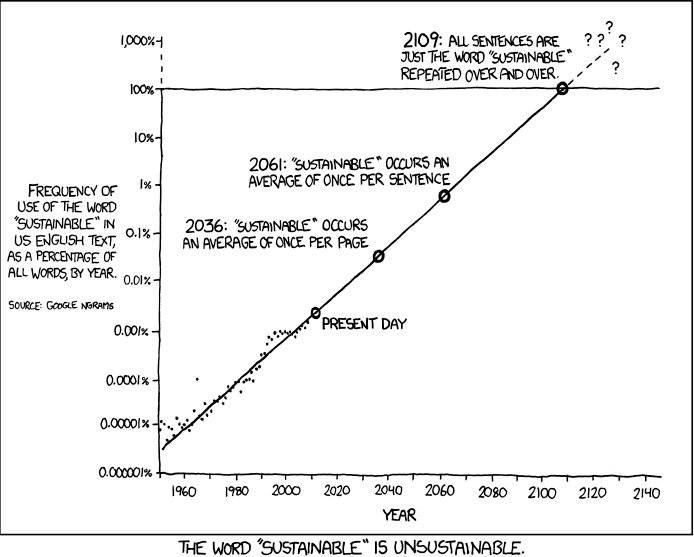
All of this means sustainability is a slippery term. It's also very popular these days. I'll borrow from our compatriot Katherine Watt at Spring Creek Homesteading who posted this cartoon graph a few weeks ago:


It's all very simple and very complicated. Most people want sustainability. Most people want what they have. Most people would like to believe that they are doing good. Most people want what they have to be sustainability because they want to believe that they are doing good. Therefore, the term will be used to make everyone feel good. It might be something like that anyway.

Today we will talk about this issue for the whole show: What does sustainabilty mean? Andy Lau is a professor of engineering at Penn State and former assistant director of the Penn State Center for Sustainability. My first encounters with him were opinion pieces on sustainability in local papers and then a presentation at a forum with Don Brown, a previous guest on this show on the ethics of climate change. Lau, like Brown, sees sustainability as something that could transform not only education, but our entire way of living. He has incorporated sustainability into a lot of his teaching, in his professional work as an engineer, and into his personal life. It's fair to say he's a sustainability wonk, going so far as to write an article on the many dimensions of sustainability and sustainable design as a new paradigm for engineering education. Lau is a funky kind of engineer, known as much for his relaxed philosophizing as he is for his engineering chops.

If you have any thoughts or questions, post them here or over at our Facebook page where you can get more involved. Listen in at 4 pm at The Lion and feel free to call in: (814) 865-9577