9.5.12
Confronting the Climate Disinformation Campaign at Penn State: Video

1.5.12
Higher Education in a Warming World
Penn State professors Michael Mann, Donald Brown, Janet Swim and Rick Schuhmann, and graduate student Peter Buckland spoke Monday evening at “Changing the Moral Climate on Climate Change,” a talk that focused on climate change denial. Mann is director of Penn State’s Earth System Science Center and part of the 2007 Nobel Prize-winning Intergovernmental Panel on Climate Change. Susannah Barsom, with the university’s Center for Sustainability, moderated the event, which included a question and answer session.
 See images of the event here or our sister publication, Voices of Central Pennsylvania.
The five speakers walked the audience through the dilemmas climate change, climate change disinformation and various kinds of climate change denial create. In particular, they addressed why and how universities should do better to confront these issues.
29.4.12
"Changing the Moral Climate on Climate Change": Update 4.29.2012
Climate change is real. It is affecting the lives of people across the globe and it presents all of us – espec
 ially the most educated among us – with an incredible dilemma. Skepticism is a real virtue and something most of us should practice. But our dilemma is made awfully difficult by industry-funded, deliberately deceptive, anti-science denialism campaigns that feed fear. This is neither reasonable or virtuous skepticism.
Tomorrow, April 30th at 7:30 pm in room 101 Thomas Building at Penn State’s University Park (map), a group of esteemed Penn State faculty and one graduate student/lecturer will confront the climate change denial machine. Doors open at 7 pm.
Over the last few years, we have been discouraged by the successful of “the merchants of doubt,” a well-organized and well-funded climate change disinformation campaign. The five presenters of “Changing the Moral Climate on Climate Change” believ
 e that as people working at a top-flight research and teaching institution, they have a responsibility to both inform the public about the many aspects of climate change – from social to environmental – and call for better action from universities in democratic society.
They will call on the University to educate civil society about the disinformation campaign and fulfill its educational role in a democratic society. They will explain the so-called “skeptics” campaign and who is behind it, distinguishing between deceitful disinformation from responsible skepticism. They will explore the problems colleges and universities face in a democratic society who
 se economy runs on fossil fuels. They will also explore relevant psychology findings around climate change. The audience will will learn about a college class that has confronted climate denial directly and learn about the backlash the professor received. Finally, you will hear from Dr. Michael Mann who has been at the epicenter of the international assault on mainstream science.
Presentations come from (pictured top to bottom): Dr. (Juris) Donald Brown from Science, Technology, and Society and former Clinton administration UN representative and blogger at Climate Ethics, Peter Buckland, A.B.D. in Educational Theory and Policy and co-host of Sustainability Now Radio, Dr. Janet Swim from Psychology and chair of the 2009 American Psychological Associations ta
Following the presentations, the panelists will answer audience questions.

Sponsors Include:
Questions can be sent to Peter Buckland by email: pdb118@psu.edu.
27.4.12
How Should Bob Stop the Train from Hitting that Child and Dog?
Bob is close to retirement. He has invested most of his savings in a very rare and valuable old car, a Bugatti, which he has not been able to insure. The Bugatti is his pride and joy. In addition to the pleasure he gets from driving and caring for his car, Bob knows that its rising market value means that he will always be able to sell it and live comfortably after retirement. One day when Bob is out for a drive, he parks the Bugatti near the end of a railway siding and goes for a walk up the track. As he does so, he sees that a runaway train, with no one aboard, is running down the railway track. Looking farther down the track, he sees the small figure of a child very likely to be killed by the runaway train. He can't stop the train and the child is too far away to warn of the danger, but he can throw a switch that will divert the train down the siding where his Bugatti is parked. Then nobody will be killed —but the train will destroy his Bugatti. Thinking of his joy in owning the car and the financial security it represents, Bob decides not to throw the switch. The child is killed. For many years to come, Bob enjoys owning his Bugatti and the financial security it represents (picture courtesy of Eastern Horizon).

Bob's conduct, most of us will immediately respond, was gravely wrong. Unger agrees. But then he reminds us that we, too, have opportunities to save the lives of children.Most of us will respond this way. My students often hem and haw on the matter but when confronted with the actual value of children’s lives versus the value of a Bugatti, they acquiesce and agree that Bob should put the Bugatti in front of the train. We can and should sacrifice for the health of others. I can be happy without a Bugatti.
Now complicate the story a lot. Imagine there were two people who came and talked to Bob. One begins carefully and calmly explaining that there is a train coming well before he can see or even hear it. The train will certainly kill the child but it can be stopped if he goes down the rail and throws some switches that will slow the train down and divert it. There is another man dressed to the nines who shows up and says there is nothing to worry about. The kid will be fine. Everything is fine.
19.4.12
PSU Earth Day: Maathai Memorial & Sustainability Site Tours
 On Friday, April 20, the Penn State Center for Sustainability will host a day of free activities at the University's 9-Acre Sustainability Experience Center, as part of Penn State's Earth Week celebration.
 The day's activities include bird walks, tours of the Morningstar solar home, 70' Wind for Schools turbine, community gardens, and Ecological Systems Lab- all located of off Porter Road, next to Lubrano Park at Medlar Field. Free onsite parking is available for the day, which culminates in a one-hour memorial ceremony to honor Kenyan social and environmental activist Dr. Wangari Maathai, who passed away in September 2011.
Maathai, founder of the Kenya-based Green Belt Movement, is internationally renowned as a lifelong advocate for environmental restoration, women's rights, peace and democracy. The recipient of a 2004 Nobel Peace Prize, her work centered on the planting of trees, but extended out to many inter-related aspects of society.
"Recognizing that sustainable development, democracy and peace are indivisible is an idea whose time has come," Maathai famously stated.
 To honor Professor Maathai's memory and legacy, the Center for Sustainability will plant five apple trees in her name, as part of a program celebrating her life. The memorial will include music, dance, poetry, personal reflections of Maathai's colleague Ephraim Govere, and the initiation of a new annual award for Penn State students who exemplify the values that she embodied in her life's work.
"All of us at Penn State's Center for Sustainability are honored to help make this lasting connection to the life and work of Professor Maathai," said Lisa Brown, associate director of the CfS. "Her courage inspired countless people when she was alive, and her impact will only grow over the years, like her beloved trees."
The Maathai Memorial is co-sponsored by the Center for Sustainability, the Departments of Women's Studies, African Studies, African American & African Diaspora Studies, The Africana Research Center, the African Student Association, the CfS Community Gardens Club, and Penn State's Office of Physical Plant.
Friday, April 20 schedule at Penn State's Sustainability Experience Center include:
9 - 10 a.m. Bird Walk Tours of Sustainability Experience Center (SEC)
12 - 3 p.m. Gardens & Tech Tours of SEC
4 - 5 p.m. Wangari Maathai Memorial Ceremony
Read the full schedule here.


13.4.12
Eco Cars?
"We the people" spend over 500 hours a year in cars. That has significant health and environmental impacts. If you don't smoke and are otherwise healthy, a long commute in a city could be the most unhealthy thing you do because you are exposed to enormous amounts of air pollution from car and truck exhaust. And the environmental effects of all that fuel combustion is clearly having a large impact. Carbon monoxide, ozone, and particulate matter generate air pollution. In total, 33% of the United States' carbon dioxide emissions come from the transportation and 60% of that comes - roughly 19% of the whole pie - comes from personal automobile use. All that time in the car pushes our waist bands, our lungs, and the planet's climate.
Our second guest today, Penn State student Taylor Kidd, is working to push the automobile's envelope. A
 s part of Penn State's Advanced Vehicle Team, he is competing in the Eco Car 2 competition, an educational competition between 15 teams at colleges and universities across the U.S. sponsored by GM and other companies. The goal is to outfit a Chevy Malibu so that it "reduces fuel consumption, reduces well-to-wheel greenhouse gas emissions, reduce criteria tailpipe emissions, and maintains consumer acceptability in the areas of performance, utility, and safety."
How do you do that? Kidd is going to talk to us about the competition, his car, and the future of car design.
Call in with questions this afternoon from 4-5 pm: (814) 865-9577. You can also join us on Facebook and Twitter as well.
9.4.12
E.O. Wilson Coming to Penn State
 book The Creation is one of the best pieces of scientifically informed outreach to the religious community on the importance of saving biodiversity. You have the chance to see him at Penn State next week.
He is coming to Penn State's University Park campus on Monday April 16, 2012 as part of the 8th annual Colloquium on the Environment speaker series. His talk "The Social Conquest of Earth" is scheduled for 5:30 p.m. in 100 Thomas Building. A book signing and reception will immediately follow his lecture. Event is free and open to the public.
Wilson, the legendary biologist, is widely considered the father of the modern environmental movement. Named one of America's 25 Most Influential People by TIME magazine, and a two-time Pulitzer Prize winner, he has made a giant contribution to our understanding of the rich spectrum of Earth's biodiversity. In his lectures, he makes a persuasive, eloquent plea to government, corporate and religious leaders to address the damage we have done to our planet before it's too late.
Wilson's works include Ants and On Human Nature, which both won the Pulitzer Prize; The Future of Life, which offers a plan for saving Earth's biological heritage; Consilience, which draws together the sciences, humanities, and the arts into a broad study of human knowledge; The Creation, a plea for science and religion to work together to save the planet; and From So Simple a Beginning, a collection of the four seminal works of Darwin, with new introductions by Wilson. His 2008 book, The Superorganism, was hailed by The New York Times as "an astonishing account of the intricate and unexpected swarm intelligence of wasps, bees, ants and termites."
A recent project of Wilson's, The Encyclopedia of Life website, catalogs all key information about life of Earth-- including data about every living species -- and makes it accessible to everyone. Launched with money from his 2007 TED Prize, the EOL recently received an additional ten million dollars from The MacArthur Foundation. Wilson is also the recipient of the U.S. National Medal of Science, the Crafoord Prize (a sister to the Nobel), and the Audubon Medal. He is the University Research Professor Emeritus at Harvard University, and continues to research at the Museum of Comparative Zoology. Recently, Wilson teamed with Harrison Ford to create a new PEN Literary award titled the PEN/E.O. Wilson Award for Literary Science Writing.
For more information, please visit this site.
2.4.12
A Class to Change Life and Living
If you are thinking that a Gen-Ed Natural Science Course on the Environment will be boring and irrelevant to your life and your major, you probably have not heard about BiSci 3! This course is taught by one of Penn State's most renowned teaching faculty, Chris Uhl*.
What BiSci 3 Will Do for You:
-It will invite you to think about your relationship to yourself and to
Earth in exciting new ways.
-It will allow you to explore the course teachings, independently, via
stimulating readings and field studies.
-It will offer you ways of directly experiencing the course content via
weekly small-group explorations.
-It will free you from the hassle of TESTS because there are none!
-It will—via an amazing collection of videos—challenge your beliefs while
also pointing to astounding possibilities.
-It will fill you with questions that may take a lifetime to answer.
Here is what past students say about BiSci 03:
“BISCI 03 challenged, inspired, and enriched me. It was much more than a class; it was an experience that helped me to better understand myself and my place in the midst of all the rush and pressure of college life.” -E. Hernandez, Journalism
“Instead of a hum-drum science class that you take for a Gen-Ed, I got an extremely personal curriculum, a teacher who was passionate, and a class that changed my life.”
-S. Asper, Political Science
“BISCI 03 helped me see the world—and the challenges we all face—in an entirely different light. I left class feeling as if one hundred new doors of opportunity had been opened for me.”
–M. Kirkpatrick, Elementary Education
“I was constantly stimulated by the unique style and content of this class. By taking a course that created a clear link between self-understanding and the condition of the world today I was challenged to think deeply about the meaning and purpose of my life.”
-H. Carney, DUS
Check out BiSci 3 website at http://www.personal.psu.edu/cfu1
---
*Chris Uhl is on Peter Buckland's dissertation committee and was a guest on Sustainability Now in the fall of 2010.
17.2.12
"A full-strength antidote to the Kryptonite of corporate greed and human ignorance."
 s work in the Foster Auditorium in the Paterno Library on the campus of Penn State, University Park, at 8:00 p.m. on Monday, February 20. The lecture is free and open to the public.
 Gessner’s most acclaimed work is the book Return of the Osprey (2001) and a sequel about following osprey migration to Cuba and South America, Soaring with Fidel (2007). His work is also closely associated with Cape Cod, including a memoir of his father’s death from cancer, A Wild, Rank Place (1997) and his account of his experiences with the Cape Cod naturalist and writer, John Hay, The Prophet of Dry Hill (2005). Gessner has also published an account of his experiences as a student writer in Boulder, Colorado, in Under the Devil’s Thumb (1999), and a collection of essays, Sick of Nature (2004), in which he tangles with such topics as the influence of Thoreau on his writing and thinking; his relationship with his teacher, the literary biographer Walter Jackson Bate; and his long quest to win an Ultimate Frisbee national championship. Gessner’s work has appeared in numerous magazines, including Orion, OnEarth, The New York Times Magazine and American Scholar. His essay about pelicans, “Learning to Surf,” won a John Burroughs Award in 2007 for the best natural history essay of the year. One Orion reviewer characterized Gessner’s writing as “Comical, energetic, and reverentially irreverent.” The Atlanta Journal Constitution called The Tarball Chronicles “a a full-strength antidote to the Kryptonite of corporate greed and ignorance,” and Publisher’s Weekly dubbed it “Brilliant.”
Get a sense of his style here. You won't be disappointed.
15.2.12
Pigs with Lipstick
We’ve been convinced that buying the right things is the way to help out. BPeople at outfits like Adbusters and the World Watch Institute have been saying this for years: consumption is still consumption. And Americans consume too much. The rise of "green" consumerism is just another way to make ourselves feel better about using too much, as if marginally reducing energy and material inputs can offset barely controlled materialism. Whether it's advertised as a "green" cleaning product or a more fuel-efficient vehicle, getting on the hedonic treadmill of endless purchasing of s*** nobody needs (SNN) does vanishingly little compared to reducing your intake of stuff. No matter how you slice it, the unrestricted production and consumption of more efficiently produced and distributed SNN is probably just a way to slow down ecological devastation. And it does nothing to counteract the fact that heavy consumption does not lead to happiness. It leads to quite the opposite.ut have we ever considered just buying fewer things, or even nothing at all?
I don’t think many of us have, because we’re addicted to consuming.
Levi’s Jeans recently rolled out a new line of pants that use less water in the dyeing and finishing process, according to Levi’s website. Cool, right? And they only cost twice as much as a normal pair of Levi’s.
What a steal.
Obviously, the truly “green” purchase here would be the $5 pair of jeans from Goodwill. But since we like to shop and we like new things, we allow Levi’s and other companies to convince us to keep buying. (Read the rest here.)
As they say, "You can put all the lipstick you want on a pig, but at the end of the day it's still a pig." I think that goes for Nittany Lions too...even if they're wearing green lipstick.
9.2.12
Denialism, Hockey Sticks, Climate Wars, and Radicalism
Already we have a world where gardeners, hikers, hunters, anglers, and farmers already see climate change in North America. Species of plants and animals are migrating north for warmer temperatures. Others, ill-adapted for a warmer world including polar bears and walruses, are being selected out. The world is changing and it's getting plainer and plainer to see. It's common sense for attentive people to see.
But common sense is exactly what seems to be lacking, especially by people who claim to be at the front of the The Common Sense Movement, a coal industry front group that bought ads on local radio attacking Mann's credibility and climate science (see here). This group joined dozens of other industry astroturf groups (fake grassroots movement) and public relations moves by the merchants of doubt to scientize politics. It is, as Mann noted today, a way to "wage politics as usual...to use science as a political football," including the climate denialism and sought-after political and professional persecution campaigns of current Republican presidential candidates, Senator James Inhofe (R-Ok), Representative Joe Barton (R-Tx), and the Republican Attorney General of Virginia. Mann, in short, has been the victim of a Republican War on Science. Climate science anyway. (David Frum and Kevin Silber have tried to point out that republicans aren't universally opposed to science.)
And it was interesting to hear Mann respond to questions. A lot about dealing with the "merchants of doubt" as Oreskes has called them and combating climate denialism. He dealt with being a political football. With education. With capitalism. Interestingly, he didn't attack capitalism but instead attacked the way we've structured our economy. Capitalism "has been stacked" he said. Toward what? Fossil fuel economics. In so many words, he was referring to sunk costs.
But what some of you might be most interested in was how he discussed shale gas drilling.
He talked about its lower carbon footprint as a burned fuel. It is "cleaner burning" with roughly one half the carbon footprint of coal per btu. However, and I think this might have stunned the powers that be, he cited a study released in the last week that showing that fugitive emissions from shale gas drilling might nullify the carbon benefits of burning natural gas. With 105 times the climate forcing potential over a 20-year span, methane leaked at 4% from shale gas operations demolishes the climate bridge fuel argument. As he seems to like to do, and many academics do for good reasons, he encouraged us to have discussions with evidence before us.
From a more radical sustainability view, some people would find Mann's talk a little disappointing. The personal steps he has taken (or at least the stated ones) were technological household fixes like changing lightbulbs and using lower-energy appliances. Don't get me wrong by any means, do it. But given our guest last week Richard Kahn, it seems that deeper and deeper transformations are needed. Mann certainl
 y confronts the status quo of the big fossil fuel industry, but there was no call for a radical restructuring of all society right now. But...and it's a big BUT...he recognizes that climate change is a civilization-challenging issue.
Alarm? Yes. Alarmist? Maybe. Radical? Not really. I'd actually call him pretty calm.
Calm or not. You have to get a picture with a Nobel-Prize sharer.
27.1.12
Sustainable Penn State?
~Richard Alley, Evan Pugh Professor of Geosciences
How long has Penn State waited? What are people doing there? And how is the institution building sustainability into everything it does? How quickly will it proceed?
Today we are revisiting the Penn State Sustainability Strategic Plan with two men who have been pushing sustainability-related issues for years. David Riley is the director of Penn State's Center for Sustainability, the piece of Penn State charged with fomenting an educational culture for sustainability. Steve Maruszewski is the Assistant Vice President of Penn State's Office of Physical Plant. He oversees or is involved with many of the physical operations of the university from energy to waste.
These videos give a sense of the vision, the scope of Penn State's influence, education, and research initiatives, energy and waste issue, and what staff can do to change things.
Yes. That is co-host Peter Buckland on the Green Team video talking about bottled water.
We will talk about the strategic plan. Where will it take this university and how will that influence the rest of the world? There is a sense in some circles that it might be greenwashing. We'll get at that too. If Penn State really has a vision, what is it?
Listen in today at 4 pm on The Lion 90.7 and feel free to call in with a question or brief comment: (814) 865-9577. You can find us on Facebook too and request to join our group. Feel free to leave questions here or there!
Follow Sustainable State's YouTube account here.
28.11.11
Marcellus Protest 2011 Redux
We include here video excerpts courtesy of ScavengerhuntPA, a citizen finding unplugged wells across the commonwealth.
Responsible Drilling Alliance member Barb Jarmoska at Old Main...
..and at the Penn Stater outside of the Marcellus Summit.
Nathan Sooy of Clean Water Action.
Jeff Schmidt of Sierra Club Pennsylvania.
Pittsburgh councilman, Dough Shields.
Sustainability Now's Peter Buckland reads the letter we delivered to Penn State President Rodney Erickson, the Board of Trustees, and the staff at the Marcellus Center for Outreach and Research. Read the letter here.
We will follow up with President Erickson's response when we receive one.
11.11.11
Tragedies
You can read the Pennsylvania Attorney General Office's Grand Jury indictment here. It is nothing short of awful. Readers should be advised that it contains graphic descriptions of childhood rape.
Mike and Peter at Sustainability Now want to reach out to the young men who were allegedly victimized, their families, and the entire community. Our deepest sympathies are with you and we hope that this Penn State community can serve you by doing better.
7.10.11
Slowing Down the Marcellus Information Orbiter
These two words have changed Pennsylvania. For most people paying attention to news in the Mid-Atlantic these days they evoke a host of other words and images. Natural gas. Water. Energy security. Bridge fuel. Pollution. Fracking and hydraulic fracturing. Flammable faucets. Gasland. Jobs. Truck traffic. Industry. Environment.
Tracking it all can be like riding an Orbiter rid
 e (pictured at right). Up becomes down, moving keeps you in one place, and when you try to focus on something your vision is too blurred because it's all shifted.
I still remember the first time I heard about the Marcellus Shale formation and natural gas. Four years ago a friend of mine came over for dinner. He told me that his brothers were involved in new natural gas drilling. A bunch of companies were leasing farmland across Pennsylvania farmers and other large landowners seemed eager to make money from gas, he said. The process to get the gas required injecting water into wells at high pressure was environmentally sound. It all seemed pretty incredible and he was really excited.
Pennsylvania would see more financially stable farmers and rural landowners. Increased energy security would from clean-burning natural gas. It could help free us from the coal- and oil-dependent industries, from transportation that accelerates climate change, and bring us to a less carbon-intense economy. Maybe it would even provide a bridge to renewable energy.
At the center of this story in Pennsylvania were Penn State University and Range Resources. In December 2007, Range reported successfully horizontally drilling, hydraulically fracturing, and extracting natural gas from the
Today, the Marcellus Shale play is the biggest new economic game in Pennsylvania. Former governor Ed Rendell called it "the golden goose." Just a few years ago there were a handful of Marcellus wells. As of May 2011, there were over 4,500. All of this gas development has brought incredible changes to the state.
Each well is a roughly $4 million-dollar affair to drill and frack and employs a small fleet of people to set up. It brings some economic benefits to the hosting municipalities and, for some landowners, large sums of money. Hotel, restaurant, and bar owners in Williamsport and other towns have made a fortune. Rental property owners have made serious money renting houses, apartments, and townhouses. And of course there is all that gas people use to heat their homes, burn for their stoves, and industry and transportation uses for fuel. Former Governor Tom Ridge stated the position clearly on The Colbert Report: “Pennsylvania is sitting on top of something that I think could lead a renaissance in America with regard to energy.” It hasn't been called the Saudi Arabia of natural gas for no reason.
Yet this is not just a win. Pennsylvania is still the only state in the nation without an impact fee or severance tax on the industry despite overwhelming public opinion calling for one. Governor Corbett has proposed an impact fee but it has been received skeptically by Republican and Democratic legislators, environmental groups, and county officials.
Well blowouts and truck crashes have spilled tens of thousands of gallons of toxic "produced water" into streams, fields, and onto lawns. Methane has migrated into well water causing hundreds if not thousands of families to require water be provided for them in external water tanks often called “water buffaloes.” People are reporting new ailments. Open air pits of produced water and compressor stations release volatile organic compounds (VOCs) known to cause and exasperate lung conditions. The land impacts from well pads disrupt habitat. At an EPA air quality hearing last week, several people testified to that their lives have been ruined by the gas industry and that they are treated like occupants of a “third world nation.”
On one side the Marcellus Shale Coalition, an industry-sponsored group tends to paint the picture as rosy and a big win. On the other environmentalists and community health advocates say that Marcellus development is a disaster of unprecedented proportions unfolding across the state. As you know, we've been quite critical of Marcellus development on Sustainability Now (archive here). But what’s real and what’s spin? What’s scientifically valid and what’s not? Who’s pulling strings and who should be? How the game changer going to change even more with a possible rush into the Utica Shale?
Between public outrcy, job creation, environmental and public health fears, corporate influence, the blogosphere, and who knows how many stories that the Marcellus information spin is a rapidly accelerating Orbiter ride. It's disorienting. We hope our guest today will help us slow down the spin.
Dave Yoxtheimer is a geologist the Penn State Marcellus Center for Outreach and Research (MCOR). Yoxtheimer is a certified geologist who has worked on water projects across Pennsylvania for several years and today works on several MCOR projects, specifically those that deal with environmental impacts.His work has included developing better practices for water withdrawal, recycling, disposal, and treatment.
MCOR has been set up to provide education and research initiative on unconventional gas plays like the  Marcellus formation. They are set up to “serve state agencies, elected and appointed officials, communities, landowners, industry, environmental groups and other stakeholders.” Their seminar series on Marcellus Shale have featured former DEP Secretary John Hanger, the prospect of developing the Utica Shale, a larger and deeper shale play in North America, and produced water treatment.
We will be asking Yoxtheimer about the current and future state of Pennsylvania’s human and non-human residents and Marcellus and Utica Shale.
The show airs today at 4 pm on The Lion 90.7. You can stream the show online. As always, feel free to call (814) 865-9577 to comment and ask a question. This week we will also have our email open so that you can send questions to sustainabilitynowradio@gmail.com
***
Update: You can listen to the show at this link.
3.10.11
Tapping ourselves out
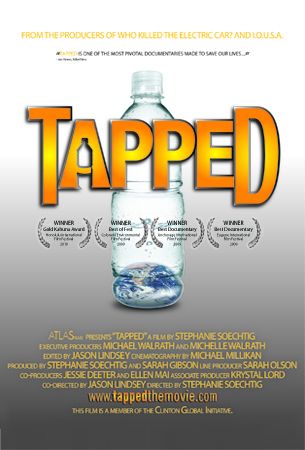 The Bucknell University Environmental Center is hosting a screening of "Tapped," a 2009 documentary film directed by Stephanie Soechtig on Tuesday, Oct. 4 at 7 p.m. The film will show at the Campus Theatre on 413 Market St., Lewisburg
Tickets are $2 and the show is open to the public.
Consider the following:
Giant masses of plastic particles swirling in the ocean.
Human health impairment in towns where PET plastics are manufactured.
Chemicals leaching from plastic packaging into drinking water.
What do these things have in common? They are some of the surprising and far-reaching impacts of the bottled water industry exposed in Stephanie Soechtig's debut feature film, Tapped. Per year, Americans pay a huge premium to consume over 8 billion gallons of bottled water, yet few consider where each bottle comes from and where it ends up. The film also probes topics like the petroleum used to make plastics and transport bottled products long distances, excessive groundwater withdrawals by bottling plants, and the general lack of regulatory oversight over the bottled water industry. Who profits and who loses out when society prioritizes convenience over sustainability? Watch this documentary and find out what's really in your bottle.
You are invited to stay for a post-screening discussion and Q & A session about bottled water and its impacts here in Pennsylvania. The discussion will be moderated by Cathy Curran Myers, Director of the BUEC and former Deputy Secretary for Water Management at the Pennsylvania Department of Environmental Protection. Sustainability Now's Peter Buckland will be a panelist discussing his recent experiences advocating for reduced bottled water use on the Penn State University Park campus.
Please note the BUEC's "Green Screens" sustainability series continues Nov. 8 Manufactured Landscapes and Nov. 29 Consuming Kids.
This event is co-sponsored by the Bucknell Environmental Club, the Bucknell Environmental Studies Program, and the Bucknell Department of Geography. "Tapped" is presented in partnership with the Bucknell Film/Media Studies Film Series (http://www.bucknell.edu/x71259.xml). For more information, visit www.campustheatre.org or email Wendy Chou (wc013@bucknell.edu).
16.9.11
Climate action in the name of God
Learn more here.
11.9.11
Is there a better way of dealing with shit?
Like most people, you probably don't know. Whatever your answer is, think about something else for a minute. Shit and piss are organic right? It's not frack water or radium 226 or bisphenol-A. It's basically digested food and microbes. So's cow manure that farmers spray on fields. And manure is in many conventional fertilizers you can purchase in home and garden shops. Well, what about basically free human manure? Humanure for short.
Enter the composting toilet. Madhu Suri Prakash explains the what, the why, and the how in this video on ecological toilets.
Talk about closing waste loops. A human growing their own garden and being not just a consumer with her/his body but also a producer in the most fundamental way. With good methods and proper conditions, this takes a considerable step toward what Wendell Berry (whom Prakash loves) calls "solving for pattern" (pdf here).
If only I wasn't renting.
Dr. Prakash is a Professor of Educational Theory and Policy at Penn State, a contributing editor at Yes! Magazine, and a frequent speaker across the United States and world on education and development having worked with the Bhutanese government on educating for happiness and the United Nations Educational Program. She is also co-host Peter Buckland's graduate adviser.
31.7.11
#1 Party school. Get #1 in beer cooling. [Updated]
Look at this low-tech solution to refrigeration.
Go that? All you need is two sizes of clay pots, sand, water, and towels to cover your pots. As a fan of many Pennsylvania microbreweries, I will surely try this out.
What else should we use this for?
***
 Here is a picture of my own. I put in some fine Pennsylvania Victory Brewery beers and at the end of the day...They were cool. Not icy cold, but definitely cool. And you know, not having to pay additional refrigeration costs is kind of nice.