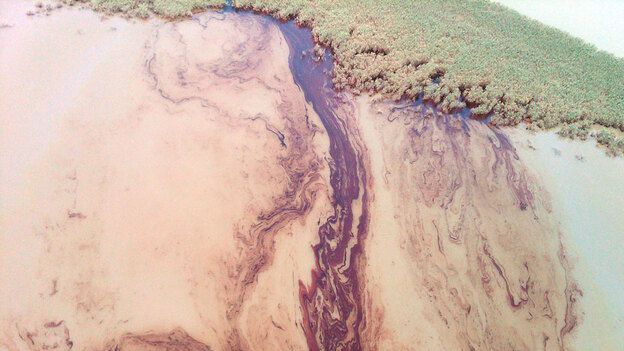
As the picture from May 1st, 2010 at below reveals, the spill released roughly 140,000,000 gallons of oil and covered more surface area than Florida, considerably larger than the Exxon Valdez disaster. Though experts say an ecological Armageddon didn't occur, the damage has been severe.

Clearly, the loss of human life on the rig sits in the minds of families and friends. For example, Living on Earth aired a story last week on the human costs of energy. They reported, "Roy Wyatt Kemp of Jonesville, Louisiana, was 27. He worked for Transocean on the Deepwater Horizon. He had two children." There are 10 other such stories.
The plume has cost billions of dollars to the Gulf economy. The Times Picayune reports that fishermen are still having trouble selling their fish on markets. They report,
"Where I'm fishing it all looks pretty much the same," said Glen Swift, a 62-year-old fisherman in Buras. He's catching catfish and gar in the lower Mississippi River again. That's not the problem.
"I can't sell my fish," he said. "The market's no good."
People around the country and the world worry about fish contamination. And their fear may be founded. Biologists worry about cascading effects. What will happen to ecosystems and species that accumulate toxins from either the oil itself or the chemical dispersants used to clear the oil slicks.
It's very difficult, if not impossible, to know the long-term effects to marine life. We have reason to believe that upwards of 5,000 whales and dolphins may have died from the oil spill, approximately 50 times the natural death rate. It threatened thousands more sea birds like pelicans, placed the already threatened Kemp's Ridley turtle in more danger, and killed an unknown number of fish, shrimp, coral, and other sea life. These effects stack on heavily fished areas and an expanding dead zone caused by effluent and nutrient saturation from the Mississippi River.
Meanwhile, the oil industry and the GOP are pushing for more offshore drilling permits. Mother Jones reports
[Three] bills, all from Rep. Doc Hastings (R-Wash.), the chairman of the Natural Resources Committee, would open new areas for drilling in the Atlantic, Pacific, and Arctic oceans, as well as Alaska's Bristol Bay. They would also speed up the process of approving drilling permits; after 60 days permits will be considered approved regardless of whether an environmental review is complete.
This comes at a time when the EPA is expected to have its funding cut heavily and have its regulatory abilities hampered for Clean Water Act, Clean Water Act, and the CO2 endangerment finding. According to The Center for American Progress, those cuts to EPA could easily be covered by enormous tax subsidies for oil companies that will cost the federal government $45 billion over the next 10 years.
However, the freeze on new offshore permits until this February and a more patient permitting process has slowed domestic oil production according to the Wall Street Journal. This coincides as well with President Obama's call to reduce oil imports by as much as one-third in the next decade. Our energy mixture in this country puts the gulf in a precarious position. First, we have experienced nothing short of an ecological catastrophe. Second, other parts of the economy have suffered horribly for our oil use and a lot of people have not been compensated. Third, people have died and their families and friends suffer from their loss. Fourth, the previous three call for stricter oversight because of a perceived lack of regulation and enforcement capability. But, fifth, domestic oil and gas demand is rising.
There is no simple lesson in an issue as complex as this one. The environmental blogosphere, exemplified by Grist's "10 Reasons to still be pissed off about the BP disaster," arrays streams of invective against BP and the Republican House of Representatives for not tackling this issue seriously. But it's not just the industry or the congress. I drive a Honda Accord that runs on gasoline. Unless we live in a super bicycle-friendly city most of us use cars, trucks, or buses to get to work. With vanishingly few exceptions, that's oil or some natural gas.
What's to be done? What should government do? What should industry do? What should your community do? What should you and I do?
It's hard to know how to be responsible when we are faced with a disaster of this magnitude. To borrow from Andrew Revkin, I hope that we can find a way to drive the car safely around the foggy corner.