27.4.11

First news on today's protest and public comment at the Marcellus Shale Advisory Commission meeting

The press reports are starting to come in from today's meeting of the Marcellus Shale Advisory Commission. Governor Corbett has tasked the Commission to "develop a comprehensive, strategic proposal for the responsible and environmentally sound development of Marcellus Shale." Many people are skeptical that this is little more than a rubber stamp commission.

The governor and the commission itself have been accused of being top-heavy with gas industry representatives. Thirteen of the commissioners come from the gas industry. That number may now be twelve as the governor asked the Chesapeake Energy representative to leave over the disaster in Bradford County. Four environmental groups including the Nature Conservancy and the Chesapeake Bay Foundation are included.
The remainder come from state and local government officials and a geologist. That geologist is Penn State professor Terry Engelder who is a vocal gas drilling proponent.

As the Pittsburgh Post-Gazette reported earlier this year,
Thirteen of the members contributed a total of $557,000 to Mr. Corbett's political campaigns since 2008; 12 have ties with companies whose executives or political action committees contributed another $562,000; one is the son of a $300,000 contributor. All together that amounted to just over $1.4 million.
The lack of parity strikes some as slightly less than fair. But there is, to some, a whiff of insider dealing and political corruption. Some people with those views, and more, came out in force to today's meeting.

Pennsylvania news is already abuzz. Laura Olson of the Post-Gazette writes:

More than 100 protesters attended a noon rally outside the Department of Environmental Protection headquarters, where the commission is holding its day-long meeting. Following the rally, many went inside, planning to participate in the public comment period later this afternoon.

The dozens who filled the inner hallway blocked entrance to the meeting room and heckled several of the commission members as they tried to squeeze through the crowd.

One local activist, Gene Stilp, walked into the morning session and began handing out "delinquent drilling tax bills" to the commission members. He was quickly escorted out of the room, after saying the lieutenant governor was a "prostitute," because of his and Gov. Tom Corbett's campaign contributions from the gas industry.

According to the Capitol Ideas blog,

Don Waltz, a Pitt professor who appeared in the anti-drilling documentary "Gasland," faulted administration officials for not including representatives from the state Department of Health on the shale panel.

"The commission is fatally flawed," he said. "It is here to look at public health, but there is no one there from the Department of Health."
As one Facebook commentor wrote, "Korporate Kangaroo Kommi$$ion DESERVES to be disrupted!!!" The distrust is deep.

You can find information on the disruption on other sites including PennLive. They did, however focus some on what the day's meeting was supposed to do: air the scientific evidence of the environmental impact of drilling. Among the issues are damages to warblers, salamanders, and trout. Perhaps we can add to those serious habitat fragmentation, air pollution, water pollution, climate problems, soil compression, and the potential for proliferating invasive species because of clear cuts.

ABC 27 said a bit about the public comments period and Commission head Lt. Governor Jim Cawley's reaction.

Each person had two minutes to speak and most were anti-drilling protesters.

Afterward, Cawley said the commission is devoted to transparency. He says some speakers' claims aren't backed up by science and fact, but he insists that he and Corbett are devoted to public health and safety.

The protestors would be happy to know that the commission is devoted to transparency. Based on what they are posting to Facebook, they hope to be a part of its process by informing it on at least public perception. As social scientists will tell you, the facts are sometimes irrelevant in the face of people's values and beliefs. If people value the land on which they live and that surrounds them, well blowout frequency might be irrelevant to them. Land or water or air will always trump a well pad.

We at Sustainability Now are most interested in the public comment period. We want to know what you said if you were there or what your perceptions were. As one other Facebook participant Lynne Whelden said, "I know we're only a flea on the hindquarters of gasocracy unlimited. But today we made them itch." Did you make them itch?

If you so desire, you can leave your comments in the comment section below or email them to sustainabilitynowradio@gmail.com and we might put them in a follow-up post.

'The Interview' with Mary McConnell

Last week, DotEarth blogger Andrew Revkin told a Penn State audience that on the balance, he believed that the proliferation of information on the internet will go toward good, true, and accurate information. We certainly hope so. In that vain of hope, we offer this tragic piece of on-the-ground citizen journalism.

The Bedford Free Press has posted Mary McConnell's story as a property owner in Bedford Country. Her property sits on the Marcellus Shale where Columbia Oil & Gas is drilling. She has been facing an incredible maze of gas corporation wrangling, governmental and legal mess, and the despoliation of her land and water. She has to sleep with a gas mask because her house is full of methane.

The email lists that have been circulating these videos are full of shock on one hand and almost eye-rolling and yawns because stories like this are business as usual. Even among activists, these stories cease to shock. Their sheer persistence, pervasiveness, and even the fat that they seem to be more frequent isn't shocking anymore.


Who has been irreparably damaged?

Over the past several months we've talked to people who don't believe that we live in a democracy anymore. Some of them, Patrick Walker and Rosa Eberly to name two, have argued that we live in a Gasocracy - a people under a government by the gas companies and for the gas companies. Whether that view is correct or not, there are petitions out there now to impeach Tom Corbett precisely because of the new administration's collusion with gas companies. What do you think? Who should be at the government's helm?

Addendum:

Today is the meeting of Governor Tom Corbett's Marcellus Shale Commission that she spoke of. There is a contingent of activists going down today. We will be following up on that story with reports from activists who attend.

26.4.11

"Gross Negligence": Legal complaint filed in Susquehanna

A case has been filed in the Court of Common Pleas in Susquehanna County, Pennsylvania.

Over 30 plaintiffs allege that Southwest Energy has made "releases, spills, and discharges of combustible gases, hazardous chemicals, and industrial wastes from its oil and gas drilling facilities." Further, they argue that these releases have caused them "to incur health injuries, loss of use and enjoyment of their property, loss of quality of life, emotional distress, and other damages." They charge Southwest Energy with gross negligence. According to the complaint, the well operators at Price Well #1 in Lenox Township in Susquehanna County continued to use a well with faulty cement casing that led to the contamination of well water with fracking fluid.

The plaintiffs are requesting several things:
i. The reasonable and necessary costs of remediation of the hazardous substances and contaminants;
ii. A preliminary and permanent injunction barring Defendants from engaging in the acts complained of and requiring Defendants to abate the aforesaid nuisances, wrongful acts, violations and damages created by them within the Price #1 Well Area;
iii. The cost of future health monitoring;
iv. Compensatory damages for the loss of property value, damage to the natural resources of the environment in and around the Plaintiffs¶ properties, medical costs, loss of use and enjoyment of their property, loss of quality of life, emotional distress, personal injury and such other reasonable damages incidental to the claims.
v. Punitive damages for Defendants for fraudulent misrepresentation and gross negligence
vi. Plaintiffs's litigation costs and fees; and
vii. Any further relief that the Court may find appropriate.
You can read the entire complaint below. This will set an interesting precedent in the state no matter which way it goes. What's your take on this?

Fracking United States District Court Complaint Final

22.4.11

More sources on natural gas drilling

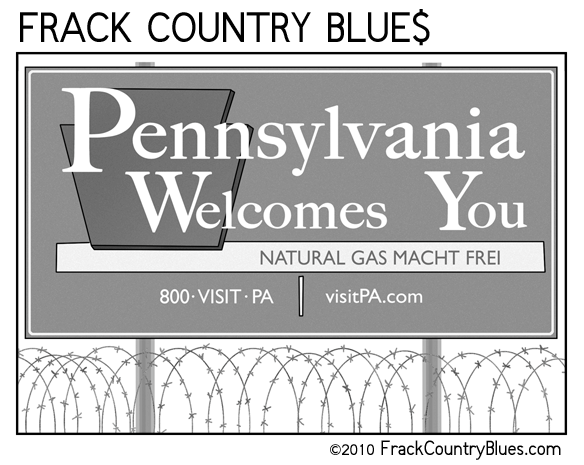
We had an extended call today with Patrick Walker of Factoryville, Pennsylvania. He is something of an activist on Marcellus Shale gas development who seems quite well informed on the breadth of shale issues. Mike asked him what sources he checks to stay on top of the issue. Among them were the Susquehanna County Natural Gas Forum, Damascus Citizens for Sustainability, FracTracker, and ProPublica. In previous shows and posts, we have had material from Responsible Drilling Alliance, Frack Country Blues (see image at right), Susquehanna River Sentinel, un-naturalgas.org, and Voices of Central Pennsylvania.

Up to this point we have not attended to the pro-gas development outlets or those that claim to be unbiased in some way. There are solid reasons for this: namely that we think that Pennsylvania's people and the water, land, air, and wildlife they share their livelihoods with are being abused by big gas and government collusion. At Sustainability Now, we do not make any claim at being balanced on an issue that we believe is so imbalanced against the common good in our commonwealth.

That said, we do think that there are a lot of sources out there that people should be aware of. At the very least, you can come to understand the sweep of the industry's positions.

Here are several sites that we recommend:
Interstate Oil and Gas Compact Commission (IOGCC)
American Natural Gas Alliance (ANGA)
Marcellus Shale Coalition
American Clean Skies Foundation
Penn State's Marcellus Center for Outreach and Research (MCOR)
These all contain their own rhetorical styles and their own political, economic, or educational goals. The first four all favor natural gas development but for different reasons. IOGCC, ANGA, and the Marcellus Shale Coalition are clearly organizations that represent the interests of the gas industry for public and political purposes. However, the American Clean Skies Foundation focuses more on natural gas's possibility as a "pairing" or "bridge" fuel to more renewable energy sources. They cite that it burns cleaner than coal and oil (1/2 the CO2 emissions from burned gas compared to coal). In a sense, they are making the greenest argument in that group. The Penn State MCOR stands apart some because it is housed at a university. However, they say they "We are committed to expanding research capabilities on technical aspects of developing this resource and to providing science-based programming while protecting the Commonwealth's water resources, forests and transportation infrastructure."

Bucknell University's Marcellus Shale Initiative Publications Database

This newly constructed database allows you to view some peer-reviewed articles and policy work. They say that their mission is to "[s]upport objective research, provide a primarily print-based publications database, and critically evaluate information related to the Marcellus Shale natural gas play." The critical evaluation in this piece is what separates it from the others. As far as I have been able to tell, this is the least overtly political of all of the resources available. That is not to say that the people who are at the helm of this initiative at Bucknell are non-partisan. Like FracTracker which helps people access information using a geographic information system approach, this site enables access to quality research and documents they might no otherwise find. It is democratic empowerment simply through availability.

Like any complex and contentious issue, Marcellus Shale development certainly does not lack information or input. If you peruse some of the blogs above, you will find links to other blogs on this issue and the take of people from Tioga to Washington Counties. Most of the organizations listed here have good links to other sources. It is a rabbit hole. It can be daunting to know where to look. Hopefully, the sources in this entry can get you started.

If there are any others you'd like to alert readers and listeners too, please post them in the comments. The more the merrier.

New York's Attorney General Threatens Suit

20.4.11

Well blows frack water in Bradford County

In LeRoy Township in Bradford County near Canton, Pennsylvania, a well blew out last night while Chesapeake Energy was fracking the well. According to WNEP TV, there is "a massive operation" by officials and Chesapeake to control the spill. According to their story, "the well blew near the surface, spilling thousands and thousands of gallons of frack fluid over containment walls, through fields, personal property and farms, even where cattle continue to graze." However, there were no injuries.

However, the spill has already reached Towanda Creek which flows to the Susquehanna River. DEP will monitor water near the blowout. Watch the story here:


It is curious that the reporter in this story does not name the specific or types of chemicals that would come back up from a fracked well. The story mentions the high salinity of the water but nothing about known carcinogens like benzene or naphthalene, the biocides or lubricants involved, nor the radioactive materials or total dissolved solids (TDS) that "produced water" from a well contains. In a world where we hope that the news can serve us well, this particular aspect of reporting seems woefully lacking in its ability to provide the public with information that could serve its interest. If this case is like others, then the cattle at that farm will be quarantined for fear of milk or meat contamination.

This is also especially interesting given that "The Landman's Manual" was recently leaked (highly recommended reading). In this manual used by people who go to property owners to lease their land to gas companies. In it, they instruct landmen to do the following things. On fracking they advise the following:
"Hydraulic Fracturing, 'Fracking' - This technique to develop gas resources is coming under scrutiny, both in the mainstream media with articles appearing in the New York Times, and even in Hollywood with the movie 'Gasland'. Expect questions on this topic and be ready to diffuse land owner concerns."
Further, they say,
"If anyone knows about slick water fracturing, avoid the topic. DO NOT discuss the chemicals and other material used during slick water fracturing. The best strategy is to say that the chemical mixtures used are proprietary and are highly diluted with water when injected. Reassure landowners that no well contamination has ever been documented. Do not mention water contamination in Pennsylvania."
This news report seems to follow a slightly weaker version of this kind of policy. Avoid alarm, there is nothing to fear, and continue as if this is business as usual. In fact, the neighbor who has refused to leave seems like he has adopted this position.

Like writers at Grist and Desmog Blog, the tragic irony that this is occurring on the anniversary of the BP Deepwater Horizon disaster has not been lost on us. And it's hard to look at this and not feel frightened by these events. To paraphrase what Barb Jarmoska from the Responsible Drilling Alliance told us a two weeks ago on the show, we are in a precarious position in Pennsylvania. It's enough to wonder how responsibly gas extraction can be done.

It will be interesting to see how activists, officials, elected officials, and regulators act in days to come.

Some thoughts on the Deepwater Horizon disaster one year later

On April 20, 2010 11 men died on the BP/Transocean Deepwater Horizon oil rig in the Gulf of Mexico. The explosion, caused by equipment failure and inadequate monitoring and maintenance, led to the worst oil spill in United States history.

As the picture from May 1st, 2010 at below reveals, the spill released roughly 140,000,000 gallons of oil and covered more surface area than Florida, considerably larger than the Exxon Valdez disaster. Though experts say an ecological Armageddon didn't occur, the damage has been severe.


Clearly, the loss of human life on the rig sits in the minds of families and friends. For example, Living on Earth aired a story last week on the human costs of energy. They reported, "Roy Wyatt Kemp of Jonesville, Louisiana, was 27. He worked for Transocean on the Deepwater Horizon. He had two children." There are 10 other such stories.

The plume has cost billions of dollars to the Gulf economy. The Times Picayune reports that fishermen are still having trouble selling their fish on markets. They report,

"Where I'm fishing it all looks pretty much the same," said Glen Swift, a 62-year-old fisherman in Buras. He's catching catfish and gar in the lower Mississippi River again. That's not the problem.

"I can't sell my fish," he said. "The market's no good."

People around the country and the world worry about fish contamination. And their fear may be founded. Biologists worry about cascading effects. What will happen to ecosystems and species that accumulate toxins from either the oil itself or the chemical dispersants used to clear the oil slicks.

It's very difficult, if not impossible, to know the long-term effects to marine life. We have reason to believe that upwards of 5,000 whales and dolphins may have died from the oil spill, approximately 50 times the natural death rate. It threatened thousands more sea birds like pelicans, placed the already threatened Kemp's Ridley turtle in more danger, and killed an unknown number of fish, shrimp, coral, and other sea life. These effects stack on heavily fished areas and an expanding dead zone caused by effluent and nutrient saturation from the Mississippi River.

Meanwhile, the oil industry and the GOP are pushing for more offshore drilling permits. Mother Jones reports

[Three] bills, all from Rep. Doc Hastings (R-Wash.), the chairman of the Natural Resources Committee, would open new areas for drilling in the Atlantic, Pacific, and Arctic oceans, as well as Alaska's Bristol Bay. They would also speed up the process of approving drilling permits; after 60 days permits will be considered approved regardless of whether an environmental review is complete.

This comes at a time when the EPA is expected to have its funding cut heavily and have its regulatory abilities hampered for Clean Water Act, Clean Water Act, and the CO2 endangerment finding. According to The Center for American Progress, those cuts to EPA could easily be covered by enormous tax subsidies for oil companies that will cost the federal government $45 billion over the next 10 years.

However, the freeze on new offshore permits until this February and a more patient permitting process has slowed domestic oil production according to the Wall Street Journal. This coincides as well with President Obama's call to reduce oil imports by as much as one-third in the next decade. Our energy mixture in this country puts the gulf in a precarious position. First, we have experienced nothing short of an ecological catastrophe. Second, other parts of the economy have suffered horribly for our oil use and a lot of people have not been compensated. Third, people have died and their families and friends suffer from their loss. Fourth, the previous three call for stricter oversight because of a perceived lack of regulation and enforcement capability. But, fifth, domestic oil and gas demand is rising.

There is no simple lesson in an issue as complex as this one. The environmental blogosphere, exemplified by Grist's "10 Reasons to still be pissed off about the BP disaster," arrays streams of invective against BP and the Republican House of Representatives for not tackling this issue seriously. But it's not just the industry or the congress. I drive a Honda Accord that runs on gasoline. Unless we live in a super bicycle-friendly city most of us use cars, trucks, or buses to get to work. With vanishingly few exceptions, that's oil or some natural gas.

What's to be done? What should government do? What should industry do? What should your community do? What should you and I do?

It's hard to know how to be responsible when we are faced with a disaster of this magnitude. To borrow from Andrew Revkin, I hope that we can find a way to drive the car safely around the foggy corner.