Showing posts with label Pollution. Show all posts

16.3.12

Plastic Everywhere!

Look around you right now. What do you see? I’m in my living room where I see children’s furniture, toys, and books, wooden furniture, an acoustic guitar, a stereo, a tiny TV, a few hundred CDs and a handful of DVDs, books on shelves. There’s a fair amount of wood and plastic.

Plastic is everywhere. Grocery store? Plastic everywhere from bottled water to the bags we put things in to the individual wrappers for the fruit snacks or candy bars to peanut butter jars to kitty litter bags. Your car? Plastic. Computer? Plastic. Toys? Plastic.

Most of us take plastic for granted. But people in places like Corpus Christi suffer the ill effects. The Natural Resources Defense Council has reported that children born near chemical plants, refineries, and incinerators are much more likely to be born with a wide variety of birth defects than children in comparable communities. Similarly, adults in these areas are more likely to develop cancer and immune-compromising chronic or terminal diseases, leading to the term “cancer cluster.”

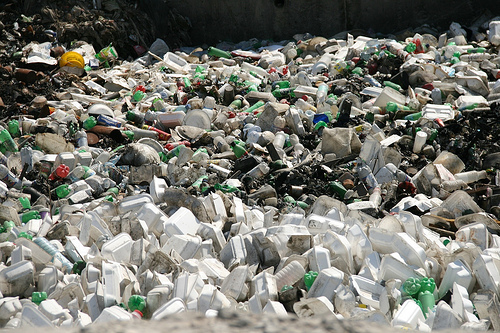
Consider climate forcing impacts on climate change. In 2007, the EPA reported, "CO2 emissions from incineration of waste (20.8 Tg CO2 Eq. in 2007) increased by 9.8 Tg CO2 Eq. (90 percent) from 1990 through 2007, as the volume of plastics and other fossil carbon-containing materials in the waste stream grew." We know that from 1990 to 2007 time single-use plastic water bottle use has at least doubled. World Watch reported that from 1997 to 2005 the market's volume doubled to 164 billion liters. PR Inside estimated that the volume increased to over 174 billion liters in 2011, though public awareness campaigns, bans, and the economic downturn could disrupt this trend. Nonetheless, billions of single-use plastic water bottles in the U.S. have ended up in landfills. [Image courtesy of Huff Post Green.]
And we have the famous expanding garbage patches in the oceans. The most famous is featured in this video of the patch in the North Pacific Gyre.


What an incredible mess.

I myself have been quite active on this issue over the years. As the former president of 3E-COE, I worked with students and the Office of Physical Plant to work on reducing Penn State’s plastic water bottle use. Those bottle-filling stations around University Park campus (now over 20 of them) came about because of that collaboration (read about the clubs work on water and plastic bottles).

Some people are taking steps to change all of this and we will talk to them today at 4 pm.

Ben Bezark works for the Plastic Pollution Coalition on the Plastic Free Campuses program. PPC seeks to “end the global dependence on disposable plastic, the primary source of plastic pollution” and “reduce the overall global plastic footprint for individuals, businesses and organizations.” And students at University of Vermont are doing just that. Gregory Francese will join us mid-show to tell us about their incredible work to ban bottled water there. Last, but not least, we will be joined by Jennifer Wagner-Lawlor, professor of Women’s Studies at Penn State who hosted a TEDx event at Penn State last year on plastic pollution.

As always, listen in on your local dial at 90.7 fm or stream us online. Call in with questions or comments: (814) 865-9477.

6.9.11

One woman's commitment to solidarity and sustainability

Toni Brink believes there are so many things that people can do for a better world today and tomorrow. She really hopes that people can "live more harmoniously with the planet." Driven in part by a longtime commitment to social and environmental justice, the 66-year-old grandmother joined thousands of demonstrators in Washington, DC to oppose the proposed Keystone XL pipeline last week.

The 1,600-mile pipeline would carry heavy oil from Alberta's tar sands across Montana and the Midwest to Port Arthur, Texas. A broad range of environmentalists, scientists, farmers, politicians, and citizens worry about air, water, and land pollution, damaged habitats, and the climate impact of tar sand development. Proponents, including TransCanada who has proposed the pipeline, argue that tar sands oil could reduce U.S. dependence on oil from the Middle East and Venezuela. That claim is disputed by Oil Change International. [For background from Sustainability Now, read our previous story here.]

On Thursday, September 1st, Brink was arrested in front of the White House. [Picture below courtesy of Nick Brink] “It really solidified my commitment," said Brink. After a briefing the night before and joining three other women, two of whom were lawyers, she felt as prepared as she could be. Bill McKibben spoke to them as did Josh Fox, director of the film Gasland, who sees an intimate and destructive connection between tar sands development and natural gas development in the Marcellus Shale and elsewhere. Tar sands refinement to get bitumen requires enormous amounts of natural gas, enlarging its energy and climate impacts.

"I've been standing with 8 or 10 people opposing the wars [in Iraq and Afghanistan] for years." She sees joining the likes of Fox, Bill McKibben (who spoke at Penn State last year), James Hansen, Naomi Klein, Darryl Hanna, and 1,200 other people as a natural and necessary step for a better world. [Learn more from 350.org.]

She hopes people will make better choices. These can be as varied as growing your own food or purchasing from local markets to reduce energy waste and restore soil to organizing political actions to helping develop cleaner and more efficient technologies.

Asked what she took away from the experience, she said, “While the destination is a safe, sustainable, equitable future for all, the journey can be a joy. It can open up new creative avenues when we work together. We are not alone.”

1.7.11

Increasing fuel efficiency

This morning on my walk to the bus station in Pine Grove Mills, PA, I saw gas at $3.69 a gallon. It's been higher than that recently and analysts predict that in coming years it will continue to climb over $4 a gallon. No doubt, filling the tank in our Honda is now a $60 endeavor. What's it like to have a Jeep or an Escalade? It's expensive.

Expense doesn't just go to families. There's the cost of obtaining, extracting, shipping, refining, and shipping all the petroleum to do all that. Obtaining all that oil and securing it has no small part in the wars in the Middle East which are in the trillions of dollars in taxpayer expense. We have record breaking oil disasters to deal with and their years of side effects. Later, there's the cost to air quality because of particulates and fumes. And don't forget the growing and ever looming costs greenhouse gases like CO2, and CO. That's a lot of consequence from just filling up your tank to get to work, take your kids to a baseball game or piano classes, or go on vacation.

But they are there: wallet to war and gulf to greenhouse.

Short of cutting individual car use what's to be done? The Pew Environment Group is calling on President Obama to increase fuel efficiency standards. They are asking you to help by signing on and telling the President to increase fuel efficiency to 60 miles per gallon for light trucks by 2025. They say in a press release, "With a 62 MPG standard, vehicle owners could see an average net savings of $6,475 over the lifetime of the car." That's nothing to ignore for most people in today's economy. Sectors of industry and so-called "consumer choice" will and have decried these standards as draconian and unrealistic, but the interconnected realities of peak oil, increasing global oil consumption, and climate change will make oil much more expensive and the cost of using it increasingly pressing as well.

So it looks as though we might aim at fuel use reduction as a goal. Reduce is the first of the "three R's" after all: Reduce. Reuse. Recycle
.

But if reduction is a genuine goal, then why not push even harder for even bigger reductions through bigger changes? In the same Pew press release they write, "[R]ecent polls show that Americans want to drive farther on a tank of gas, including one survey on behalf of Go60MPG, a coalition of advocacy groups seeking higher fuel-efficiency standards, which revealed 74 percent of those surveyed supporting 60 MPG by 2025." This is confusing.

Many people want more efficient cars which would reduce environmental and personal economic woes if they drive the same amount. More than doubling fuel economy could more than halve your gas payout if you drive the same distance. But if you double your driving distance you have neither saved fuel, money, nor the effects of burning that gas. Do you smell a Jevons Paradox?

What do you think? Should we go beyond fuel efficiency standards?
Should we go beyond transportation to urban or national planning?

27.4.11

'The Interview' with Mary McConnell

Last week, DotEarth blogger Andrew Revkin told a Penn State audience that on the balance, he believed that the proliferation of information on the internet will go toward good, true, and accurate information. We certainly hope so. In that vain of hope, we offer this tragic piece of on-the-ground citizen journalism.

The Bedford Free Press has posted Mary McConnell's story as a property owner in Bedford Country. Her property sits on the Marcellus Shale where Columbia Oil & Gas is drilling. She has been facing an incredible maze of gas corporation wrangling, governmental and legal mess, and the despoliation of her land and water. She has to sleep with a gas mask because her house is full of methane.

The email lists that have been circulating these videos are full of shock on one hand and almost eye-rolling and yawns because stories like this are business as usual. Even among activists, these stories cease to shock. Their sheer persistence, pervasiveness, and even the fat that they seem to be more frequent isn't shocking anymore.


Who has been irreparably damaged?

Over the past several months we've talked to people who don't believe that we live in a democracy anymore. Some of them, Patrick Walker and Rosa Eberly to name two, have argued that we live in a Gasocracy - a people under a government by the gas companies and for the gas companies. Whether that view is correct or not, there are petitions out there now to impeach Tom Corbett precisely because of the new administration's collusion with gas companies. What do you think? Who should be at the government's helm?

Addendum:

Today is the meeting of Governor Tom Corbett's Marcellus Shale Commission that she spoke of. There is a contingent of activists going down today. We will be following up on that story with reports from activists who attend.

18.3.11

The Rural Impacts of Natural Gas Drilling and Fracking

This video shows some pretty startling footage from Colorado. Citizens there have stories about well blowouts, contaminated water, plummeting property values, drug and crime problems from transient workers, and other negative impacts.


If you follow the blog talk and speak to people on the street in much of Pennsylvania, I think it's fair to say that many of these problems have transferred to this state.

Later in the series, there are some suggestions about what to do. What do you think should be done? How can you work to affect local politics, state politics, regulations and enforcement, and community organizing? Is it possible to slow this down or change its direction?

5.11.10

The great Pacific garbage patch - TEDx Talk at Penn State

If you aren't aware of it, there is a continent of trash in the North Pacific Gyre about twice the area of the state of Texas. How did we get this thing? What is it doing? What can we do about it? How can we change to prevent more of it?

On Saturday, November 6th, at 11:30 a.m. you can join the TEDxGreatPacificGarbagePatch Watch Party at PSU! at the Life Sciences Building, Berg Auditorium (RM 100).

Here's the flier.Today, on Sustainability Now radio, the PSU organizer for this event, Jennifer Wagner-Lawlor will join us for a few minutes to discuss the event and answer a few questions. Tune in from 4-5 pm on The Lion 90.7 fm.