9.5.12
Confronting the Climate Disinformation Campaign at Penn State: Video

1.5.12
Higher Education in a Warming World
Penn State professors Michael Mann, Donald Brown, Janet Swim and Rick Schuhmann, and graduate student Peter Buckland spoke Monday evening at “Changing the Moral Climate on Climate Change,” a talk that focused on climate change denial. Mann is director of Penn State’s Earth System Science Center and part of the 2007 Nobel Prize-winning Intergovernmental Panel on Climate Change. Susannah Barsom, with the university’s Center for Sustainability, moderated the event, which included a question and answer session.
 See images of the event here or our sister publication, Voices of Central Pennsylvania.
The five speakers walked the audience through the dilemmas climate change, climate change disinformation and various kinds of climate change denial create. In particular, they addressed why and how universities should do better to confront these issues.
29.4.12
"Changing the Moral Climate on Climate Change": Update 4.29.2012
Climate change is real. It is affecting the lives of people across the globe and it presents all of us – espec
 ially the most educated among us – with an incredible dilemma. Skepticism is a real virtue and something most of us should practice. But our dilemma is made awfully difficult by industry-funded, deliberately deceptive, anti-science denialism campaigns that feed fear. This is neither reasonable or virtuous skepticism.
Tomorrow, April 30th at 7:30 pm in room 101 Thomas Building at Penn State’s University Park (map), a group of esteemed Penn State faculty and one graduate student/lecturer will confront the climate change denial machine. Doors open at 7 pm.
Over the last few years, we have been discouraged by the successful of “the merchants of doubt,” a well-organized and well-funded climate change disinformation campaign. The five presenters of “Changing the Moral Climate on Climate Change” believ
 e that as people working at a top-flight research and teaching institution, they have a responsibility to both inform the public about the many aspects of climate change – from social to environmental – and call for better action from universities in democratic society.
They will call on the University to educate civil society about the disinformation campaign and fulfill its educational role in a democratic society. They will explain the so-called “skeptics” campaign and who is behind it, distinguishing between deceitful disinformation from responsible skepticism. They will explore the problems colleges and universities face in a democratic society who
 se economy runs on fossil fuels. They will also explore relevant psychology findings around climate change. The audience will will learn about a college class that has confronted climate denial directly and learn about the backlash the professor received. Finally, you will hear from Dr. Michael Mann who has been at the epicenter of the international assault on mainstream science.
Presentations come from (pictured top to bottom): Dr. (Juris) Donald Brown from Science, Technology, and Society and former Clinton administration UN representative and blogger at Climate Ethics, Peter Buckland, A.B.D. in Educational Theory and Policy and co-host of Sustainability Now Radio, Dr. Janet Swim from Psychology and chair of the 2009 American Psychological Associations ta
 sk force on the psychology of climate change, Dr. Rick Schuhmann, an environmental engineer and Director of Penn State’s Engineering Leadership program, and Dr. Michael Mann, director of Penn State’s Earth System Science Center, member of the 2007 Nobel Peace Prize-winning Intergovernmental Panel on Climate Change, and author of The Hockey Stick and the Climate Wars.
Following the presentations, the panelists will answer audience questions.

Sponsors Include:
Questions can be sent to Peter Buckland by email: pdb118@psu.edu.
2.4.12
A Class to Change Life and Living
If you are thinking that a Gen-Ed Natural Science Course on the Environment will be boring and irrelevant to your life and your major, you probably have not heard about BiSci 3! This course is taught by one of Penn State's most renowned teaching faculty, Chris Uhl*.
What BiSci 3 Will Do for You:
-It will invite you to think about your relationship to yourself and to
Earth in exciting new ways.
-It will allow you to explore the course teachings, independently, via
stimulating readings and field studies.
-It will offer you ways of directly experiencing the course content via
weekly small-group explorations.
-It will free you from the hassle of TESTS because there are none!
-It will—via an amazing collection of videos—challenge your beliefs while
also pointing to astounding possibilities.
-It will fill you with questions that may take a lifetime to answer.
Here is what past students say about BiSci 03:
“BISCI 03 challenged, inspired, and enriched me. It was much more than a class; it was an experience that helped me to better understand myself and my place in the midst of all the rush and pressure of college life.” -E. Hernandez, Journalism
“Instead of a hum-drum science class that you take for a Gen-Ed, I got an extremely personal curriculum, a teacher who was passionate, and a class that changed my life.”
-S. Asper, Political Science
“BISCI 03 helped me see the world—and the challenges we all face—in an entirely different light. I left class feeling as if one hundred new doors of opportunity had been opened for me.”
–M. Kirkpatrick, Elementary Education
“I was constantly stimulated by the unique style and content of this class. By taking a course that created a clear link between self-understanding and the condition of the world today I was challenged to think deeply about the meaning and purpose of my life.”
-H. Carney, DUS
Check out BiSci 3 website at http://www.personal.psu.edu/cfu1
---
*Chris Uhl is on Peter Buckland's dissertation committee and was a guest on Sustainability Now in the fall of 2010.
16.3.12
Plastic Everywhere!
Plastic is everywhere. Grocery store? Plastic everywhere from bottled water to the bags we put things in to the individual wrappers for the fruit snacks or candy bars to peanut butter jars to kitty litter bags. Your car? Plastic. Computer? Plastic. Toys? Plastic.
Most of us take plastic for granted. But people in places like Corpus Christi suffer the ill effects. The Natural Resources Defense Council has reported that children born near chemical plants, refineries, and incinerators are much more likely to be born with a wide variety of birth defects than children in comparable communities. Similarly, adults in these areas are more likely to develop cancer and immune-compromising chronic or terminal diseases, leading to the term “cancer cluster.”
Consider climate forcing impacts on climate change. In
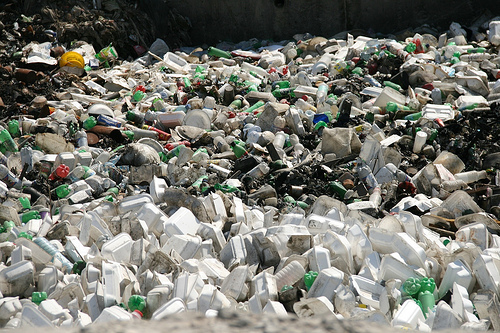 2007, the EPA reported, "CO2 emissions from incineration of waste (20.8 Tg CO2 Eq. in 2007) increased by 9.8 Tg CO2 Eq. (90 percent) from 1990 through 2007, as the volume of plastics and other fossil carbon-containing materials in the waste stream grew." We know that from 1990 to 2007 time single-use plastic water bottle use has at least doubled. World Watch reported that from 1997 to 2005 the market's volume doubled to 164 billion liters. PR Inside estimated that the volume increased to over 174 billion liters in 2011, though public awareness campaigns, bans, and the economic downturn could disrupt this trend. Nonetheless, billions of single-use plastic water bottles in the U.S. have ended up in landfills. [Image courtesy of Huff Post Green.]
And we have the famous expanding garbage patches in the oceans. The most famous is featured in this video of the patch in the North Pacific Gyre.
What an incredible mess.
I myself have been quite active on this issue over the years. As the former president of 3E-COE, I worked with students and the Office of Physical Plant to work on reducing Penn State’s plastic water bottle use. Those bottle-filling stations around University Park campus (now over 20 of them) came about because of that collaboration (read about the clubs work on water and plastic bottles).
Some people are taking steps to change all of this and we will talk to them today at 4 pm.
Ben Bezark works for the Plastic Pollution Coalition on the Plastic Free Campuses program. PPC seeks to “end the global dependence on disposable plastic, the primary source of plastic pollution” and “reduce the overall global plastic footprint for individuals, businesses and organizations.” And students at University of Vermont are doing just that. Gregory Francese will join us mid-show to tell us about their incredible work to ban bottled water there. Last, but not least, we will be joined by Jennifer Wagner-Lawlor, professor of Women’s Studies at Penn State who hosted a TEDx event at Penn State last year on plastic pollution.
As always, listen in on your local dial at 90.7 fm or stream us online. Call in with questions or comments: (814) 865-9477.
13.3.12
What is an educated person?
I've been teaching at Penn State for going on 9 years. This summer will mark the end of my teaching here and the last time I'll have the opportunity to teach Philosophy of Education here. It would be great if you would join me. We'll have class outside every day unless it rains...or it's really way too hot.
EDTHP 440: Philosophy of Education
Summer 2012, First SessionWhat is a happy life? What is the purpose of society? What is nature and what is our place in it?
Register for this course and explore these questions to develop your philosophy of education and your philosophy of living. When you register for this course you will have the opportunity to be both teacher and student, be free to question and answer, and explore the work of our local culture and local natural environment. By course’s end, you will have written and presented your personal philosophy of education.
Following in the thousands of years of tradition of people who learned by listening and speaking, the majority of student evaluation is based on the cultivated ability to carefully and clearly speak your ideas and feelings so that you mean what you say and say what you mean.
Reading list:
- Ursula LeGuin, The Wizard of Earthsea
- J.K. Rowling, Harry Potter and the Order of the Phoenix
- Wendell Berry, What Are People For?
- John Dewey, Moral Principles in Education and Experience and Education
- Thomas Princen, Treading Softly
- David Orr, Hope is an Imperative
Additional readings come from Peter Singer, Derrick Jensen, Madhu Prakash, Vandana Shiva, Parker Palmer, Yes! Magazine, Alan Watts, Christopher Uhl and Dana Stuchul, and others.
Students from across the university, including graduate students, are invited to this class.
Registration #871396For more information contact Peter Buckland via email: pdb118@psu.edu
28.2.12
Immersion in Sustainable Science, Politics, and Ethics in Jamaica
Enroll in this immersion experience this summer with Dr. Neil Brown, a Jamaican (Ph.D. in Animal Science) of the Office of Global Initiatives. We'd love to see you there.

If you have any questions, you can email me, Peter Buckland: pdb118@psu.edu
24.2.12
The Rotten Heart of the Heartland of Denial
Ezra Klein at the Washington Post puts it in good terms:
And so, according to internal documents from the Heartland Institute, the group is paying $100,000 for David Wojick, a coal-industry consultant, to develop “modules” for classroom discussion. (Wojick has confirmed this.) These modules would include material for grades 10-12 on climate change (“whether humans are changing the climate is a major scientific controversy”) and carbon pollution (“whether CO2 is a pollutant is controversial”). In fact, none of these issues are scientific controversies — the vast majority of climatologists believe, with a high degree of confidence, that man-made carbon-dioxide emissions are heating the planet.And that's why we need organizations like the National Center for Science Education and teachers and their teachers who are literate in climate science and, I might add, a group I'd wager can't afford to pay $100,000 for one person to create great climate education materials. Instead, they do it for the love of good knowledge, good science, healthy people, and a healthier planet.
But could Heartland actually spread its views? Rosenau says that Heartland could do what creationist groups like the Discovery Institute have been doing for years and simply mail out supplemental materials to educators far and wide. “There will be teachers who are sympathetic to the skeptic view or who think the material looks useful, and they’ll say to themselves, okay, I’ll bring this into the classroom,” he explains. It’s worth noting that the Heartland Institute had already developed a video along these lines — titled “Unstoppable Solar Cycles,” which laid out the long-debunked theory that the sun is driving recent warming — and shipped it off to teachers. (These earlier efforts, according to one Heartland document, met with “only limited success.”)
Even if these materials turn out to be wildly inaccurate or out of sync with a state’s science-education standards, keeping tabs on their use would be quite difficult. “In almost all cases,” Rosenau says, “there are no policies that would prevent a teacher from using such material.” Quite the opposite: A few states, such as Louisiana, have non-binding laws that urge teachers to embrace “supplemental” material on heated topics like evolution and climate change.
On a final note, as a media service on sustainability, we believe a free press is imperative for democracy. But being a press service comes with responsibility and the need for good information so that we can make good collective decisions. The great American philosopher John Dewey said, "A democracy is more than a form of government; it is primarily a mode of associated living, of conjoint communicated experiences." If we are to live together in associated living then our communication about our experiences needs to be clear, warranted, and just. We can't deceive ourselves or others. We have to have good reasons to believe what we believe. And whatever we do about it must be equitable and fair. Denying climate change to school children undermines all of that.
Climate denialism undermines democracy.
23.2.12
Opening a Closing Door with Good Climate Change Education
~ Fatih Birol, chief economist at the International Energy Agency as quoted in The Guardian
If we are to get dodge climate catastrophe, we need to understand it. To understand it, we need good information reaching students in schools, taught by capable and well-informed teachers. All of that requires a supportive environment that confronts reality, uses science and communication effectively, is grounded in responsibility, and keeps what Isaac Asimov called "the armies of the night" out of schooling. That's really hard to do in a democracy and especially hard in a country with extremely powerful religious and corporate factions discrediting science on ideological grounds.
When I walk and bike into the forests near my house each
 week I see damage linked to climate change. Stands of my favorite trees, the Eastern hemlock are infested with the woolly adelgid, a tiny insect that kills the trees by destroying their nutrient gathering capacity. Steadily, the hemlocks are dying, a tragedy whose proportions you can begin to understand in Charles Little's The Dying of the Trees. The problem started in the south because adelgids were checked by frequent enough or deep enough cold snaps in north Mid-Atlanic and New England states. But winter temperatures have steadily risen with anthropogenic global warming and the adelgid has traveled north to Pennsylvania and New England. This winter is the 11th warmest on average. It's February and it's been in the 40s and 50s often in State College. It's weird. [Picture of my son with hemlocks and rhodedendron in Rothrock State Forest at right.]
Most of us are familiar with the big signs. Melting ice caps, polar bears drowning, "drunken trees" in the northern boreal forests, and the statistical images like the "hockey stick." The increasing frequency of "extreme weather" events like the Moscow heatwave now likely happen more frequently because of anthropogenic (human-caused) climate forcing from burning fossil fuels. There is widespread suspicion that the Texas heatwave and drought last year, the intense monsoons in the Indian subcontinent, floods in Pakistan, and the drought on the Horn of Africa are more intense than they would have been without anthropogenic climate change.
So it's not just happening somewhere else. It's not going to happen later. It is happening now. Author Bill McKibben calls this new world Eaarth because humans have altered it so much.
The quotation I opened with reflects predictions from the International Energy Agency. As The Guardian reported,
The new research adds to that finding, by showing in detail how current choices on building new energy and industrial infrastructure are likely to commit the world to much higher emissions for the next few decades, blowing apart hopes of containing the problem to manageable levels. The IEA's data is regarded as the gold standard in emissions and energy, and is widely regarded as one of the most conservative in outlook – making the warning all the more stark. The central problem is that most industrial infrastructure currently in existence – the fossil-fuelled power stations, the emissions-spewing factories, the inefficient transport and buildings – is already contributing to the high level of emissions, and will do so for decades. Carbon dioxide, once released, stays in the atmosphere and continues to have a warming effect for about a century, and industrial infrastructure is built to have a useful life of several decades.And yet there are still politicians in denial. None of the current Republican presidential candidates will touch the reality of climate change. Rick Santorum has said "there's no such thing as global warming" and the science behind it is "junk science" while Newt Gingrich has flip-flopped on the issue (read here). None of them is quite as bad as Senator James Inhofe of Oklahoma who called climate change "the greatest hoax ever." Chris Mooney made the first strong case about this largely Republican phenomenon in his book The Republican War on Science. [Hear a great interview between Mooney and McKibben on climate change and climate denial here.] Some of Oklahoma's state legislature seems to agree.
Yet, despite intensifying warnings from scientists over the past two decades, the new infrastructure even now being built is constructed along the same lines as the old, which means that there is a "lock-in" effect – high-carbon infrastructure built today or in the next five years will contribute as much to the stock of emissions in the atmosphere as previous generations.
The "lock-in" effect is the single most important factor increasing the danger of runaway climate change[.]
Just a few days ago, the National Center for Science Education reported Sally Kern had gotten the state's House Common Education Committee to consider an anti-evolution and anti-climate science education bill. Last February the bill went down in a 7-9 vote. Three days ago, Republican representative Gus Blackwell brought the the bill back to the same committee. The bill's language has been changed slightly, now mimicking a similar law in Louisiana pushed through a few years ago with the aid of the conservative Seattle-based Discovery Institute. The bills says,
"the Legislature further finds that the teaching of some scientific concepts including but not limited to premises in the areas of biology, chemistry, meteorology, bioethics and physics can cause controversy, and that some teachers may be unsure of the expectations concerning how they should present information on some subjects such as, but not limited to, biological evolution, the chemical origins of life, global warming, and human cloning."The House Common Education Committee voted 9-7 to accept it, and assuming nothing holds it up, the full House of Representatives will be voted up or down by March 15, 2012, before proceeding to the state Senate.
Attacks on evolution in American schools, school boards, and legislatures are old. Americans infamously distrust evolution as the explanation for the emergence and diversity of life on earth. In large part, many Americans' ideas about Biblical inerrancy and literal interpretations of the Book of Genesis conflict with evolution. According to the Pew Research Center, an August 2006 survey found "63% of Americans believe that humans and other animals have either always existed in their present form or have evolved over time under the guidance of a supreme being" while "26% say that life evolved solely through processes such as natural selection." A 2005 poll "found that 64% of Americans support teaching creationism alongside evolution in the classroom." That distrust has resulted in famous educational, political, and legal showdowns from the famous Scopes trial, Epperson v. Arkansas, McLean v. Arkansas, the Supreme Court case Edwards v. Aguillard, and the 2005 Pennsylvania case Kitzmiller v. Dover which also featured the Discovery Institute (Sustainability Now co-host Peter Buckland attended Kitzmiller). But climate change is a newer form of denialism and the denialists aren't the same.
This Friday we are going to dive right into this. Mark McCaffrey is the newly hired Programs and Policy Director at the National Center for Science Education (NCSE). McCaffrey has worked on a number of projects for climate literacy and holds an M.A. in Educational Leadership and Policy Studies from University of Northern Colorado. He is charged with helping to develop better "climate change education in formal and informal educational environments, in order for future citizens to be able to make scientifically informed decisions about the consequences of climate change." With the recent attacks in legislatures, the revelation that the Heartland Institute had been preparing anti-climate science curriculum for K-12 schools (pdf) (the leaker of those Heartland documents was Peter Gleick who resigned from NCSE's board), and the recently renewed attacks on Dr. Michael Mann by the Common Sense Movement in the wake of his newly released book The Hockey Stick and the Climate Wars (here and here). Hear a new interview with Michael Mann on his book by Chris Mooney here on this fight.
We will also be joined by Beth Hufnagel, a doctoral student in Penn State's Curriculum and Instruction program focusing on science education. She is currently working as an assistant for a class that teaches climate change and evolution education content and strategies to future elementary school teachers. She worked as an environmental researcher in New Jersey and then as an Environmental Science teacher in Boston for several years before starting her doctoral program in 2010.
What's good climate education? Is science enough? Do children need to learn the ethical lessons? How do we open the door the IEA says is closing?
The show airs at 4 pm EST on Friday on The Lion 90.7 fm. Stream it online and feel free to call in (814) 865-9577 with questions or comments. As always, feel free to leave questions here, at our Facebook page (ask to join), or at our Twitter account.
3.2.12
Education in the Age of Ecological Crisis
"Jump!" they say.
"How high?" people ask.
Richard Kahn is a professor at Antioch University in Los Angeles. He's an anarchist educator who studies social movements and challenges the way dominant institutions - corporations, government, medicine, and industry hinder "greater planetary freedom, peace, and happiness." Over the last several years, Kahn has created a broad critique of modern industrial life. It is not just negative, but also a vision of future life liberated from denigrating practices and belief structures like racism, sexism, speciesism, and the corporatized consumerism literally consuming us and the planet. A high bar to jump over.
One of his most potent formulations of this critique and vision came in his 2010 book Critical Pedagogy, Ecoliteracy, and Planetary Crisis. In it, he writes for "ecopedagogy." He describes it as,
a movement concerned with the cosmological, technological, and organizational dimensions of social life, that seeks to achieve victory through its ability to:Unlike some university professors, Kahn refuses to shy away from political positions.
1. provide openings for the radicalization and proliferation of ecoliteracy [see Orr, 1992] programs both within schools and society;
2. create liberatory opportunities for building alliances of praxis between scholars and the public (especially activists) on ecopedagogical interests; and
3. foment critical dialogue and self-reflective solidarity across the multitude of groups that make up the educational left during an extraordinary time of extremely dangerous planetary crisis (page 56).
We will talk with Kahn about ecopedagogy and our educational future. Sustainability, radical sustainability, needs to be front and center. Maybe in jumping, we can take flight.
Listen in today at 4 pm on The Lion 90.7. Call in (814) 865-9577.
27.1.12
Sustainable Penn State?
~Richard Alley, Evan Pugh Professor of Geosciences
How long has Penn State waited? What are people doing there? And how is the institution building sustainability into everything it does? How quickly will it proceed?
Today we are revisiting the Penn State Sustainability Strategic Plan with two men who have been pushing sustainability-related issues for years. David Riley is the director of Penn State's Center for Sustainability, the piece of Penn State charged with fomenting an educational culture for sustainability. Steve Maruszewski is the Assistant Vice President of Penn State's Office of Physical Plant. He oversees or is involved with many of the physical operations of the university from energy to waste.
These videos give a sense of the vision, the scope of Penn State's influence, education, and research initiatives, energy and waste issue, and what staff can do to change things.
Yes. That is co-host Peter Buckland on the Green Team video talking about bottled water.
We will talk about the strategic plan. Where will it take this university and how will that influence the rest of the world? There is a sense in some circles that it might be greenwashing. We'll get at that too. If Penn State really has a vision, what is it?
Listen in today at 4 pm on The Lion 90.7 and feel free to call in with a question or brief comment: (814) 865-9577. You can find us on Facebook too and request to join our group. Feel free to leave questions here or there!
Follow Sustainable State's YouTube account here.
18.1.12
Post Carbon Institutue: Resilience and Hope in the Face of Ecocide and Greed
This Friday we'll be hosting Asher Miller, Executive Director of the Post Carbon Institute. Post Carbon brings together the people working on issues like climate change, energy, agriculture, education, economics, and more to foment creative action toward sustainable, resilient, and healthy societies and economies within a healthy environment. Their fellows include well-known leaders like David Orr, Richard Heinberg, and Bill McKibben, champions of sustainability themselves for at least three decades and emerging sustainability wizards like Majora Carter who has been fostering resilience in New York City with incredible results.
But it is Post Carbon which means the end of fossil fuel use. To get a sense of their take on the end of the carbon age, watch this video.
.
We'll talk about these issues and people this Friday at 4 pm on The Lion 90.7 fm. Feel free to call in (814) 865-9577.
1.11.11
Occupy Penn State's Teach-ins

11.5.11
Seven Questions on Shale Gas Development
1. What are the projected impacts of Utica Shale
 development?
If you don't know, the Marcellus Shale is only one "unconventional" shale play in Pennsylvania. The Utica Shale is much bigger. It stretches into Quebec and well south of us. It's thousands of feet below Marcellus and holds trillions and trillions more cubic feet of natural gas. Right now, it's not economically viable to get at in Pennsylvania. But my home sits atop and so does my beloved Rothrock State Forest. I have a friendly acquaintance who said, "When I saw the map of the Utica Shale, I felt like an endangered species. It's that big. The impacts will be astronomical.2. Maybe someone in the audience can explain why Penn State professors are not speaking out on this issue. Is there academic freedom on the issue of gas drilling in Pennsylvania?
This is something of a "myth" as Dr. Ingraffea might call it. There are a lot of prominent people, especially in the College of Earth and Mineral Sciences who are quite pro-gas. Dr. Terry Engelder is the most noticed. However, there are several Penn State faculty who have signed a statement that is yet to be released by PennEnvironment that questions the benefit of Marcellus development. I don't know what the status of that signing statement is but I personally know at least two faculty who are signatories.3. If Central Pennsylvania gas production all comes to fruition, about how many square miles of wells will exist?
You can track existing impacts at sites like FracTracker and the Nature Conservancy's interactive map.4. Can you comment on the Duke study released on May 9th?
The research in that article finds evidence that there is "methane contamination of drinking water associated with shale-gas extraction" from the Marcellus and Utica shales. "In active gas-extraction areas (one or more gas wells within 1 km), average and maximum methane concentrations in drinking-water wells increased with proximity to the nearest gas well and were 19.2 and 64 mg methane (n = 26), a potential explosion hazard." At distances beyond 1 km they found no such problems. Importantly, the researchers "found no evidence for contamination of drinking-water samples with deep saline brines or fracturing fluids."5. Why has science in the US become such a target of hysteria? Can serious policy be developed in such a context?
You can read the full article here.
This question is so important. It is far beyond the scope of this blog to say much about it. But Americans, and particularly conservative Americans (though not exclusively) have real trouble with science and some of the authority it comes to have. There are very serious disputes between segments of the public, politicians, and scientists over a host of things. These include climate change, the theory of evolution, and whether or not immunizations cause autism.6. What would responsible development of this resource look like? Can we slow it down?
The vast majority of scientists working on climate change recognize that humans burning fossil fuels have forced the climate and are accelerating those climate forcings. Rates, extent, scale, etc. are open to debate. But not the cause. Of course there are people who, for ideological reasons, simply won't believe it. Short term economics are more important so they deny climate change because it's easier than accepting it and still saying economics are more important. Or God wouldn't let it happen so it's something else like sun spots.
How do you construct rational policy in this context? I guess that depends on your definition of rational. If you have to include people's values, attitudes, and beliefs in the calculations of political action, then the rationality of politics in a representative democracy might be fundamentally opposed to the forces of nature and long-term human interest. But they might still be rational.
Dr. Ingraffea spoke to this quite eloquently. At the most basic level, he suggested pressing our elected officials regularly and intelligently. Be organized and effective. Press for regulation. Press for effective restitution for violations. This is a representative democracy right?7. I am meeting with my state representative next Friday. What 3 things do I need to understand about Marcellus and Utica development to ground my meeting with him?
Note what I said above about regulation, restitution, and pressure. Next Friday May 20th, PennFuture is holding an event with Representative Scott Conklin. I suggest attending. More details pending.
9.5.11
Anthony Ingraffea: Development of Natural Gas from Shales: Some Myths and Realities
 “Marcellus Shale, Fracking, Fossil Fuels-again”
Tuesday May 10th 7:00 PMDevelopment of Natural Gas from Shales: Some Myths and Realities
Location: HUB Auditorium
Penn State Campus, University Park, PA
Cornell Professor Anthony Ingraffea
We will evaluate myth and facts concerning some of the more notable issues involved in development of unconventional natural gas wells in shale formations.
Among these are:
- Such development is a 60-year-old Well-Proven Technology
- Operators in PA are Recycling 90% or more of their fluid wastes
- Gas Migration from Faulty Wells is a rare phenomenon
Sponsored by:
Penn State Eco-Action
Sierra Club Moshannon Group
Co-Sponsors:
Clearwater Conservancy
Environment-Ecology-Education
Halfmoon Township
Juniata Valley Audubon
Little Juniata River Association
Penn State Center for Sustainability
Rock Ethics Institute
Science, Technology and Society Program
Spring Creek Chapter of Trout Unlimited
Sustainability Now Radio
CNET coverage made possible by Halfmoon Township
28.4.11
Governor Corbett suggests "drilling for natural gas below campus"
Gov. Tom Corbett told the Pennsylvania Association of Councils of Trustees that the state's universities could ease their financial woes by tapping into Marcellus shale deposits beneath their campuses.The proposed state budget would cut the state's higher education system a whopping $220 million. The state higher education system faces Penn State faces a 52% state budget decrease, amounting to a 2% cut in the PSU budget, and approximately $182 million. What does the Penn State system's map look like relative to the Marcellus Shale map in Pennsylvania?Speaking at Edinboro University during his first visit to northwestern Pennsylvania since taking office, Corbett said six campuses in the Pennsylvania State System of Higher Education sit on the Marcellus shale formations now being tapped for natural gas.
A Penn State campus system map.
 A Marcellus Shale play map in Pennsylvania.
 Penn State has an awful lot of land on that map. Why not tap the campus gas reserves? They can feed the new power plant that University Park will get. Right? And then we can float education on gas. Right?
15.4.11
Can we measure happiness?
Is this just nutty thinking? Or does it have the possibility of moving human civilization in better directions? Is it puppy dog tails, bubble gum, and the idea that we can fuel cars on children's laughter or something deeper than that? Can we "get stuff done" with happiness?
On today's show, we'll be talking about happiness and Gross Domestic Happiness with Cole Hons of Penn State's Center for Sustainability and Karma Thinley, the senior program officer for the Department of Higher Education at the Ministry of Education in Bhutan and visiting Humphrey Scholar in Penn State's College of Education.
Listen in from 4-5 pm today at The Lion 90.7 fm. As always, feel free to call at (814) 865-9577in or leave comments below.
10.2.11
An invitation to inspiration from a Penn Stater
Watch this!
2.1.11
A local vision of education for sustainability
There are three ways to retool school and society for a sustainable future: First, most schools are not democratic. Children generally do not have meaningful influence on school policies. But the sustainable future will require people to fully participate in civic life, to make the decisions that affect their lives. Given opportunities to help govern their schools with caring adults working with them, children will have an opportunity to learn the skills of self-governance by self-governing: informing themselves of issues and perspectives, persuading others to adopt new points of view, negotiating compromises and implementing solutions.Read the entire piece at this link. What do you think our local schools should be doing?
Second, most schools reflect the biases of the larger economic system, minimizing the crucial historic and current roles of indigenous people, nonwhite immigrants and women. We need to honor and focus on those roles and live into their cultural practices and beliefs. By grounding ourselves in part in movements for justice and how they changed society in the past, the sustainability movement can build on those successes.
Third, schools should better connect children with the places where they live. Here in central Pennsylvania, our children can learn the histories of Penns Valley, Bellefonte and surrounding towns. They can learn how the stream water in Galbraith Gap Run flows from Bear Meadows to meet Spring Creek. They can come to know the subtle changes in tree stands in Cooper’s Gap, learn to recognize by sight and sound the myriad birds that cohabitate with us and understand the cyclical seasons of the wild and domesticated plants and animals we live among.
3.12.10
Penn State seeing what sustainability curricula it has
To date, colleges and universities have had no standardized, comprehensive way to compare their sustainability efforts across institutions. The growing demand for such a system has led to the Sustainability Tracking, Assessment and Rating System (STARS), developed by the Association for the Advancement of Sustainability in Higher Education (AASHE). STARS is a voluntary, self-reporting framework for recognizing and gauging relative progress toward sustainability among institutions of higher education.
The PSU Sustainability Tracking, Assessment and Rating System (STARS) Sustainability Course Survey seeks to identify academic offerings in sustainability across Penn State’s colleges and campuses. In support of Penn State’s current efforts to develop a strategic plan for sustainability, the participation of Penn State faculty members, instructors and graduate assistant instructors is sought.
The participation of full-time, part-time, adjunct, and graduate-student course instructors is encouraged. It is important that all those who teach resident instruction courses at Penn State have an opportunity to respond to this assessment survey and share their efforts in education for sustainability.
I know about this because I am working with the Center for Sustainability on these efforts. Next week, we'll be talking to Dave Riley from the Center for Sustainability and Erik Foley-DeFiore to talk about these and other developments. Stay tuned.