24.3.11

Marcellus Shale Advisory Commission Open Meeting

The first meeting of the Governor's Marcellus Shale Advisory Commission will be March 25 and the meetings will be open to the public. The meeting will be held in Room 105 Rachel Carson Building starting at 10:30.

The purpose of the commission, Corbett said, is “to oversee how we can build around this new industry and how we can make certain we do this while protecting our lands, our drinking water, our air – all the time growing our workforce.’’

Led by Lt. Governor Jim Cawley, the commission is to report to Gov. Corbett with its findings within 120 days of its first meeting.

The commission is to address the needs and impacts of natural gas development on local communities, as well as promote the efficient, environmentally sound and cost-effect development of Marcellus Shale and other natural gas resources.

The list of individuals invited to join the commission includes:
-- Mike Krancer, acting Secretary of Environmental Protection, Harrisburg.
-- George Grieg, acting Secretary of Agriculture, Harrisburg.
-- C. Alan Walker, acting Secretary of Community and Economic Development, Harrisburg.
-- Barry Schoch, acting Secretary of Transportation, Harrisburg.
-- Patrick Henderson, the Governor’s Energy Executive, Harrisburg.
-- Robert Powelson, chairman of the Pennsylvania Public Utility Commission, Harrisburg.
-- Glenn Cannon, executive director of Pennsylvania Emergency Management Agency, Harrisburg.
-- James W. Felmlee, president of the PA State Association of Boroughs, Harrisburg.
-- Clifford “Kip’’ Allen, president of the PA League of Cities and Municipalities, Harrisburg.
-- Gene Barr, vice president, Government & Public Affairs, Pennsylvania Chamber of Business and Industry, Harrisburg.
-- Terry R. Bossert, vice president, Government & Regulatory Affairs, Chief Oil & Gas, Harrisburg, and former Chief Counsel at DEP.
-- Jeff Wheeland, Lycoming County Commissioner, Williamsport.
-- Vincent J. Matteo, president Williamsport-Lycoming Chamber of Commerce, Williamsport.
-- Terry Engelder, professor of geosciences, Penn State University, Department of Geosciences, University Park.
-- Matthew J. Ehrhart, executive director of the Chesapeake Bay Foundation’s Pennsylvania office, Harrisburg.
-- Ronald L. Ramsey, senior policy advisor, the Nature Conservancy, Pennsylvania Chapter, Harrisburg.
-- David Porges, chief executive officer, EQT, Pittsburgh.
-- Christopher J. Masciantonio, general manager, State Government Affairs, U.S. Steel, Pittsburgh.
-- Cynthia Carrow, vice president of Government & Community Relations, Western Pennsylvania Conservancy, Pittsburgh.
-- David Sanko, executive director of the PA State Association of Township Supervisors, Enola.
-- Dave Spigelmyer, vice president, Government Relations, Chesapeake Energy, Canonsburg.
-- Randy Smith, U.S. Government Affairs Manager, Exxon Mobil, Fairfax, Va.
-- Ray Walker, chairman Marcellus Shale Coalition, Canonsburg.
-- Chris Helms, NiSource Gas Transmission and Storage, Houston, Texas.
-- Terry Pegula, Delray Beach, Fla. (founder of East Resources).
-- Jeff Kupfer, Chevron, Washington, D.C.
-- Gary Slagel, chairman, PA Independent Oil & Gas Association, Wexford.
-- Anthony S. Bartolomeo, chairman, Pennsylvania Environmental Council, Philadelphia.
-- Nicholas S. Haden, vice president, Reserved Environmental Services, Mt. Pleasant.
Looks like we will have some follow-up to do with interviews.

23.3.11

PBS Need to Know: The Price of Gas

In all of our discussion of natural gas development in the Marcellus Shale region, and soon the Utica Shale region, we have not looked much at what is happening in other parts of the country. The PBS show, Need to Know, did a special last year on the effects to water and communities of hydraulic fracturing and gas development in the Wyoming shale plays. Watch it here:


What do you think of the argument that companies can use "intellectual property" as a reason to hide harmful chemical mixtures to which the public could be exposed?

18.3.11

Part IV: The Meeting and Next Steps

After the protest, 13 of us including my 3-year-old son, walked to the capitol. One of our members sat and handwrote her letter to Mr. Corbett. Others of us took some time to chat and look around.

Surely we looked out of place. In a building full of suited people, most of whose body language and speech is formalized into the interlocking interests of the corporate government, we were sore thumbs. I was wearning a tee-shirt over my bike jersey, tee-shirt protesting the collusion of big oil and state government. Others were just wearing casual work clothes. One of us, a young woman from West Chester, PA was in her finest protest regalia that showed her “counter-culture” devotion. We were looked at askance by more than one person. And you have to wonder if it hurt our message to look so plain. My father-in-law wondered this quite a bit. I think maybe but not in a way that I think worth compromising in that visit.

We are common people from the commonwealth – Carlisle, Harrisburg, West Chester, State College, Julian, and other places. All but one of us was white. One of us was in a motorized wheel chair. We ranged in age from early 20s to late 60s. None of us were wealthy as far as I know. Our educational attainment may have been the one thing that separated us from the average. But I also know from people who wrote to me thanking me that we were there in spirit for many others. Elderly, disabled, rural, urban, activist, and non-activist people told me that they were so glad that someone was doing this. These are common people. So being the common person means representing yourself honestly and playing a game of airs and pretend. I am a father and a cyclist. I am not a politician or a lobbyist for a corporatized or governmentally “legitimized” group. I am me. We are us.

Interestingly, I saw paintings of our cultural heritage and a kind of classical Promethean humanism where men convene for the good of men.

Natural gas and pollution were conspicuously absent. No acid mine drainage streams. No strip mining. No massive deforestation. Nothing in those images seemed, at least at one glance, to show us the collusion between polluting and despoiling industries at the expense of the people. Just the triumph of reasoned men.

We walked to Governor Corbett’s office, a beautifully ornate room with gorgeous wood furnishings. We requested a meeting with the governor but were told by his assistant tat he was not in. The office assistant was joined by the same Capitol police officer who earlier told me that he had received an email about me. We asked to meet with the Chief of Staff. He was also gone. They were at a Gallagher’s Milk plant. Eventually we were offered the services of a woman who makes the executive branch work smoothly. Interestingly, she is from Bradford County where the impacts of Marcellus drilling are off the hook. Eventually, she connected us with Deputy Secretary for Legislative Affairs, Andrew Ritter who works with DEP and DEP Secretary Krancer.

We spoke with Ritter for an hour. We discussed natural gas drilling’s effects on water, air, and the forests, community health, and corporate influence in state government. We urged Ritter for a moratorium, for state forests and parks to be free of drilling, and an immediate severance tax. One of our submitted letters expressed the way that nuclear power harmed her family and neighbors growing up. Others referred to coal and strip mining. We are a fossil fuel addicted people.

Though we came to no real agreement on anything we were able to make our positions clear. And one of our group, a woman from Harrisburg who works with Clean Water Action, read aloud and submitted a letter that said that under the Pennsylvania Constitution that Governor Corbett is impeachable. It looks as though, however small, some people in the state have the same idea with an online petition to impeach him.

Ultimately I think that my position at this meeting is best articulated in the letter I submitted to meet with Governor Corbett. It is as follows:

Dear Governor Corbett,

Thank you for working to serve Pennsylvania as our governor. I am writing to you to request a meeting with you on the afternoon of Wednesday March 9th, 2011 to bring some measure of better representation to the natural gas rush that’s gripped our state. I will be arriving at approximately 4 pm. Other people who have sent you letters requesting a meeting will be joining me. I, for one, will be riding my bicycle about 120 miles from my home in Pine Grove Mills to meet you.
You may wonder why I insist on meeting you on such short notice. Too many of us are not being heard. That includes people across the state who have already been negatively impacted, people who worry about our shared resources and especially the forests, and people who believe very strongly in a better quality of life.

Allow me to tell you a little bit of my story. When I was a boy, I played in Slab Cabin Run, a stream that flows down the Tussey Ridge south of State College. My friends and I loved that stream, clambering over rocks in our shorts from late spring to the fall. One day we built up the guts to go through the culvert that goes under Route 26 over the mountain to Greenwood Furnace and Whipple Dam State Parks and Shaver’s Creek. Beneath the hemlocks, we followed the stream up toward the headwaters just a few hundred feet from the Rothrock State Forest. We tramped around as adventurous boys do, throwing mossy rocks into Slab Cabin and picking up big sticks that were alternately the walking sticks of wizened old men or knightly swords.

On other occasions we played in a small spillway below someone’s backyard bridge. The other side of that little cascade housed a small brook trout area the homeowners built. Once, my friend Elliott and I found a snapping turtle on the sidewalk between our houses. With a combination of apprehension for our fingers and the self-assuredness of boyhood machismo, we picked it up, dropped it into a bucket and put it into that trout run.

Down West Chestnut Street, just below the headwaters, lies a yellow gate into some forest trails. When I was a kid we used to march up there to get to our favorite sledding runs. Dead Man’s Trail was our favorite with a tree right down the middle. When I was old enough to take long walks by myself and get around at night, I walked my dog in those woods. Today, that gate is 500 feet from my house.

For the last 10 years or more I have spent thousands of hours in the state forests. As a mountain biker, hiker, and camper, the forest is my second home. Rothrock is just outside my door. I know it is not currently on the gas market. But just two ridges to the west lies the Moshannon State Forest where 90,000 acres of state forest has been leased to gas companies. To my north lies the Bald Eagle. I travel by bike in the Forbes, Gallitzin, Sproul, Michaux, Tidaghton, and Tioga State Forests. The forests are my second home and they are the source of much of my health. They bring us all health.

They breathe for us. They filter our water. They bring us beauty. They are the homes of the glorious and diverse creation of Nature. In our state, they embody the flourishing Creation of which we are a very special part.

Our intelligence and our organization have brought the most amazing changes to this planet. But in our intelligence and our power we have not always done what ought to have done. In a quest to do what we can we have too often been shortsighted, impatient, and lacked moral clarity. I won’t bother enumerating a huge list of human-made disasters here because we know too many of them. But from the people of Easter Island who deforested their island to the utter devastation downstream of the Tennessee Valley Authority, powerful people have too often done “business as usual” at the expense of other people’s health, the integrity of their communities, our shared water, our air, the habitat we share with other organisms, and the glorious wilderness we have agreed not to touch.

From the collapse of Easter Island or the ecosystems in Tennessee there is something disturbing at work. How do a boy and his friends appreciate beauty if it doesn’t exist near him? How do those kids learn to live better with the other creatures of the Creation if what exists is the roar of a compressor station and the clear-cutting of the trees for a road that will crush the soil? What is the smell of thousands of uninterrupted acres of woods? What does a ridge top trail look like with its patches of sandstone cracked over the course of millions of freeze-thaw cycles?
Can that boy’s health be worth another gas well? Another one hundred gas wells? Another several thousand as has been estimated will come soon?

Is it worth terrifying a family by introducing evaporating benzene into the air he breathes and poisoning? Is it worth his waking in the night screaming with a pounding headache because people he will never know are allowed to use other people he will never know to extract gas from a formation of rock buried tens of millions of years ago?

That boy lives all around the state right next to thousands of mountain gap streams. This problem is not just in my backyard. It is in our common backyard.

Is this the price of progress? The destruction of our common resources that bring us a common good in our great commonwealth? I find it hard to believe that this is the right thing to do. Is progress in Pennsylvania to make it into a third world nation, where there is no justice and the people are not only ignored but hurt by a collusion of big industry and government?

Like you, I am a father. When I think of my son, Sacha, waking up in the night repeatedly because of a toxic environment, I shudder and grow very angry. I have talked to and had correspondence with people all over the state who have stories about their neighbor’s health. The headaches. The smells. The trips to the doctor. It is only a matter of time until we start seeing the long-term health effects caused by prolonged exposure to heavy metals like cadmium, barium, strontium, radium, and gross alpha. As you know, the recent New York Times articles have provided a wake-up call that cannot be ignored. Following former DEP secretary John Hanger’s recent statements, I would certainly hope that you are going to summon additional DEP power to sample all drinking water across the state for these toxins. Of course, there are other chemicals like benzene that need to be tested for.
We have to stop accepting ugliness and destruction in the name of progress. This is not progress. I am calling on you to focus on our forests’ and our people’s abilities to sustain themselves and each other.

I have to say that there is something else that really bothers me and thousands and thousands of others around the state, certainly those who will join me on Wednesday the 9th. See, we don’t have hundreds of thousands of dollars to donate to your campaign. We don’t have nearly $3,000,000 to contribute to total campaigns over the last 10 years in the state. We can’t buy airtime. We can spend millions to lobby the legislature, to tangle up regulation and regulators, or run create glossy pamphlets that we can dispense at public symposia. We can’t put gag orders into leases. We aren’t poisoning people’s wells and buying them water from elsewhere and shipping it to them. We can’t pay the price for this. On any level.

I am riding my bike to see you because it represents a way of being in the forest that is so much better than the natural gas industry. It is better for me and my health. From bicycling on roads, fire roads, and trails, I can go into communities and forests in a light way with small impacts on Nature and happy impacts on people.

Well…sometimes people honk at us. But the vast majority of businesses appreciate us coming to buy some food and people like talking to us and we to them. It is also a way of finding that peace of mind in myself. It’s a beautiful thing. Hunters get it. Fishermen get it. Hikers and campers get it.

Pennsylvania’s forests bring us great wealth. Not only do people gain the monetary benefits of our forest tourism; they get peace of mind, clean air, fresh water, beautiful trails, wild game from turkey to black bear, and the joy and thrill of being out in wilderness. I am a big fan of happiness…not in the empty bubble gum and pink hearts way but the kind of happiness that comes from meaningful and joyful experiences with friends and family in great places. The state parks and state forests are those places.

We, the concerned, must be heard and represented. We insist that you meet with us now because we aren’t being heard and you are OUR governor. Tomorrow, at about 4 pm, I and my fellows will request that you do the following:
a) Impose a statewide moratorium on new gas drilling;
b) Reinstate DCNR’s ability to perform assessments as per last October’s announcement;
c) Reinstate DEP’s ability to carry out air quality assessments from drilling operations;
d) Provide for the immediate testing of all drinking water facilities around the state to test for all chemicals associated with natural gas drilling process; and
e) Impose a severance tax on existing operations with accrued funds going back into some combination of environmental restoration, infrastructure maintenance, and local municipal and/or educational funding.

This will, I’m sure, be a lively and spirited discussion that might just mark the beginning. See, we believe in conversation and in the power of meeting face to face with those whom we have elected no matter their political persuasion. But to have that conversation, we need to be heard.
We hope you will listen to that little boy.
With great hope,
Peter Dawson Buckland
I wonder what would happen the concerned people across the state joined together on this. If they joined with Clean Water Action, the Forest Coalition, the Responsible Drilling Alliance, Trout Unlimited, their local hiking, mountain biking, or watershed groups and took matters into the hands of the citizens. We are creatures of Nature who need to live more sustainably on this planet. That means flourishing more harmoniously with one another and with the watersheds, rivers, lakes, forests, farmlands, and wilds all around us. We have so much to lose and gain. The gain is our health and life. The loss is the perpetuation of Marcellus Personality Disorder and its associated problems.

I know that a coalition is forming right now that hopes to organize people more effectively and demand better for our health, our neighbors, our water, our air, and our forests. You can bet that there will be more of this kind of action even as we wait to hear from Governor Corbett. We fully expect that meeting to come.

What will you do?

The Rural Impacts of Natural Gas Drilling and Fracking

This video shows some pretty startling footage from Colorado. Citizens there have stories about well blowouts, contaminated water, plummeting property values, drug and crime problems from transient workers, and other negative impacts.


If you follow the blog talk and speak to people on the street in much of Pennsylvania, I think it's fair to say that many of these problems have transferred to this state.

Later in the series, there are some suggestions about what to do. What do you think should be done? How can you work to affect local politics, state politics, regulations and enforcement, and community organizing? Is it possible to slow this down or change its direction?

16.3.11

Part III: The Protest

The protest was organized by union and environmental organizations. 300-400 people rallied against Governor Corbett’s deep budget cuts and his refusal to put a severance tax on natural gas drilling in the Marcellus Shale. Speeches ran the gamut from union organizers who are tired of working with people who are told to take less while the corporate fatcats get to take more profit home and share in none of the pollution. Their were public health workers whose patience had diminished after all of the talk of shared sacrifice while we give away the gas in the Marcellus Shale instead of taxing it. There was a teacher there who once again was being told he had to sacrifice more of his benefits than the CEOs at the gas companies or the staffers in the governor’s office. And there was a young man there who has home help because he almost drowned at the age of five. His care worker, probably already paid little, will probably take another cut.

The gas companies? Not enough.

A representative from Clean Water Action said something to the effect that the Corbett administration said it wants a “frictionless relationship” with the gas industry. “Well we’re going to bring them some friction.”

We spontaneously started chanting, “Friction! Friction!” And friction we brought.

We marched to the Marcellus Shale Coalition offices chanting away. “Hey hey! Ho ho! Gas drillers’ pockets are lined with gold!” Repeat. Into the offices we went, chanting and stomping and demanding justice. Inside, some of our compatriots found a bunch of wine, a pool table, some Knob Creek (at least they have good taste) and other vittles. What are they doing? Boozing it up with legislators? Don’t get me wrong. I am far from a teetotaler, but this is a bad sign. I’d love to see what legislators are going in and out of that place and see their conditions before and after. Let’s look at that “frictionless” relationship.

In an aside, I hope you have done is gone and looked at the two websites linked above. Clean Water Action. Marcellus Shale Coalition. Go back up. Look at their logos and artwork on their websites and compare them. That, my friends, is Big Brother at work. The blues and the greens. The comfort in that graphic design to lull the viewer into a sense of watery verdant bliss. Marketing is amazing isn't it?

The organizers delivered a bill of $117 million in back severance taxes that we the common people are owed by these gas monsters. Sadly, Tom Ridge and Katherine Klaber, the head honchos working to lubricate the halls of Harrisburg into frictionless caves for gas trucks to drive, were unavailable to take receive the bill. So we handed it off to someone who promised to meet with us again.

I think that sounds great. Actually, what I think should probably happen is that people like you, me, your neighbors, and everyone we know, should just start visiting the corporate headquarters in Pennsylvania of places like Range Resources, Anadarko, Chief, Chesapeake, Rex, and more. This is our commonwealth right? Not theirs. We should start doing tours of these facilities and documenting it all and taking it back to them for accountability. We should take it to our representatives and our senators and DEP and DCNR if it’s in the forest. If we want the bureaucracy to work for us, then We have to make it work.

Margaret Mead wrote, “Never doubt that a small group of thoughtful, committed citizens can change the world. Indeed, it is the only thing that ever has.” Well, never doubt that an organized group of committed rich people who have profited from polluting industries will change the world. They are thoughtful too. Very. They just seem to think that the invasion and rape of land and water is good. Negligence is a sign of progress.

And if you flip that Mead quotation over so that it says, “Never doubt that a large group of inattentive, non-committal consumers will let a group greedy gas drillers change the world. Indeed, it already has.” It has.

But I suspect that now that isn’t so true. People are coming alive to this and they have had it. And some of us were even more prepared to share it. We were going to the Capitol Building to demand our right to meet with Governor Corbett. And if not Governor Corbett, then someone in the executive branch. It was time to demand accountability.

To be continued…

14.3.11

Hydraulic fracturing and human rights

The following is a letter submitted by the Center for Constitutional Rights and the Columbia Environmental Law Clinic on human rights abuses created by hydraulic fracturing. As recent reports about produced water from hydraulic fracturing get more traction, we might see lawsuits appear. This provides a new view on the matter for many. The piece was originally posted at FrackTracker.

---

The Center for Constitutional Rights and Columbia Environmental Law Clinic submit this letter to provide background on hydraulic fracturing in the United States. The Center for Constitutional Rights is dedicated to advancing and protecting the rights guaranteed by the United States Constitution and the Universal Declaration of Human Rights. CCR is based in New York but works throughout the United States and internationally to promote and protect human rights. Supervised by clinical faculty, Columbia Environmental Law Clinic students represent local, regional and national environmental and community organizations working to solve critical environmental challenges facing the New York metropolitan region as well as other parts of the world. The Clinic is part of a team of lawyers from local, state and national organizations who bring their legal resources to address impacts of gas drilling in the Marcellus Shale, a shale formation that cuts across New York and Pennsylvania. This joint letter with background and recommendations identifies substantial deficiencies in the U.S. Government’s regulation and monitoring hydraulic fracturing.

In the last several decades the United States has experienced political and economic pressure to decrease its dependence on foreign fossil fuels and increase domestic fossil fuel production. New technological developments have allowed the fossil fuel industry to extract natural gas from shale resources previously thought too expensive and difficult to tap. One such development, hydraulic fracturing, has been used in the industry for over 60 years and is now utilized in around 90 percent of the nation’s oil and gas wells.1 The process involves injecting water, chemicals and natural materials into the well to release trapped gases. Unfortunately, government regulators and industry leaders have historically ignored the substantial health and welfare costs associated with the process.2 Government regulators and industry leaders have historically ignored the substantial health and welfare costs associated with the process. Residents living in areas near fracturing sites have higher incidents of cancer and have reported that water itself is often discolored, pungent and contains bubbles because of the high levels of methane gas.3...

Read the rest here.

Part II: Along the Susquehanna River to Harrisburg

“I confess that I am angry at the manufacturers who make these things. There are days when I would be delighted if certain corporation executives could somehow be obliged to eat their products. I know of no good reason why these containers and all other forms of manufactured “waste”— solid, liquid, toxic, or whatever — should not be outlawed. There is no sense and no sanity in objecting to the desecration of the flag while tolerating and jusitifying and encouraging as a daily business the desecration of the country for which it stands.”

Wendell Berry, “Waste”


My trip took me through the town of Shamokin Dam by the mighty Susquehanna River. That dam testifies to other things we do for our energy “needs.”

It testifies to a belief that machines save us from the alleged drudgery of work.

It testifies to the abdication of our culture to keep itself skilled in the things that have enabled its survival for the thousands of years since the ice retreated and people domesticated animals from the dog to the sheep, learned how to irrigate land and rotate crops.

It exemplifies how people use machines to proliferate other machines at the expense of Nature.

When I looked at the dam on that blustery Wednesday riding under my own power into a full face of wind, I couldn’t just see the dam. In the energy calculus of Pennsylvania right now, our corporate government, what Wendell Berry has called “the economy’s government and the government’s economy,” are not seeing fit to disestablish the Shamokin Dam or any other dam and replacing them with other less ecologically damaging sources of energy. They certainly are not reducing our energy consumption. They are merely adding to it because of our so-called “needs.” Following the logic of a host of energy “experts” who no doubt profit from the despoliation of the Earth on which we rely, our “needs” will just escalate. Infinitely.

So when I saw the Shamokin Dam, I also saw the coal plant and the natural gas well, all of which pollute our water, scar the landscape, pollute the air whether through the release of carbon dioxide, methane, benzene, or the incredible din of the operation. Our “needs” seem to overshadow sanity and moral clarity.

According to those with Marcellus Personality Disorder (MPD), we are the freest people on Earth. And yet we are told we are the also the neediest. I fail to see how a people who need so much that they must destroy Nature’s ability to maintain or restore its carrying capacity are free. It sounds as though we are actually slaves to the energy magnates who tell us we are free. All around me I hear the voice of Big Brother and see his propaganda. The newspeak inverts the truth so that freedom is slavery, beauty is ugliness, progress is regress, and cleanliness is pollution. Wow. I love Big Brother.

Down, down, down along the Susquehanna I went. I stop for a whoopie pie, some water, and some hot chocolate mixed with coffee. The people at the little shop ask me where I am going. “The Capitol,’ I reply.

“Are you a teacher?” they ask. They know something about how angry teachers are in this state because of Corbett’s budget cuts to schools.

“I am,” I reply. I don’t explain that I teach at Penn State as a graduate assistant. It’s immaterial. “Isn’t it nuts that the governor is going to slash spending on schools and he refuses to tax the booming natural gas industry?”

The older woman behind the counter, probably in her mid- to late-sixties smiles and looks puzzled at the same time. “I don’t know anything about that. I don’t use natural gas. It’s funny how you don’t pay attention to stuff that doesn’t affect you.”

Exactly. And herein lies one of the great hills we must constantly climb and descend. A great swath of people out there cannot envision how their behaviors ripple out into the larger world. To use Wendell Berry again, people have great trouble seeing themselves within a large pattern. To use a mechanical metaphor we are one part in a system of interlocking parts that makes the machine function. I prefer a biological metaphor. We are cells in a superorganism. One cell’s function and functionality modifies the other parts of the system for better or worse. An unconscious human in the United States – one who does not see how their voting, their basic electricity or fuel consumption, their food purchasing or growing, or the number and kinds of widgets they have and use in and out of the house – is an ecologically dangerous entity. Buying, using, and selling the gadgetry of such a fossil fuel addicted economy perpetuates and extends that same economy. Because our state and national corporate governments’ prime directive is growth, the individual is steered toward ignorance about the consequences of fuel consumption whether that be climate change, mountain top removal, or methane migration and hydraulic fracturing.

How can a woman like this woman, polite and warm with a kind smile, selling me a whoopie pie, understand her and her community’s consumption on other places? I suppose one possibility would be through schooling where students would learn about the ecological consequences of actions. It could also be done through conscious and conscientious media. And when I say ecological consequences, I mean the broad set of effects on economies, society, and ecosystems scaled small to large. And here, of course, I am hung on the governor’s decision to slash school funding and to give away the gas rights to our state forests.

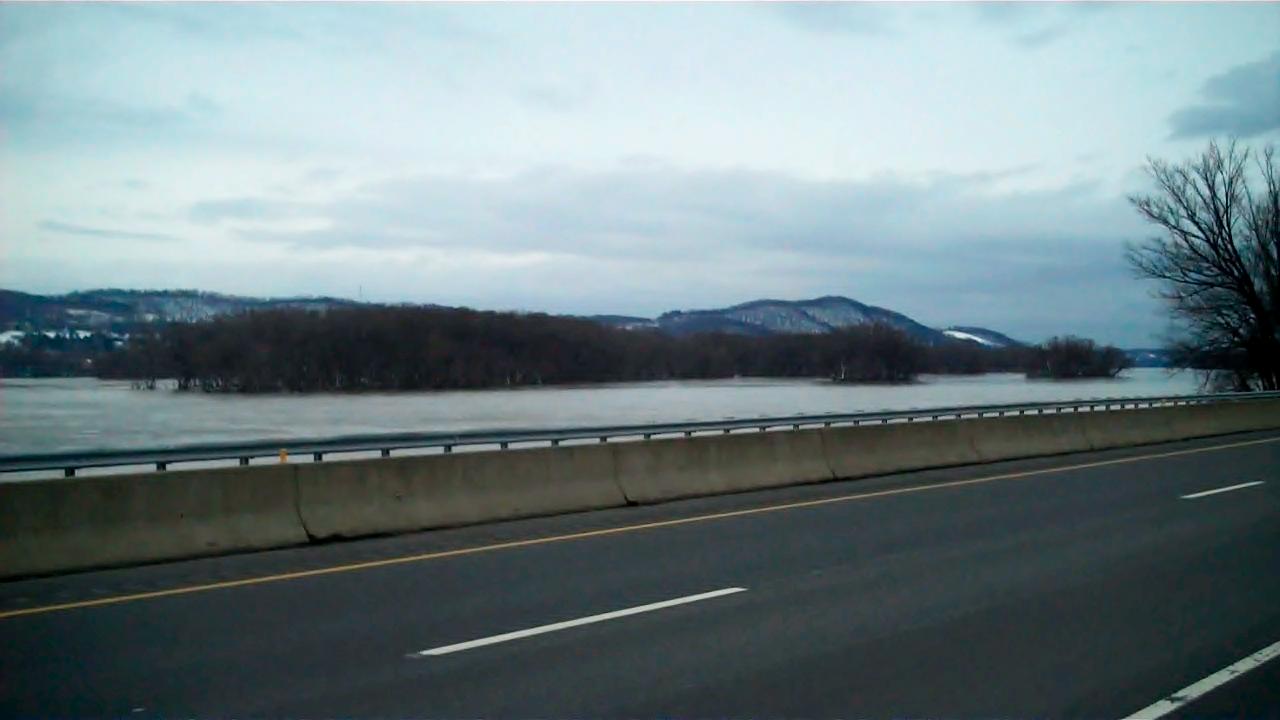
South I went. Gulls soared overhead. At one point I flew below a flock of a few hundred and watched them wheel from the east shore over the islands. Miles downriver, I see the ridges on the other side move into a bend in the river. This river is millions of years old and its winnowing way is surrounded by the wisdom of the mountains (picture at right). Trucks roar by, their wakes pulling me along. Highways really do not exist for bikes. Highways are barely for humans.

And then, out of the blue, I see my wife and son in our car. Just shy of crossing the river south of Halifax, they pull over and we smile (picture at right). It is a beautiful moment. In those moments I feel buoyed beyond measure. I feel believed in and supported. I can practically touch the devotion when she tells me she has a cheese sandwich for me to eat when I get to Harrisburg. My son, just three years old, gives me a big hug and kiss. After just a couple of minutes, I am warmed and go on. It is just less than 20 miles to the end of this ride.

At about noon, I can see the Capitol building ahead of me, miles down Route 22 into the city. I smiled a big smile and thought what a kind of nutty thing it is I am trying to do. There I was, one guy on a bicycle trying to do something right. But I was also aware of the fact, and continue to be aware of the fact, that I was not alone. When I started letting people know what I was going to do, a marvelous thing happened. First, of course, some people tried to get me to plan well and I am indebted to them for “talking me off the ledge” and doing this too rashly. Then, as the plan emerged and I decided to attend the rally with PennEnvironment and others from across the state to protest the budget cuts and the lack of a severance tax, people started sending me emails.

They wrote to me about their fears and their hopes. Both were hand in hand. There was a grandmother who wants justice for her, her children, and her grandchildren. There is a woman who gave birth to her children in her house in the midst of the beautiful forest and how the surrounding forest has been carved up for gas drilling and trucks and you can no longer hear peepers at night. Now it’s a hellish din of trucks and compressors. There is a woman bound to a wheelchair who wished she could go with me. People saying, “Give ‘em hell!” People are full of hope that someone will do something right. And so I wasn’t just one man on his way to a rally and a meeting. I was carrying those people’s stories to the capitol so that they could be seen in the face of a 34-year-old father who loves his place and the places that millions more love.

Ultimately, it seems this is about love. Love of family. Love of home. Love of place. Love of life and living with, on, and through the land. I am not a religious man, but somehow I like to believe that somewhere Aldo Leopold, one of America’s great naturalists, is smiling at me warmly.

At about 12:20 I roll to the east entrance of the capitol building. My father-in-law and two other Centre County residents have come. We are ready to protest for justice and ready to visit Mr. Corbett. Our letters are ready and our words are true.

I talk to one of the Capitol Police who tells me that he got an email about me that morning. I was surprised and not. I could be some total wingnut after all. He tells me that the governor isn’t in. Whether this is a way to divert me and my compatriots, I can’t know. It didn’t matter. We were going up anyway.

I changed into a t-shirt that reads “Don’t tread on me” with a boot print with the words “Big Oil” in it we are ready to go. I got it from a fellow gas activist that It was time to protest.

To be continued…