23.2.12

Opening a Closing Door with Good Climate Change Education

"The door is closing. I am very worried – if we don't change direction now on how we use energy, we will end up beyond what scientists tell us is the minimum [for safety]. The door will be closed forever."
~ Fatih Birol, chief economist at the International Energy Agency as quoted in The Guardian

If we are to get dodge climate catastrophe, we need to understand it. To understand it, we need good information reaching students in schools, taught by capable and well-informed teachers. All of that requires a supportive environment that confronts reality, uses science and communication effectively, is grounded in responsibility, and keeps what Isaac Asimov called "the armies of the night" out of schooling. That's really hard to do in a democracy and especially hard in a country with extremely powerful religious and corporate factions discrediting science on ideological grounds.

When I walk and bike into the forests near my house each week I see damage linked to climate change. Stands of my favorite trees, the Eastern hemlock are infested with the woolly adelgid, a tiny insect that kills the trees by destroying their nutrient gathering capacity. Steadily, the hemlocks are dying, a tragedy whose proportions you can begin to understand in Charles Little's The Dying of the Trees. The problem started in the south because adelgids were checked by frequent enough or deep enough cold snaps in north Mid-Atlanic and New England states. But winter temperatures have steadily risen with anthropogenic global warming and the adelgid has traveled north to Pennsylvania and New England. This winter is the 11th warmest on average. It's February and it's been in the 40s and 50s often in State College. It's weird. [Picture of my son with hemlocks and rhodedendron in Rothrock State Forest at right.]

Most of us are familiar with the big signs. Melting ice caps, polar bears drowning, "drunken trees" in the northern boreal forests, and the statistical images like the "hockey stick." The increasing frequency of "extreme weather" events like the Moscow heatwave now likely happen more frequently because of anthropogenic (human-caused) climate forcing from burning fossil fuels. There is widespread suspicion that the Texas heatwave and drought last year, the intense monsoons in the Indian subcontinent, floods in Pakistan, and the drought on the Horn of Africa are more intense than they would have been without anthropogenic climate change.

So it's not just happening somewhere else. It's not going to happen later. It is happening now. Author Bill McKibben calls this new world Eaarth because humans have altered it so much.

The quotation I opened with reflects predictions from the International Energy Agency. As The Guardian reported,
The new research adds to that finding, by showing in detail how current choices on building new energy and industrial infrastructure are likely to commit the world to much higher emissions for the next few decades, blowing apart hopes of containing the problem to manageable levels. The IEA's data is regarded as the gold standard in emissions and energy, and is widely regarded as one of the most conservative in outlook – making the warning all the more stark. The central problem is that most industrial infrastructure currently in existence – the fossil-fuelled power stations, the emissions-spewing factories, the inefficient transport and buildings – is already contributing to the high level of emissions, and will do so for decades. Carbon dioxide, once released, stays in the atmosphere and continues to have a warming effect for about a century, and industrial infrastructure is built to have a useful life of several decades.

Yet, despite intensifying warnings from scientists over the past two decades, the new infrastructure even now being built is constructed along the same lines as the old, which means that there is a "lock-in" effect – high-carbon infrastructure built today or in the next five years will contribute as much to the stock of emissions in the atmosphere as previous generations.

The "lock-in" effect is the single most important factor increasing the danger of runaway climate change[.]
And yet there are still politicians in denial. None of the current Republican presidential candidates will touch the reality of climate change. Rick Santorum has said "there's no such thing as global warming" and the science behind it is "junk science" while Newt Gingrich has flip-flopped on the issue (read here). None of them is quite as bad as Senator James Inhofe of Oklahoma who called climate change "the greatest hoax ever." Chris Mooney made the first strong case about this largely Republican phenomenon in his book The Republican War on Science. [Hear a great interview between Mooney and McKibben on climate change and climate denial here.] Some of Oklahoma's state legislature seems to agree.

Just a few days ago, the National Center for Science Education reported Sally Kern had gotten the state's House Common Education Committee to consider an anti-evolution and anti-climate science education bill. Last February the bill went down in a 7-9 vote. Three days ago, Republican representative Gus Blackwell brought the the bill back to the same committee. The bill's language has been changed slightly, now mimicking a similar law in Louisiana pushed through a few years ago with the aid of the conservative Seattle-based Discovery Institute. The bills says,
"the Legislature further finds that the teaching of some scientific concepts including but not limited to premises in the areas of biology, chemistry, meteorology, bioethics and physics can cause controversy, and that some teachers may be unsure of the expectations concerning how they should present information on some subjects such as, but not limited to, biological evolution, the chemical origins of life, global warming, and human cloning."
The House Common Education Committee voted 9-7 to accept it, and assuming nothing holds it up, the full House of Representatives will be voted up or down by March 15, 2012, before proceeding to the state Senate.

Attacks on evolution in American schools, school boards, and legislatures are old. Americans infamously distrust evolution as the explanation for the emergence and diversity of life on earth. In large part, many Americans' ideas about Biblical inerrancy and literal interpretations of the Book of Genesis conflict with evolution. According to the Pew Research Center, an August 2006 survey found "63% of Americans believe that humans and other animals have either always existed in their present form or have evolved over time under the guidance of a supreme being" while "26% say that life evolved solely through processes such as natural selection." A 2005 poll "found that 64% of Americans support teaching creationism alongside evolution in the classroom." That distrust has resulted in famous educational, political, and legal showdowns from the famous Scopes trial, Epperson v. Arkansas, McLean v. Arkansas, the Supreme Court case Edwards v. Aguillard, and the 2005 Pennsylvania case Kitzmiller v. Dover which also featured the Discovery Institute (Sustainability Now co-host Peter Buckland attended Kitzmiller). But climate change is a newer form of denialism and the denialists aren't the same.

This Friday we are going to dive right into this. Mark McCaffrey is the newly hired Programs and Policy Director at the National Center for Science Education (NCSE). McCaffrey has worked on a number of projects for climate literacy and holds an M.A. in Educational Leadership and Policy Studies from University of Northern Colorado. He is charged with helping to develop better "climate change education in formal and informal educational environments, in order for future citizens to be able to make scientifically informed decisions about the consequences of climate change." With the recent attacks in legislatures, the revelation that the Heartland Institute had been preparing anti-climate science curriculum for K-12 schools (pdf) (the leaker of those Heartland documents was Peter Gleick who resigned from NCSE's board), and the recently renewed attacks on Dr. Michael Mann by the Common Sense Movement in the wake of his newly released book The Hockey Stick and the Climate Wars (here and here). Hear a new interview with Michael Mann on his book by Chris Mooney here on this fight.

We will also be joined by Beth Hufnagel, a doctoral student in Penn State's Curriculum and Instruction program focusing on science education. She is currently working as an assistant for a class that teaches climate change and evolution education content and strategies to future elementary school teachers. She worked as an environmental researcher in New Jersey and then as an Environmental Science teacher in Boston for several years before starting her doctoral program in 2010.

What's good climate education? Is science enough? Do children need to learn the ethical lessons? How do we open the door the IEA says is closing?

The show airs at 4 pm EST on Friday on The Lion 90.7 fm. Stream it online and feel free to call in (814) 865-9577 with questions or comments. As always, feel free to leave questions here, at our Facebook page (ask to join), or at our Twitter account.

17.2.12

"A full-strength antidote to the Kryptonite of corporate greed and human ignorance."

David Gessner (pictured at right with a bottle of Pennsylvania's oldest beer), an award winning nature writer best known for his edgy and humorous style and interest in ospreys and Ultimate Frisbee, will read from his work in the Foster Auditorium in the Paterno Library on the campus of Penn State, University Park, at 8:00 p.m. on Monday, February 20. The lecture is free and open to the public.

Gessner’s most acclaimed work is the book Return of the Osprey (2001) and a sequel about following osprey migration to Cuba and South America, Soaring with Fidel (2007). His work is also closely associated with Cape Cod, including a memoir of his father’s death from cancer, A Wild, Rank Place (1997) and his account of his experiences with the Cape Cod naturalist and writer, John Hay, The Prophet of Dry Hill (2005). Gessner has also published an account of his experiences as a student writer in Boulder, Colorado, in Under the Devil’s Thumb (1999), and a collection of essays, Sick of Nature (2004), in which he tangles with such topics as the influence of Thoreau on his writing and thinking; his relationship with his teacher, the literary biographer Walter Jackson Bate; and his long quest to win an Ultimate Frisbee national championship. Gessner’s work has appeared in numerous magazines, including Orion, OnEarth, The New York Times Magazine and American Scholar. His essay about pelicans, “Learning to Surf,” won a John Burroughs Award in 2007 for the best natural history essay of the year. One Orion reviewer characterized Gessner’s writing as “Comical, energetic, and reverentially irreverent.” The Atlanta Journal Constitution called The Tarball Chronicles “a a full-strength antidote to the Kryptonite of corporate greed and ignorance,” and Publisher’s Weekly dubbed it “Brilliant.”

Get a sense of his style here. You won't be disappointed.

16.2.12

My Farmer

I was sort of born into the local food movement. Not in a huge way. But sort of. Enough that when the local food movement started to flourish again a few years ago it was a natural fit. And I knew when I had found my farmer, John Eisenstein of Jade Family Farm. It was the carrots.

When I was a kid, we were part of a local food co-op. My mom tells this story of how at about two and a half I picked up a carton of eggs and methodically dropped the eggs one by one on the floor. As a father now, I recognize the classic moment. It was probably great and dreadful at the same time.

We had a big garden in our backyard. A strawberry patch, cucumbers galore that went into salad and became pickles, tomatoes fresh and some canned into sauce, green beans, raspberries along the back fence, and squash I couldn't stand if my 6-year-old memory serves at all.

At the garden's edge by the low stone wall behind the back porch was our big two-chamber compost. It was a classic railroad tie design. How many pounds of coffee grounds and grapefruit rinds went in there? My dad, bandanna wrapped around his head, turned it with the spade.

My best friend Elliott's family two houses down had a comparable garden. His mother was a canning machine and she made so many pickles, jams, and sauces all summer long. Emma's pickles were the ultimate. They are the apotheosis of pickles, the ideal pickles that the denizens of Plato's cave can only dream about.

As a boy I had to weed. I liked it as much as most 6-year-olds do which is to say not really at all. I'd have rather been climbing trees and riding bikes. My sister hated it more than I did. Sometimes we got out of doing it. Sometimes not. But it was great to have fresh fruit and veggies.

My mom is one of twelve children from a New York farm family. Every summer and Christmas we traveled to "the farm" to stay with my uncle and grandmother. I played in the barn with the cats, pet the cows, and climbed in the rafters of the hay mow. It was great. As a youngster I got to steer the tractor in the high fields on my uncle's lap. Even as a punk-ass teenager more interested in Slayer, skateboards, and the girls who tortured my very existence (you remember them forever right?) than the farm's operations, I still loved it. During summer visits I wandered the 100 acres alone or with a visiting cousin.

And then I went to college. I think it nearly totally separated me from food and nature. I'd occasionally go to the friday farmer's market. The summer peaches and blueberries were about all I cared about. I think I got my girlfriend Emily sunflowers and wildflowers a couple of times.

But it wasn't until my wife and I joined a small community supported agriculture group with Reeger's Farm Market when we lived in Indiana, Pennsylvania that we started getting back to local food. When we came back to State College and I started my Ph.D. program, we were ready for something more. That's the year Michael Pollan's The Omnivore's Dilemma and Barbara Kingsolver's Animal, Vegetable, Miracle came out. In a class I took we read Kingsolver, Francis Moore Lappe's Diet for a Small Planet, some essays by Wendell Berry, and Eric Schlosser's rather terrifying Fast Food Nation. I wrote some stories for Voices of Central Pennsylvania on local food and farmers, started a club for future teachers who wanted to embed ecological literacy and sustainability into their education, attended a PASA conference, and worked with Mike to launch this show. Our moniker, courtesy of Mike, has been, "We believe sustainability is best when it's fresh and local."

For two and a half years on the air I've brought up my farmer, John Eisenstein and his family's farm, Jade Family Farm. I call him my farmer (that's his hand, shirt, and jeans on the right) because from May to October we get most of our produce from Jade through our share of the farm. Why did he become my farmer? The carrots. It was very simple. I'd never had a carrot like that before. If I try to describe the taste I will mangle the flavor profile so I will just say that it's about as close to heaven as I think occurs from vegetable consumption. Maybe you know what I mean. The scent of soil is still on it and the sugars and the bitterness pop. See...I mangled it. Just try some Jade carrots and you'll get it.

Tomorrow, we'll have John on the show. He's a sort of romantic prone to making jokes, not serious and serious. We'll talk about his experiences as a farmer and how he's gotten there. As someone with a bit of familial history with sustainability pedigree, he'll have some good things to share we're sure. Carrots are out I suppose so we aren't likely to be crunching on the air.

As always, listen in on The Lion 90.7 fm from 4-5 pm and feel free to call in with questions or comments.

15.2.12

Pigs with Lipstick

In today's Daily Collegian, Nathan Pipenberg has a thoughtful op-ed piece about "green" consumption. As part of our Penn State community, we want to give him a shout out for confronting us with a real problem. A Penn State problem. A college student problem. A big American problem.
We’ve been convinced that buying the right things is the way to help out. But have we ever considered just buying fewer things, or even nothing at all?

I don’t think many of us have, because we’re addicted to consuming.

Levi’s Jeans recently rolled out a new line of pants that use less water in the dyeing and finishing process, according to Levi’s website. Cool, right? And they only cost twice as much as a normal pair of Levi’s.

What a steal.

Obviously, the truly “green” purchase here would be the $5 pair of jeans from Goodwill. But since we like to shop and we like new things, we allow Levi’s and other companies to convince us to keep buying. (Read the rest here.)
People at outfits like Adbusters and the World Watch Institute have been saying this for years: consumption is still consumption. And Americans consume too much. The rise of "green" consumerism is just another way to make ourselves feel better about using too much, as if marginally reducing energy and material inputs can offset barely controlled materialism. Whether it's advertised as a "green" cleaning product or a more fuel-efficient vehicle, getting on the hedonic treadmill of endless purchasing of s*** nobody needs (SNN) does vanishingly little compared to reducing your intake of stuff. No matter how you slice it, the unrestricted production and consumption of more efficiently produced and distributed SNN is probably just a way to slow down ecological devastation. And it does nothing to counteract the fact that heavy consumption does not lead to happiness. It leads to quite the opposite.

As they say, "You can put all the lipstick you want on a pig, but at the end of the day it's still a pig." I think that goes for Nittany Lions too...even if they're wearing green lipstick.

13.2.12

Taking Out the Keystone and Building Something Else

A "keystone" plays an integral role in an arch of a bridge or any span. It is the incredible wedge maintaining the whole vault's structural integrity. If you want to call something necessary, call it the keystone.

So calling the Keystone XL pipeline a "keystone" is to repeat the name of a thing deemed necessary. It's to say that we absolutely need the pipeline to the tar sands if we are to continue having what we have. But some people won't have it.

As we reported last fall, local Toni Brink decided to protest the Keystone XL pipeline and was subsequently arrested along with over two thousand other citizens. Before leaving she said, "I think it’s really important. Future of life on our planet depends on it.” Like Josh Fox, climate activist and environmental leader Bill McKibben, consumption critic and author Naomi Klein, climate scientist James Hansen, and others, the she recognizes that climate change is real, it's upon us now, and that investing in the dirtiest form of petroleum extraction and production constitutes an enormous loss.

For its opponents, this pipeline is the keystone of a bridge that mustn't be built. It's a bridge at the edge of the world that leads to a climate nightmare. It sort of wraps up the problem of sustainability in one package.

The current Republican house continues to fight for the Keystone XL after President Obama nixed it last month. They are still citing inflated jobs numbers and ignoring a host of human health, water, air, land, and climate problems, not the least of which is the continued despoliation of a swath of Alberta the size of Florida. People like McKibben have joined with Friends of the Earth, the Rainforest Action Network, the Sierra Club, and and the ever-justice-minded Occupy groups have banded together to get 500,000 petitions and letters sent to the U.S. Senate to fight the newest move.

It seems the current Republican house leadership will not stop pushing for new fossil fuel development. In the last 40 years, there hasn't been this much environmentally-related rancor. Some see it as a sign that the old way is crumbling and doing whatever it can do to hang on. The oil barons, the coal tycoons, and the gas giants will spend more money and more resources to get at less and less fossil fuel. And to do that, they have to spend even more to corrupt our politics, paying enormous sums to political campaigns and even more on lobbying.

People like Richard Heinberg, a fellow of the Post Carbon Institute likely read this as the desperate strangulation of an industry clutching its bags of money and lashing out. But at some point, tired of being abused, we will turn to more harmonious and sustainable ways of doing things. We'll take the bricks that were going to build that bridge off the end of the world and build something much better.

At least some of the future of life on earth might depend on it. That's what Toni might say anyway.

12.2.12

The Crises of Sustainability as Birth

Environmentalists everywhere are at no shortage of awful things to describe in gory detail. Polar bears are drowning because their habitat is changing and disappearing. Natural gas drilling is ruining people's lives in Pennsylvania and Wyoming and mountain top removal creates cancer clusters in West Virginia and Kentucky. To hell in a hand basket we go! But could the ecological crises at hand be the possibility for rebirth of humanity?

In this brief conversation one of our former guests, Kevin May (Phil Osophical on YouTube) talks with Charles Eisenstein, author of Sacred Economics and The Ascent of Humanity. Instead of viewing humanity as a cancer or a virus, maybe it is more suitable to think of humanity in its industrial development as a fetus. It can't live as it has inside of its mother forever. As it gets bigger, it must be discharged into a new way of life to which it cannot know. Is development driving us to a new way of being in the world and even in a new world?


In a great confluence, our guest this coming Friday is Charles' brother John Eisenstein, owner of Jade Family Farm.

10.2.12

What Is Sustainability?

As you know, we ask everyone who comes on the show: "What does sustainability mean to you?" And if you've listened or use a little imagination, you know that there are nearly as many definitions of sustainability as there are people who have thought about sustainability for more than one minute. Now the term is everywhere.

Last week, Richard Kahn called sustainability a "contested" term. Who uses it and how they use it will tell us what should be sustained, maybe even how, why, for whom, and maybe even for how long. Exxon using the term means something different from a small Pennsylvania farmer which is different from the U.N.'s definition from the famous Our Common Future publication defining sustainable development. The contest over defining sustainability means people can use it very differently. Deep ecologists can make it into some purist notion, so-called pragmatists can use it as a lens for understanding issues, and the corporate status quo can use it to "greenwash" their images.

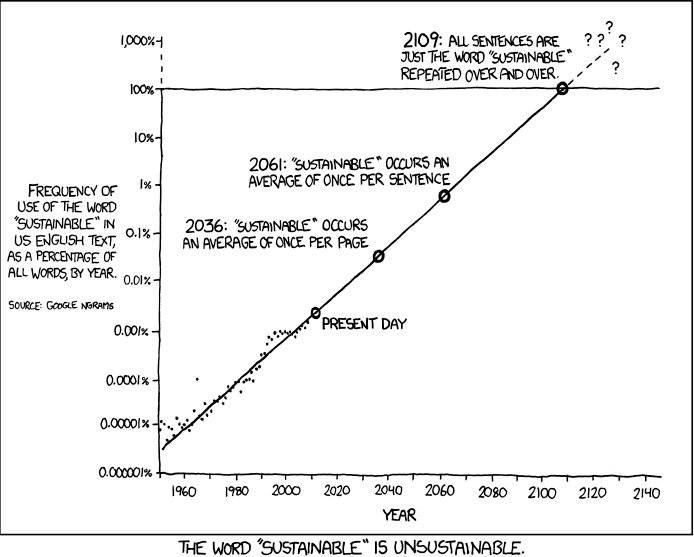
All of this means sustainability is a slippery term. It's also very popular these days. I'll borrow from our compatriot Katherine Watt at Spring Creek Homesteading who posted this cartoon graph a few weeks ago:


It's all very simple and very complicated. Most people want sustainability. Most people want what they have. Most people would like to believe that they are doing good. Most people want what they have to be sustainability because they want to believe that they are doing good. Therefore, the term will be used to make everyone feel good. It might be something like that anyway.

Today we will talk about this issue for the whole show: What does sustainabilty mean? Andy Lau is a professor of engineering at Penn State and former assistant director of the Penn State Center for Sustainability. My first encounters with him were opinion pieces on sustainability in local papers and then a presentation at a forum with Don Brown, a previous guest on this show on the ethics of climate change. Lau, like Brown, sees sustainability as something that could transform not only education, but our entire way of living. He has incorporated sustainability into a lot of his teaching, in his professional work as an engineer, and into his personal life. It's fair to say he's a sustainability wonk, going so far as to write an article on the many dimensions of sustainability and sustainable design as a new paradigm for engineering education. Lau is a funky kind of engineer, known as much for his relaxed philosophizing as he is for his engineering chops.

If you have any thoughts or questions, post them here or over at our Facebook page where you can get more involved. Listen in at 4 pm at The Lion and feel free to call in: (814) 865-9577