The radio show that brings global and local sustainability issues to central Pennsylvania.
Every Friday from 4 to 5 pm on TheLion.fm/listen 90.7fm WKPS
A few weeks ago we hosted Katherine Watt on the show to talk about localism and the Transition Towns initiatives in central Pennsylvania. As we collectively face the reality of peak oil will we face the challenge intelligently?
Katherine wrote a piece for the Centre Daily Times reflecting on the peak oil problem and the urgent need for us to move to regional and local economies of scale.
Wednesday’s Sustainable Centre County page is all about energy, with columns on how to build a regional energy system around the sun, food and biodiesel crops. Bustling as it seems, I think the Marcellus methane-energy boom will fizzle out soon. Investing time and money to release colossal Earth farts is a luxury, and we’re not a rich society anymore.
Growth won’t restart because oil prices will keep rising. As we revisit the Dow milestones of the past few decades — heading back down — physical and biological imperatives will be far more pressing than the political and economic calculations underpinning the gas boom. Complex institutions will break apart, replaced by simpler regional cooperatives now rising from grass roots.
We’ll stop digging up dead things to sell and burn, and return to the most basic elements of human life: taking care of each other by working with surrounding life-support systems that provide water, food and shelter.
The National Wildlife Federation has released “Extreme Heat in Summer 2010.” This summer is the hottest on record so far and a sign of more to come. The Eastern and Southern United States are especially suffering, with many states having one of their hottest summer months on record. A new analysis from National Wildlife Federation finds that summers like the current one could become the norm by 2050 unless steps are taken to curb global warming. Philadelphia and Pittsburgh are on a list of those cities most vulnerable to heat wave effects as the planet warms. Approximately half of the residents in both cities have relatively high levels of vulnerable populations and low rates of air conditioning.
The analysis comes a few weeks after the U.S. Senate shelved action on comprehensive climate and energy legislation.
The State College community is better equipped than most to deal with extreme heat because most residents have air conditioning. However, many communities are not so fortunate. Our failure to take action on global warming will affect those who can least afford to deal with extreme temperatures. It is the poor, elderly, and those with health problems who will bear the brunt of the expected extreme heat events.
When: August 25, 2010, 10:30am
Where: Schlow Memorial Library, Community Room
Who: Dr. Michael Mann, Director, Earth System Science Center, Penn State University Prof. Sylvia Neely, Creation Care Coalition, Pennsylvania Interfaith Power and Light. Arno Vosk, MD, Fellow of the American College of Emergency Physicians Peter Buckland, President of Environment - Ecology - Education, Penn State University and co-host of Sustainability Now Radio
Contacts: Ed Perry, National Wildlife Federation, Phone - 814-880-9593 paglobalwarmingoutreach@gmail.com
Citizens concerned about the threat that Marcellus Shale drilling has and will have on their communities' well-being are taking matters into their own hands. Literally. Across Pennsylvania and New York, bloggers and independent journalists have been tallying and analyzing how gas wells, rigs, frack water, gas and water trucks, and more affect life above the Marcellus Shale.
We are really excited this week to host an independent journalist and two Pennsylvania bloggers who have covered the Marcellus Shale issues on the ground.
Hannah Abelbeck, who joined us last month, has worked for Voices of Central Pennsylvania covering environmental news for the last year. She has done two in-depth stories on the Marcellus and interviewed a few dozen people from several counties in Pennsylvania and New York.
Don Williams keeps his eye on the effects of Marcellus activities at his blog Susquehanna River Sentinel. He was born in northeastern PA not far from the heart of the Marcellus Shale Zone. I don't think it would be much of a stretch to say that Don is outraged at what he sees as the degrading effect that the natural gas industry has had on Pennsylvania. He uses his training in Earth and Environmental Science to look at water and land issues especially.
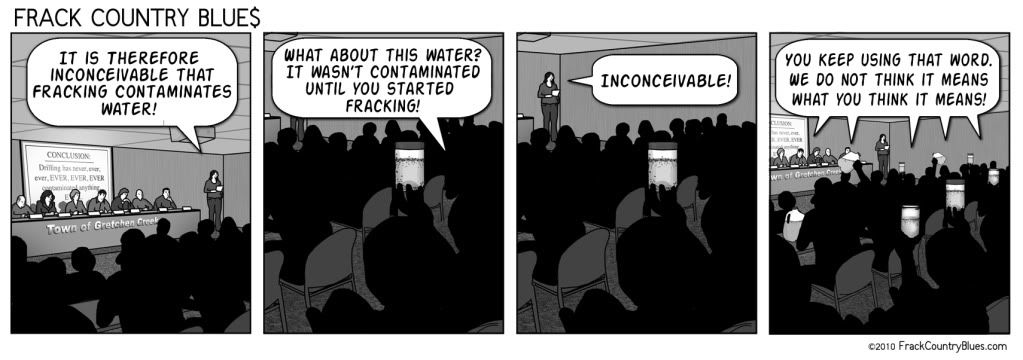
Karen keeps a quite different blog at Frack Country Blues. While she is certainly concerned and perhaps outraged, she writes, "Because sometimes all you have left is gallows humor…" Her blog uses comics to illustrate the problems that Marcellus drilling industry is creating, particularly in the Tioga State Forest near Wellsboro, Pennsylvania about 100 miles north of Penn State University Park.
She combines the comics with news stories and commentary to "to raise awareness about the consequences of natural gas drilling and the plight of the communities that live above the Marcellus shale – a plight that echoes the experiences from the gas fields in the western states where the air quality can be worse than Los Angeles’ and where the water is not just toxic, it’s flammable."
Flammable? Yes. Flammable. Watch this trailer for the movie Gasland.
Yes. Flammable.
Maybe that's an anomaly.
Guess not.
Hopefully today we will be enlightened further on what's going on at these places and what we might be able to do about it.
Listen in today on The Lion 90.7 from 5-6 pm to get more up to speed on this sustainability issue.
--- We hope to continue this conversation next week with some other bloggers and community activists in New York and Pennsylvania as well.
A few months ago we did a show with Don Brown (Asst. Professor of Science, Technology and Society and lead blogger at Climate Ethics) on the ethics of climate change. On that show, we talked about how and why climate change is a moral issue and what people can and ought to be doing about it.
Always a busy man, Don was recently interviewed by Andy Revkin over at Dot Earth about why an academic has started blogging:
My blog is a way of focusing on actual arguments about climate change policies as they unfold, teasing out these arguments the often hidden ethical questions, and inviting the world to see these questions not as “value neutral” scientific or economic questions but as ethical issues. A blog is the only way to do this that I know of that is relevant and timely to many of the climate change issues as they unfold. Most academic environmental ethics is neither relevant to actual public policy disputes nor timely. (It is often also far, far too abstract.) There is a huge need to do ‘applied’ climate change ethics as most ethical analysis in the academy on environmental issues has not engaged policy-makers or the general public. Yet climate change and several other global environmental issues are raising civilization challenging moral, justice and ethical questions that need to be teased out of policy debates.
I (Peter Buckland) have worked with Don on several occasions and have found this to be one of the most rewarding and refreshing aspects of working with him. His work is at the front what might be our largest collective problem - climate change - and it is confronting its hardest challenges. As he did on our show, Don focuses us on how our language controls our thinking about something and how in the case of economics and science our "value neutral" thinking and talking has actually landed us in some big problems.
This in from Climate Science Watch, the New York Times, and DotEarth: Michael Mann, a climate scientist and professor in Penn State's College of Earth and Mineral Sciences has been exonerated of the charges that he had violated accepted scientific practice. This is only the end of this part of the climate denialism movement though.
Watch an interview conducted with him yesterday on his exoneration.
We dealt with this topic earlier this year when we hosted Ed Perry of the National Wildlife Federation who called so-called "Climategate" a sham. Listen here.
This question is the elephant in the room for us. Penn State University owns an enormous amount of property, runs one of the highest energy bills in the state, uses vast amounts of water, tens of thousands of people, and schools about 80,000 students each year. That's a lot of resources to move that comes with a sizable ecological footprint.
How does something so big move on a more sustainable path?
How does it reduce its carbon footprint when its main campus is running on coal, some of which has recently been traced to mountain top removal?
How do you mobilize employees to become less wasteful? To reduce, reuse, and recycle?
What research is and can be coordinated at a university to reduce its and its graduates' ecological impact and expand human capacities within reason?
How do you try to get sustainability into the broader curriculum?
The list can go on and on.
Today we are going to learn how some of this, and much more, is happening. We have the good fortune of hosting Erik Foley-DeFiore, Penn State's Manager of Sustainability (pictured at right with his co-workers Milea Perry and Lydia Vandenburg). Hired last year, Foley-DeFiore has an MBA from St. Francis University and has worked extensively on funding enormous wind power projects in Pennsylvania. He was recently elected as President of the Pennsylvania Environmental Resource Consortium, a coalition of over 50 Pennsylvania colleges and universities that have made a commitment to sustainability in some fashion.
Listen today from 5-6 pm on The Lion 90.7. Call in to ask questions at 865-9577.